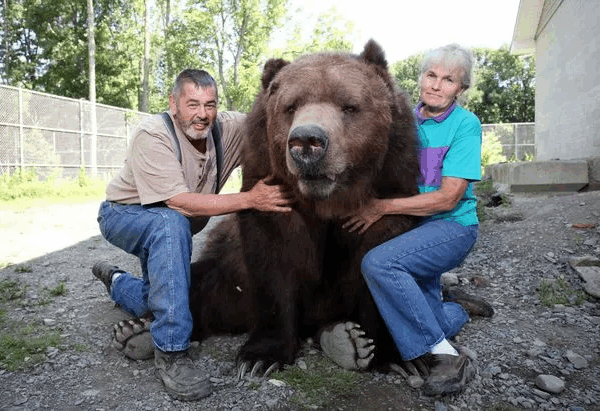
At the Orphaned Wildlife Center in Middletown, New York, life unfolds at a different pace, guided not by schedules or spectators but by the needs of the animals themselves. Spanning more than one hundred acres of protected land, the sanctuary is the life’s work of Marty and Debbie Kowalczik, a couple whose commitment to wildlife rescue goes far beyond profession or hobby. For decades, they have devoted themselves entirely to rescuing injured, orphaned, and displaced animals that cannot survive without human intervention. The center is home to a wide array of species, each with its own story of loss, survival, and adaptation. Among them are several species of bears—Kodiak, Syrian, and American black bears—each rescued from circumstances that left them unable to return to the wild. Yet among all these remarkable animals, one stands apart not because of spectacle or training, but because of an extraordinary temperament that defies assumptions about size and power. His name is Jimmy, and he has become the emotional heart of the sanctuary.
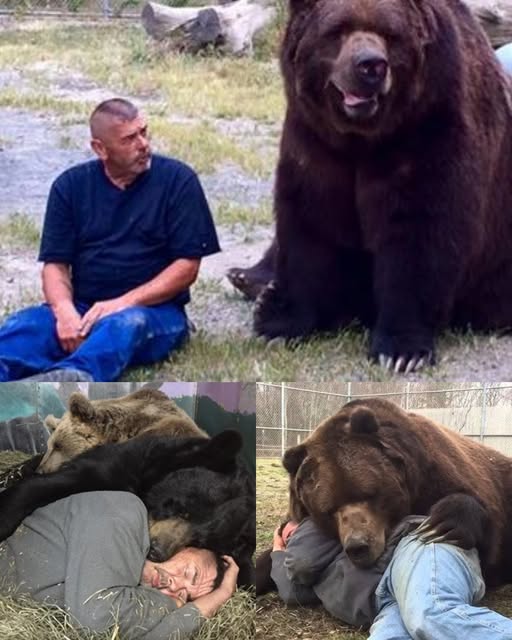
Jimmy is now twenty-one years old, and unlike many of the animals that arrive at the center after injury or trauma, his life began entirely in captivity. From the moment he was born, human hands provided his food, safety, and comfort. While that care saved his life, it also shaped it in irreversible ways. Raised without a bear mother, Jimmy never learned the skills required to survive independently in the wild—how to forage seasonally, avoid danger, or navigate vast territories. Releasing him would not have been an act of kindness, but a sentence to confusion and danger. The Kowalcziks understood this early on and made a decision that would define the rest of Jimmy’s life: he would stay, not as an exhibit, but as a permanent resident whose well-being came first. Over the years, Jimmy developed a personality that surprised even seasoned wildlife caretakers. He grew into a bear who was calm, deeply affectionate, and unusually attuned to the people who cared for him, forming bonds based on trust rather than fear.
Physically, Jimmy is impossible to ignore. Standing more than nine feet tall when upright and weighing over fifteen hundred pounds, he embodies the raw power most people associate with bears. His sheer size alone commands respect, yet his behavior consistently contradicts the fear such an animal might inspire. Those who work with him describe a presence that is steady and reassuring rather than unpredictable. Jimmy does not perform tricks, pose for photos, or entertain visitors—because there are no visitors. The Orphaned Wildlife Center is not open to the public, a deliberate choice that reflects its philosophy. Animals here are not commodities or attractions; they are living beings recovering from circumstances they did not choose. As the center has shared publicly, Jimmy has been cared for since he was a cub, and he thrives in an environment rooted in consistency, respect, and calm interaction. His gentle nature is not trained or coerced—it is the result of years of stable, compassionate care.
The sanctuary’s guiding principle is rehabilitation first, release when possible, and lifelong care when necessary. Every animal that arrives is evaluated with the same question at the center of their treatment: can this creature return safely to the wild and live independently? When the answer is no, the responsibility does not end—it deepens. Jimmy is one of ten bears who will live out their lives at the center, each housed in expansive, naturalistic enclosures designed to encourage movement, exploration, and natural behaviors. These spaces are carefully maintained to provide stimulation without stress, allowing the bears to dig, climb, rest, and roam in ways that respect their instincts. There is no pressure to perform, no crowds, and no forced interaction. This approach stands in stark contrast to facilities that prioritize visibility or profit, and it reflects the Kowalcziks’ unwavering belief that ethical wildlife care means putting the animal’s psychological and physical health above all else.
Daily life at the Orphaned Wildlife Center revolves around routine, enrichment, and nutrition tailored to each individual animal. For the bears, this includes a carefully balanced diet of fruits, vegetables, and meats, with each bear consuming roughly twenty-five to thirty pounds of food per day. Meals are more than sustenance; they are opportunities for mental engagement, encouraging problem-solving and natural foraging behaviors. One treat universally adored by the bears is peanuts, and watching them skillfully crack shells and discard husks offers a small but powerful reminder that instinct does not vanish in captivity—it adapts. For Jimmy, these routines are accompanied by moments of quiet connection. Caretakers speak of lying beside him during rest periods, only to feel his massive body shift gently closer, his paw drawing them in with unmistakable intention. Such moments are never taken lightly. They are signs of trust built over years, earned through consistency and respect, and always guided by strict safety awareness.
Jimmy’s life is not a substitute for the wild freedom he will never know, but it is a life defined by dignity, safety, and care. His story embodies the deeper mission of the Orphaned Wildlife Center and the philosophy of its founders. Marty and Debbie Kowalczik do not see themselves as owners of animals, but as guardians responsible for lives that depend entirely on human integrity. Their work is a reminder that true conservation is not about spectacle or sentimentality, but about responsibility—acknowledging when human intervention is necessary and committing fully to the consequences of that choice. Through their tireless dedication, Jimmy and the animals like him are not merely surviving; they are thriving within the boundaries of what is possible. Jimmy, the gentle giant, stands as living proof that compassion, when practiced with patience and humility, can transform captivity into something meaningful. In the quiet rhythms of the sanctuary, surrounded by care rather than crowds, he lives a life rich with trust, comfort, and the profound assurance that he is safe, valued, and deeply loved.