The final days of December delivered an unusual convergence of symbolism and substance in American politics, as the U.S. House and Senate aligned on a rare bipartisan resolution condemning what lawmakers described as the “horrors of socialism.” The vote came at a moment charged with political significance: New York City Mayor-elect Zohran Mamdani, one of the most prominent democratic socialists in the country, was preparing to assume leadership of the nation’s largest city. While the resolution itself carried no binding legal force, its timing transformed it into a powerful statement, underscoring ongoing ideological tensions that stretch far beyond Capitol Hill. For supporters, the measure reaffirmed the nation’s commitment to capitalism and free enterprise. For critics, it appeared performative, an exercise in messaging rather than governance. Either way, the vote illustrated how deeply socialism remains a flashpoint in American political identity, even as local leaders who openly embrace the label rise to positions of real executive power.
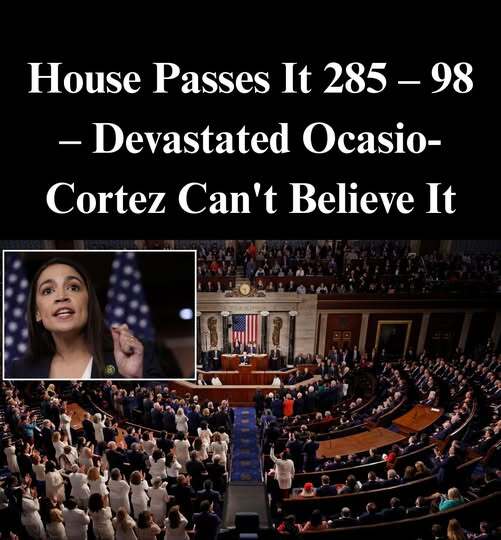
The resolution passed the House by a decisive margin of 285 to 98, a tally that drew attention not only for its size but for its bipartisan nature. Eighty-six Democrats joined Republicans in supporting the measure, signaling that skepticism toward socialism still runs through significant segments of the Democratic Party. Among those voting in favor were House Minority Leader Hakeem Jeffries and several New York Democrats, including Ritchie Torres, Greg Meeks, Grace Meng, Laura Gillen, and Tom Suozzi. Their support reflected both ideological differences and political calculation, particularly as they represent constituencies where the word “socialism” carries electoral risk. Suozzi’s vote, in particular, echoed his earlier decision to distance himself from Mamdani during the mayoral campaign, highlighting fractures within the party between its progressive wing and more centrist lawmakers. For Republicans, the vote was framed as a clear rejection of economic systems associated with authoritarian regimes, while Democrats who opposed it argued that the resolution flattened complex ideas into slogans and failed to address the material concerns facing everyday Americans.
At the center of the moment stood Mamdani himself, a figure who embodies the evolving shape of progressive politics. As mayor-elect of New York City, he represents a growing cohort of leaders who openly identify as democratic socialists while emphasizing practical governance over ideological purity. Rather than responding defensively to the resolution, Mamdani downplayed its significance, noting that his focus remained firmly on the responsibilities awaiting him at City Hall. He reiterated that his administration would prioritize affordability, housing stability, transportation, and public services—issues that resonate across ideological lines for New Yorkers struggling with the city’s high cost of living. By refusing to engage in rhetorical escalation, Mamdani signaled an awareness that symbolic battles in Washington do not necessarily translate into effective leadership on the ground. His response suggested a strategic choice: acknowledge ideological disagreement without allowing it to define his term before it even begins.
The week’s events took on added complexity with Mamdani’s scheduled meeting in Washington with former President Donald Trump, a figure who has repeatedly criticized socialism and whose political brand is often positioned in direct opposition to progressive movements. Given their history of public criticism, expectations for the meeting were low, with some anticipating tension or outright hostility. Instead, reports described the conversation as civil and surprisingly productive. While no dramatic policy alignment emerged, both sides reportedly expressed a willingness to communicate and maintain open channels. In an era where political interactions are often reduced to viral soundbites, the meeting stood out as a reminder that personal diplomacy can coexist with sharp ideological divides. For Mamdani, the encounter reinforced his image as a pragmatic leader willing to engage across differences. For Trump, it offered an opportunity to project statesmanship without conceding ideological ground. The meeting underscored how political theater and real-world negotiation often unfold in parallel, sometimes contradicting public expectations.
Beyond the individuals involved, the episode highlighted broader shifts in American politics. The bipartisan resolution revealed how deeply ingrained Cold War-era language about socialism remains, even as younger voters and urban constituencies increasingly support policies rooted in social democracy. At the same time, Mamdani’s rise illustrates that local governance can serve as a testing ground for ideas that face resistance at the national level. The Democratic Party, in particular, finds itself navigating an internal balancing act: appealing to a base energized by progressive economics while reassuring moderates and swing voters wary of ideological labels. The resolution vote exposed this tension in stark terms, showing that unity on certain symbolic issues does not necessarily translate into consensus on policy direction. It also demonstrated how national lawmakers often respond to perceived ideological threats not with legislation, but with statements designed to signal values and draw lines.
Ultimately, the rare agreement between the House and Senate, the mayor-elect’s measured response, and the unexpected civility of a high-profile meeting together painted a nuanced picture of contemporary governance. American politics, the week suggested, is no longer defined solely by left versus right, but by the interplay of symbolism, substance, and personal approach. While Congress debated the meaning of socialism in abstract terms, a self-described democratic socialist prepared to govern a city of more than eight million people, focused less on ideology than on implementation. The juxtaposition served as a reminder that resolutions may shape narratives, but leadership is judged by outcomes. As Mamdani steps into office, his tenure will test whether pragmatic governance can transcend national ideological battles—and whether the politics of symbolism can coexist with the demands of real-world problem-solving in an increasingly polarized nation.