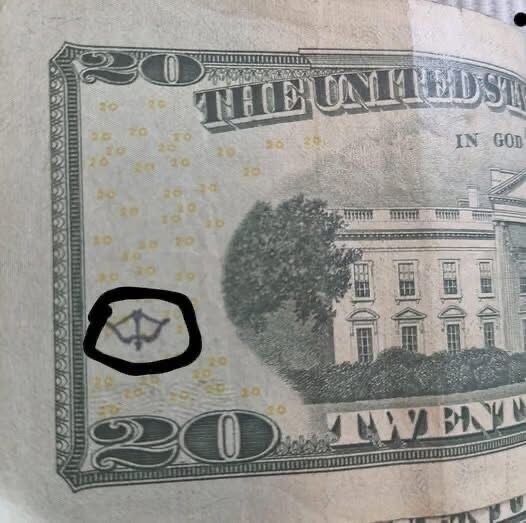
Most people treat paper money as a purely functional object, something to be counted, folded, and passed along without much reflection. A twenty-dollar bill is usually nothing more than a quick calculation of value, a means to an end in everyday transactions. Yet occasionally, a bill catches the eye for an unexpected reason: a small, unfamiliar symbol stamped near the margin, a strange emblem close to the portrait, or a mark that looks vaguely like a bow and arrow. At first glance, such markings can seem suspicious, even alarming. Many assume they are signs of vandalism, secret codes, or counterfeit attempts. In reality, these tiny symbols are neither random nor malicious. They are traces of a long-standing global tradition that predates modern banking and quietly continues to shape how money is trusted, verified, and circulated far beyond U.S. borders.
These markings are part of a practice known as chop marking, a system of informal verification that functions outside official government printing and banking structures. Chop marks are essentially stamps applied by money handlers—merchants, money changers, or traders—to confirm that a bill has been inspected and deemed authentic. Rather than diminishing a bill’s value, these marks historically increased its credibility in regions where trust in foreign currency depended on human verification rather than institutional guarantees. The bow-and-arrow–like symbol seen on many U.S. bills is simply one variation among thousands of unique stamps used around the world. Each mark represents a moment when someone paused, examined the bill, and vouched for its legitimacy. What appears mysterious to an American consumer is, in fact, a visible record of trust forged through commerce.
The roots of chop marking stretch back centuries to ancient China, where long-distance trade demanded systems of verification long before standardized banks existed. Merchants dealing in silver coins and ingots faced constant risks of debasement, forgery, and adulteration. To protect themselves, they developed a hands-on approach to authentication, testing weight, purity, and sound before stamping the metal with a personal or business mark. This stamp—known as a “chop”—served as a signature, signaling that the coin had passed inspection. Over time, coins covered in multiple chop marks became more desirable, not less, because they carried proof of repeated verification by different parties. Each additional stamp told a story of travel, trade, and trust built across markets and generations.
As global trade expanded and currencies evolved, the chop-marking tradition adapted rather than disappeared. When paper money began to replace metal coins, especially in regions where foreign currencies circulated alongside local ones, merchants transferred the same logic to banknotes. Ink stamps replaced metal punches, but the purpose remained unchanged: to confirm authenticity quickly in environments where counterfeit bills could spread easily. The rise of the U.S. dollar as the world’s dominant reserve and trade currency made it the most common target for chop marks. In places where dollars circulate widely but formal banking access is limited or inconsistent, visual confirmation still matters. A stamped bill reassures the next handler that the note has already passed scrutiny, reducing risk in fast-paced markets.
Today, chop-marked U.S. bills are most commonly found in parts of Asia, Africa, Latin America, and the Middle East, where dollars function as parallel currencies alongside local money. Street vendors, currency exchangers, wholesalers, and informal traders often rely on these marks as a shorthand system of trust. The symbols themselves vary widely—arrows, circles, characters, initials, abstract shapes—and carry no hidden messages or secret affiliations. They are practical tools, not codes. Each stamp belongs to an individual or business, meaningful primarily to those within that trading network. Over time, a single bill may accumulate several marks, silently recording its journey through markets, borders, and hands far removed from its original printing press.
When these marked bills eventually return to the United States, they often cause confusion. Many people worry that the stamps render the currency invalid or unusable. In fact, U.S. banks generally accept chop-marked bills at full value as long as the note remains structurally intact and identifiable. To the Federal Reserve, these marks are considered minor alterations, not defacement. For collectors, historians, and the curious, however, they offer something far more intriguing than face value. Each marked bill is a physical artifact of global commerce, a reminder that money is not just a national symbol but a traveling object shaped by countless human interactions. A twenty-dollar bill stamped in a market thousands of miles away carries with it an invisible map of economic relationships that most people never notice.
Ultimately, the small bow-and-arrow symbol on a $20 bill is not a mystery to be feared but a story to be understood. It represents a living tradition of trust that exists beyond modern institutions, rooted in human judgment and shared economic necessity. In a world increasingly dominated by digital transactions and abstract finance, these humble marks serve as quiet evidence that commerce has always relied on relationships as much as systems. The next time such a bill passes through your hands, it may be worth pausing for a moment to consider where it has been, who examined it, and how centuries-old practices continue to shape the flow of money in ways that remain largely unseen.