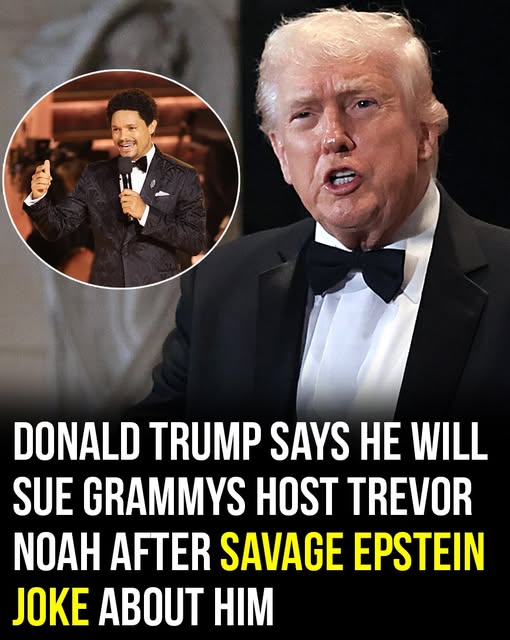
The 2026 Grammy Awards delivered more than music, drama, and fashion—they ignited a controversy that quickly dominated national headlines. While the ceremony featured stunning red-carpet appearances, unexpected award presentations, and viral moments that had audiences laughing and scrolling simultaneously, the most talked-about segment had little to do with music. During the presentation of Song of the Year, host Trevor Noah made a sharp joke referencing Donald Trump, Jeffrey Epstein, and recently unsealed documents tied to Epstein’s controversial activities. His line, linking Trump and Bill Clinton to Epstein’s island while quipping about Trump’s desire for Greenland, drew immediate attention and polarized reactions across social media and news outlets.
The timing of Noah’s joke amplified the response. Just days prior, legal documents concerning Epstein’s alleged network and contacts were made public, though officials repeatedly cautioned that mentions in the files do not equate to criminal liability. Trump’s name reportedly appears multiple times, but the White House and Department of Justice stressed that inclusion in documents alone is not evidence of wrongdoing. Nonetheless, Noah’s quip intersected sharply with these revelations, blurring the line between humor and perceived accusation, and prompting rapid online debate over both the appropriateness of the joke and the responsibilities of high-profile hosts in politically charged moments.
In response, Donald Trump publicly condemned the remarks. Speaking aboard Air Force One, he emphasized that the documents vindicate him, framed the joke as misleading, and accused author Michael Wolff of conspiring with Epstein to politically damage him. Trump’s comments quickly spilled onto Truth Social, where he labeled the Grammys “virtually unwatchable” and described Noah’s line as “false and defamatory,” fueling speculation about potential legal action. The announcement of a possible lawsuit immediately dominated news cycles, drawing commentary from media analysts, legal experts, and fellow entertainers weighing in on freedom of speech versus reputational risk in high-profile awards shows.
The controversy highlights how entertainment platforms, once purely celebratory, now serve as flashpoints for national conversation. The Grammys, intended to honor musical achievement, also reflected broader cultural tensions, demonstrating how comedy, politics, and current events intersect in real time. Celebrity commentary, social media amplification, and legal threats all contribute to a climate in which jokes are no longer contained within the stage or broadcast—they ripple across public discourse, influencing political narratives and public perception. For viewers and industry insiders alike, these moments serve as reminders of the stakes involved in navigating humor in politically sensitive contexts.
Beyond the immediate legal and political implications, the episode underscores a shifting landscape for award shows and public performance. Hosts are increasingly expected to balance comedic license with awareness of potential repercussions. Audiences, in turn, consume these performances not only as entertainment but as commentary with real-world resonance. The tension between satire and defamation has become a prominent concern for both performers and the figures they reference, raising questions about accountability, public perception, and the boundaries of humor in an era where every remark can be dissected online.
Ultimately, the 2026 Grammys will be remembered not solely for musical achievements, but for the collision of entertainment, politics, and social discourse. Trevor Noah’s joke, Trump’s immediate rebuttal, and the ensuing media frenzy illustrate the high stakes of public humor and celebrity commentary today. The unfolding legal developments will likely continue to dominate headlines, reminding audiences that in contemporary culture, the line between award show spectacle and national debate is increasingly indistinct.