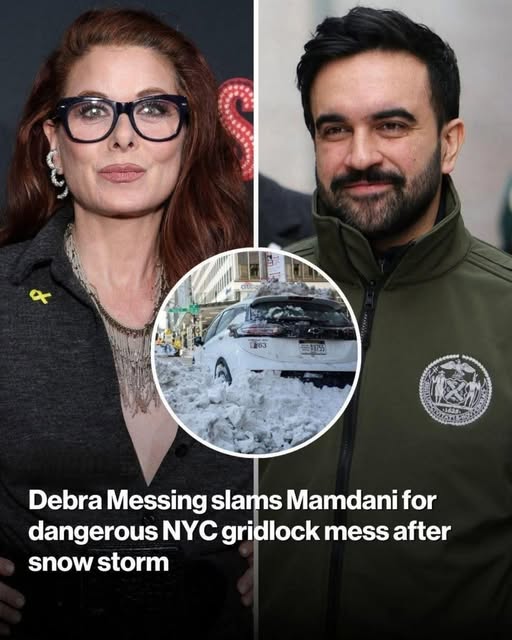
Debra Messing has never been shy about voicing her opinions, but her response to the chaos that followed Winter Storm Fern struck a particularly raw nerve. What should have been a routine trip to a hospital appointment instead became, in her words, a frightening journey through a city that appeared frozen not just by snow, but by dysfunction. Streets clogged with unplowed drifts, cars locked in unmoving lines, and emergency vehicles struggling to pass painted a picture of a metropolis unable to recover even after the storm itself had subsided. For Messing, the experience was not merely inconvenient. It was alarming, personal, and emblematic of a deeper failure that demanded public accountability rather than quiet frustration.
In a sharply worded post, the Will & Grace star described sitting in gridlock while snowbanks towered along the roads days after the snowfall had ended. The most disturbing moment, she said, was watching an ambulance trapped in the same traffic, its urgency rendered meaningless by streets that should have been cleared long before. The image resonated powerfully with New Yorkers who know that in emergencies, minutes can mean the difference between life and death. Messing’s anger was not abstract or political for the sake of politics. It was rooted in fear, witnessing firsthand how easily a breakdown in basic city services could put lives at risk. Her words captured a sense of vulnerability that many residents felt but struggled to articulate.
As a Brooklyn native, Messing framed her outrage through the lens of lived history. New York, she pointed out, has endured crises that shook it to its core: massive blackouts, terror attacks, economic collapse, and a global pandemic. Those events tested resilience and solidarity, often under circumstances far beyond municipal control. This storm, however, felt different to her. Snowstorms are not new to the city, nor are they unpredictable. Preparation, coordination, and rapid response are expected parts of governance in a place that prides itself on endurance. In Messing’s view, what unfolded was not an unavoidable disaster but a preventable failure, one that exposed cracks in leadership rather than the limits of nature.
Her criticism was aimed squarely at Mayor Zohran Mamdani and his new administration, which she accused of allowing essential services to falter when they were most needed. By naming leadership directly, Messing transformed her personal ordeal into a broader indictment, amplifying frustration already simmering among residents. Many New Yorkers echoed her sentiment, describing delayed plowing, inconsistent communication, and a sense that the city had simply stalled. During a brutal cold snap that followed the storm, those failures took on deadly weight. Reports of cold-related deaths and overwhelmed emergency systems intensified public anger, shifting the conversation from inconvenience to consequence.
Supporters of Mayor Mamdani have pushed back, urging patience and perspective. They argue that the administration inherited a fragile and outdated system, one strained by years of underinvestment and compounded by the scale of the storm. From this viewpoint, the gridlock exposed long-standing structural weaknesses rather than the shortcomings of a single leader. Plans to modernize snow removal and emergency response, they say, are already underway, and no city could fully escape disruption from such extreme conditions. This defense, however, has done little to quiet critics who believe that crisis leadership is defined precisely by moments like these, when systems are tested under pressure.
For those critics, Messing’s account crystallizes a growing erosion of trust between residents and City Hall. They argue that hesitation, poor coordination, and slow recovery are not abstract policy debates but lived realities with tangible risks. When ambulances cannot move and hospitals become harder to reach, governance stops being theoretical. It becomes a matter of survival. Celebrity voices often draw skepticism, but in this case, Messing’s story resonated because it mirrored the experiences of countless ordinary New Yorkers who felt stranded, unheard, and exposed during the aftermath.
As the snow finally melts and streets gradually reopen, the larger questions remain unresolved. New York now finds itself navigating not only physical recovery but a reckoning over responsibility, competence, and preparedness. Between an angry public, a high-profile critic, and an administration still defining itself, the storm’s legacy may extend far beyond weather reports. It has forced the city to confront an uncomfortable reality: when disaster shifts from natural to human-made through inaction or mismanagement, the cost is measured not just in delays, but in trust, safety, and lives.