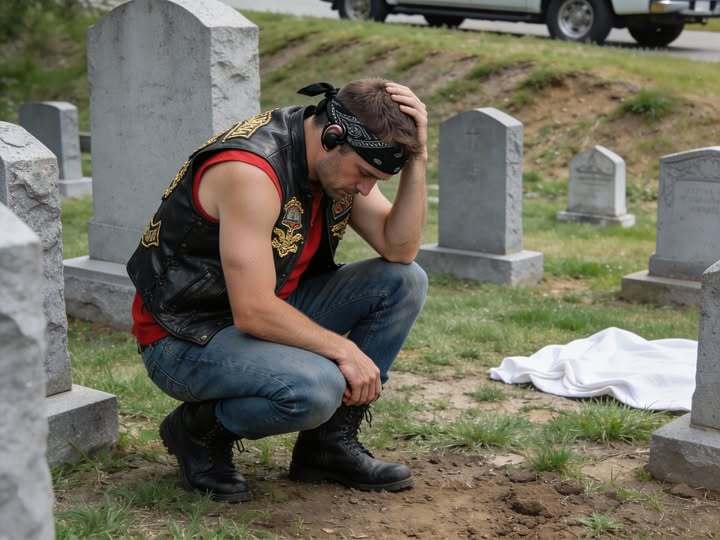
Every Saturday at exactly two in the afternoon, without fail, the sound of a motorcycle announced itself at the far end of the cemetery road. I learned the rhythm of it the way one learns the ticking of a clock after a long illness—resentfully at first, then obsessively. The rider always slowed near the old maple tree whose roots broke the ground like knuckles pushing upward. He parked there, removed his helmet with deliberate care, and walked a straight line toward my wife Sarah’s grave as though guided by muscle memory rather than sight. From my car, positioned a respectful distance away, I watched this ritual repeat itself week after week for six months. He never hesitated, never wandered, never checked the name on the stone as if to confirm he was in the right place. He already knew. The precision unsettled me. Grief had already hollowed my days, but this added a sharp, persistent edge—an unanswered question that gnawed at me in the quiet spaces where Sarah’s absence screamed the loudest.
He did not behave like a curious stranger or a casual mourner. He never brought flowers, candles, or tokens of remembrance. Instead, he sat on the grass beside her headstone, sometimes cross-legged, sometimes with his knees pulled to his chest, his gloved hands resting on the earth as though grounding himself. He stayed exactly one hour. I timed it. At three o’clock sharp, he would lean forward, press his palm flat against the marble, and exhale a breath so heavy with emotion it carried across the distance between us. That sound—half sigh, half sob—was what finally convinced me this was no coincidence. It was the sound of grief stripped bare of performance. It was the sound of someone who had loved her. Watching him stirred something volatile inside me, a mixture of jealousy, fear, and a creeping sense that there were rooms in my wife’s life I had never been invited into. Grief is possessive. It whispers that love is finite and that if someone else claims a share, yours must be diminished.
At first, I tried to explain him away. A coworker, maybe. A distant cousin. Someone she had known before we met. Each theory dissolved under the weight of his devotion. I began to feel invaded, as if this stranger was trespassing on something that belonged to me alone. Sarah was my wife. I had held her hand as she died. I had chosen her casket, approved the engraving on her headstone, memorized the shape of her absence in our home. Yet here was this man, claiming space beside her grave with a confidence that suggested history. My confusion hardened into anger. I imagined confrontations in my head, rehearsed sharp questions, prepared myself for answers I wasn’t sure I wanted. Every Saturday, I told myself I would approach him. Every Saturday, I stayed in my car, paralyzed by the fear of what he might say and what it might take away from the version of my marriage I clung to for survival.
One afternoon, impulse overpowered caution. I stepped out of my car and walked toward them—toward him and toward her stone—my heart pounding so hard I could hear it in my ears. As I drew closer, I saw his shoulders shaking, his head bowed, tears falling freely into the grass. The sight disarmed me completely. This was not a man guarding a secret or indulging a fantasy. This was a man undone by loss. The words I had prepared collapsed in my throat. I turned away, ashamed of my anger and disturbed by the realization that grief had connected us long before I ever spoke to him. The following Saturday, I returned with a different resolve. I would ask, not accuse. When I told him I was Sarah’s husband, he looked up at me with red-rimmed eyes and nodded slowly. “I know,” he said, as if that knowledge had always been part of his weekly pilgrimage.
His name was Mark. He spoke calmly, without drama, as if recounting a truth he had carried carefully for years. Two years before Sarah died, he had been standing on a bridge late at night, drowning in addiction, debt, and the unbearable weight of losing his sister. He told me he had already decided not to go home. That was when Sarah pulled her car over. She didn’t rush him or call the police. She sat with him on the cold concrete for hours, listening, asking gentle questions, telling him small stories about ordinary things—about her garden, about a meal she once ruined, about how life had surprised her by continuing even after heartbreak. When the sun rose, she drove him to a clinic and waited until he was admitted. She never gave him her last name. She never told him she was married. She asked for nothing in return. Mark said that moment had split his life into before and after. He came every Saturday because it was the only way he knew how to thank her.
From that day forward, the cemetery became a shared space rather than a battleground of unspoken resentment. We sat together on the grass, sometimes talking, sometimes not. Mark told me about his recovery, his work, the small rituals he built to stay sober. I told him about Sarah’s laugh, her impatience with clutter, the way she hummed while cooking. Slowly, my anger gave way to something deeper and more humbling. I realized my grief had been shaped by ownership, by the belief that love was something to be defended rather than expanded. Sarah had lived differently. Her kindness had not stopped at the borders of our marriage or the safety of familiarity. It had reached outward, quietly, decisively, and without witnesses. In learning that, I lost one illusion but gained something greater: the understanding that love does not end at death, and it does not belong to one person alone. It multiplies, leaving traces in places we may never see, waiting patiently to be discovered.