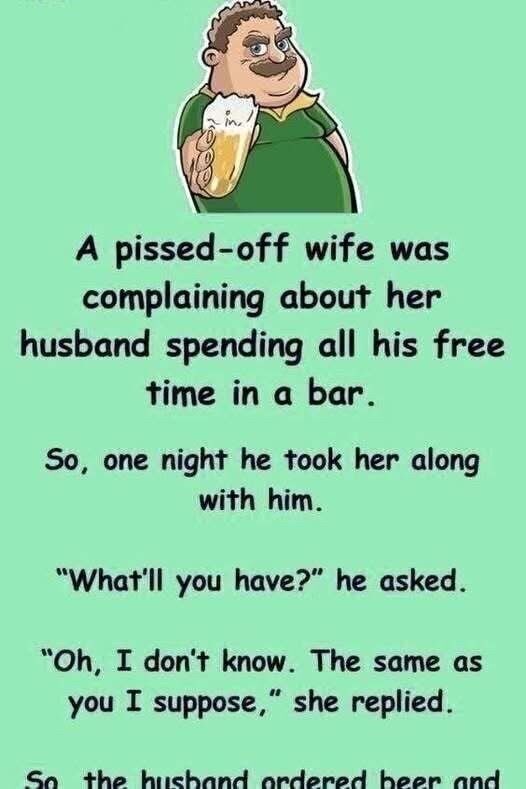
Resentment rarely arrives loudly. It settles instead, accumulating in small, repetitive moments until it feels permanent. In their marriage, it grew every evening when the front door closed behind her husband shortly after he arrived home from work. There was always the same pattern: a brief greeting, a tired kiss on the cheek, a muttered line about heading out for a drink. To her, the pub became more than a place—it became a symbol. It represented laughter she wasn’t part of, conversations that mattered more than hers, and a choice he made again and again to be elsewhere. Alone in the quiet house, she replayed the same story in her mind: him relaxed, smiling, enjoying himself while she waited with unresolved anger and loneliness. Over time, the habit felt like rejection. She wasn’t just annoyed; she felt replaced. Each night fed the belief that he preferred a glass in his hand to a conversation with her, and that belief slowly hardened into something bitter and personal.
For years, she swallowed her frustration, telling herself it wasn’t worth the fight. But resentment does not disappear when ignored—it ferments. Eventually, one evening, the words escaped with more force than she intended. She accused him of wasting his free time, of choosing alcohol over his marriage, of finding joy everywhere except at home. She spoke of lonely dinners, of silence, of feeling invisible. She expected defensiveness, maybe anger, maybe an argument that would confirm everything she feared. Instead, he surprised her. He didn’t interrupt or deny her feelings. He didn’t justify himself. When she finished, breathless and emotional, he simply looked at her and asked if she wanted to come with him the next night. The calmness of the invitation unsettled her more than a fight would have. It felt like a challenge and an explanation all at once. Determined to prove her point and see the truth for herself, she agreed.
The following evening, they walked into the pub together, and her assumptions immediately began to crack. It wasn’t lively or warm the way she had imagined. There was no music that lifted the mood, no contagious laughter spilling from crowded tables. The lighting was dim and tired, the air thick with the smell of stale beer and grease that had soaked into the walls over decades. The men inside weren’t celebrating the end of the day; they were sitting quietly, shoulders slumped, eyes fixed on their glasses or the floor. Conversations were sparse and low, interrupted more by sighs than jokes. It didn’t feel like a place people came to enjoy themselves. It felt like somewhere they came to disappear for a while. As her husband nodded at the bartender, she noticed the lack of enthusiasm in the exchange. There was familiarity, but no excitement. That realization unsettled her. This wasn’t escape into pleasure—it was retreat into routine.
They sat at the bar, and without hesitation, her husband ordered his usual drink. Out of stubbornness and curiosity, she ordered the same. He lifted the glass and swallowed it in one practiced motion, his face unreadable, almost distant. There was no savoring, no pleasure, no smile. When she raised her glass and took a sip, the bitterness hit her instantly. She gagged, coughing loudly, her face twisting in genuine disgust. The taste was harsh, unpleasant, and nothing like the indulgence she had imagined. She couldn’t stop herself from blurting out how awful it was, how she didn’t understand how anyone could drink something so vile willingly. For the first time that night, her husband looked at her fully. Without sarcasm or defensiveness, he said quietly that this was what she thought he enjoyed every night. There was no accusation in his voice—only fatigue.
In that moment, the truth settled in with unexpected weight. The pub wasn’t a place of joy for him. It was a pause. A space where no one expected conversation, emotional presence, or strength. He wasn’t chasing happiness; he was numbing exhaustion. Looking around the room again, she saw it clearly—the men weren’t celebrating their lives, they were avoiding their thoughts. Each glass wasn’t indulgence, but anesthesia. Her resentment loosened its grip, replaced by something softer and more uncomfortable: understanding. She realized how much of her anger had been fueled by imagination rather than reality. She had filled the silence with stories that hurt her, never questioning whether they were true. The pub hadn’t stolen him from her; it had been absorbing what he didn’t know how to bring home.
They left shortly after, without dramatic apologies or emotional promises. The night ended quietly, but something fundamental had shifted. The fantasy she had built around his habit dissolved, replaced by clarity. She understood that what looks like avoidance is often survival, and what appears to be indulgence can be nothing more than a coping mechanism. The experience didn’t fix everything, but it opened a door that had been closed by assumption and silence. Sometimes, understanding doesn’t come from arguments or explanations, but from standing inside the truth instead of imagining it from afar. And sometimes, one bitter sip is all it takes to turn resentment into laughter—and replace judgment with empathy.