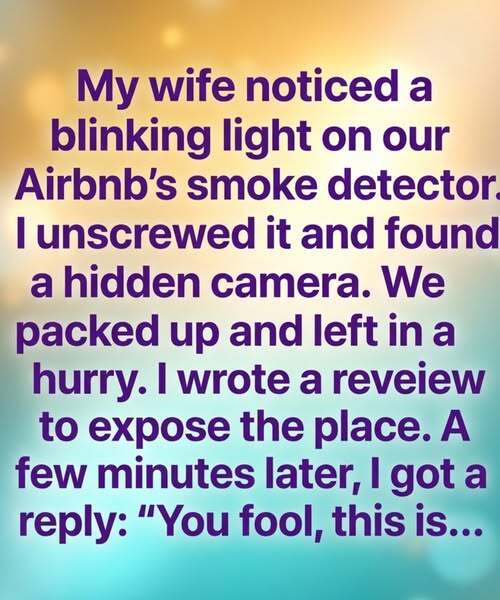
The rental looked exactly like the photos when we arrived—warm lighting, minimalist décor, clean lines meant to suggest safety and care. It was supposed to be a quiet stopover, a reset between long drives, nothing more than a place to sleep and shower before continuing our trip. We had chosen it because of its reviews, dozens of them praising the host’s responsiveness and the “peaceful atmosphere.” Inside, everything felt curated but impersonal, like a staged life paused mid-sentence. The first evening passed uneventfully, yet there was a subtle tension neither of us could explain. It wasn’t fear, not yet, just the sense of being slightly unsettled, like standing in a room where a conversation has just stopped. The next morning, as sunlight filtered through the thin curtains, my wife noticed a small blinking light on the smoke detector above the bed. At first, we dismissed it as a normal indicator, but the blink felt irregular, almost deliberate. Curiosity turned to unease. I pulled over a chair, climbed up, and examined it more closely. The casing was loose, poorly sealed. When I gently twisted it open, my stomach dropped. Inside, nestled where wiring should have been, was a tiny glass lens reflecting back at me. The moment stretched thin. We didn’t speak. We didn’t argue or debate. Instinct took over, sharp and immediate. We packed everything we owned in minutes, hands shaking, movements frantic but silent. We left the keys on the counter, locked the door behind us, and drove without destination until distance felt like oxygen.
We didn’t stop until we were two towns away, pulling into the harsh glow of a 24-hour diner parking lot. The normalcy of it—the smell of grease, the hum of fluorescent lights, a tired waitress refilling coffee—felt surreal after the panic. Only then did the adrenaline begin to drain, replaced by nausea and disbelief. We replayed the discovery again and again, questioning ourselves. Could we be wrong? Could it have been some strange sensor, a misunderstanding? But the image of that lens wouldn’t loosen its grip. I posted a review immediately, hands trembling as I typed, careful to stick to facts while warning others. I expected denial, excuses, maybe an apology. What I received instead arrived within minutes and felt colder than silence. The host accused me of damaging a “transmitter” linked to a private security system. The language was oddly impersonal, almost rehearsed. Then came the line that turned fear into something sharper: “They’ll come looking for it.” No explanation. No clarification. Just that. The implication hung there, heavy and deliberate. Who were “they”? Why would anyone come looking for something hidden inside a smoke detector in a guest bedroom? The response wasn’t reassurance—it was a warning.
Shaken, I began going through the photos I had taken during our stay, searching for anything else we might have missed. It was an attempt to regain control, to prove this wasn’t just paranoia fueled by exhaustion. That’s when I noticed it. In one photo, taken casually from the bed, a faint red dot glowed near the curtain rod. At first glance, it looked like a reflection, but zooming in revealed something else entirely. The dot wasn’t reflecting light—it was emitting it. A laser point, small and precise, partially obscured by fabric. The realization landed slowly, then all at once. This wasn’t an isolated device or a misunderstanding. It was a system. Cameras, sensors, possibly trackers. The blinking light wasn’t passive; it was active. The red dot wasn’t accidental; it was intentional. The Airbnb wasn’t just a rental—it was a controlled environment. The sense of being watched retroactively flooded every memory of the stay. The quiet, the stillness, the unease we couldn’t name. We understood then that leaving quickly hadn’t been dramatic—it had been necessary. Without hesitation, we got back in the car and drove for hours, heading toward the nearest city, choosing a large, anonymous hotel where faces blurred into crowds. I destroyed the prepaid phone used to book the rental, snapping it in half before throwing it away at a gas station.
The following day, we filed a police report, though the process felt hollow. We showed photos, explained the host’s message, described the devices. The officer listened carefully, but there was an unspoken limitation in the room. Without the device itself, without proof still inside the rental, everything became circumstantial. Jurisdiction complications, platform policies, and the ambiguity of intent created gaps too wide to bridge easily. Still, the report existed, and that mattered. It was a record, a refusal to let the experience dissolve into disbelief. As the hours passed, exhaustion replaced fear, but sleep remained elusive. Every sound felt amplified. Every blinking light in the hotel room triggered a spike of adrenaline. The world felt suddenly thinner, trust more fragile than we had ever realized. What disturbed me most wasn’t just the possibility of surveillance—it was the calm efficiency with which it had been hidden, normalized, and defended. The host’s response suggested familiarity with fear, even comfort in invoking it. The idea that privacy could be violated so casually, and then dismissed with a veiled threat, changed how I saw spaces meant for rest.
That night, lying awake beside my wife, the final realization settled in. Safety, as we understand it, is often an illusion carefully constructed by appearances. Star ratings, friendly messages, staged photos—they create a sense of control that may not exist. Most places are safe, most people are ordinary, but it only takes one violation to permanently alter perception. We think of danger as loud and obvious, but sometimes it whispers through blinking lights and neutral language. Sometimes it hides behind policies and plausible deniability. Since that night, I no longer assume privacy simply because it is promised. I check ceilings, corners, reflections. I read responses more carefully than reviews. The experience didn’t just frighten us—it recalibrated our understanding of trust. The most chilling part wasn’t discovering the camera. It was realizing how easily comfort can be manufactured, and how quickly it can be weaponized. Sometimes, the blinking light isn’t there to protect you. Sometimes, it’s there to remind you that someone else is watching, and they don’t feel the need to hide it anymore.