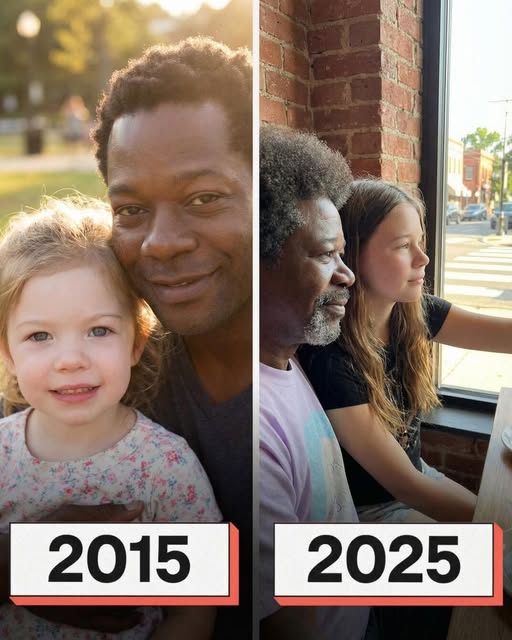
Some moments arrive with such force that they seem to shift the ground beneath your feet, realigning everything you thought was steady. They do not announce themselves; they do not wait for readiness. They simply happen, leaving you scrambling to make sense of a new reality. For me, that moment unfolded on a Thanksgiving morning—a day that had always been a quiet anchor in our lives, filled with warmth, laughter, and the subtle comfort of routine. For ten years, Grace and I had transformed loss into stability, grief into ritual, and sorrow into quiet joy. That morning, however, carried a tension that felt unfamiliar, thickening the air in our home. When I saw her standing in the doorway, hands trembling, eyes wide with fear, I understood immediately: something fundamental had shifted, and our lives would never quite be the same.
A decade earlier, on what would become the final day of her mother’s life, Laura entrusted me with a promise that would define the next ten years of my existence. She asked me to raise her daughter as if she were my own. I did not hesitate. There is no calculation in love when it demands commitment; only a recognition that duty and care are inseparable from devotion. Over the years, I learned the delicate architecture of parenting a child shaped by loss—how to read her moods, how to guide without controlling, how to cultivate independence while offering unwavering security. We built traditions, small but meaningful, that anchored our lives. Birthdays, holidays, and quiet evenings together became symbols not of biology, but of belonging. Love, I discovered, does not require genetics—it requires presence, patience, and an unshakable willingness to protect.
That Thanksgiving morning, Grace struggled to articulate her fear. Finally, in a voice barely above a whisper, she told me she might not stay for dinner. Her biological father, absent for ten years, had resurfaced, reaching her through messages and social media. His words were not of reconciliation but of pressure, veiled threats mingled with feigned concern. He implied that ignoring him could imperil our livelihood, hinting at the small business that sustained our lives. Grace confessed that she had carried this burden alone, believing that sacrificing her own peace might protect me. Her silence, born from love and loyalty, cut deeper than any confrontation could. My heart broke, not at the audacity of her father, but at the weight she had borne silently for so long.
I took her trembling hands into mine and spoke with a clarity born of both fear and certainty: nothing mattered more than her safety. She had been given enough responsibility already; my role as her guardian was to shield her, not the other way around. Later that day, her biological father arrived at our doorstep, radiating self-assuredness, attempting to assert control with performative confidence. I had anticipated this moment. Armed with printed copies of his messages, I made it unequivocally clear that further intimidation would have legal consequences. His power evaporated instantly in the presence of evidence and the unwavering boundary I had set. The confrontation ended swiftly, leaving silence in its wake—an uneasy, yet liberating quiet. Grace, finally released from the invisible chains of fear, collapsed into my arms, sobbing, shaking, and exhaling the anxiety she had held for far too long.
In the months that followed, our lives began to reclaim their rhythm. Laughter returned to the shop, a sign of trust rebuilt and innocence restored. Gradually, the shadow of fear faded from our home, replaced by the quiet confidence of belonging and security. One evening, as we closed the shop together, Grace looked up at me with a soft seriousness that caught me off guard. She asked if I would walk her down the aisle someday. In that moment, everything crystallized—the years of sacrifice, the small acts of care, the promises made in whispers and tears. All the days spent building a life together, all the nights spent soothing anxieties that were not of her making, converged into an unshakable certainty: family is not defined by DNA, but by devotion, loyalty, and the courage to stand against those who exploit vulnerability.
Looking back, that Thanksgiving morning no longer feels like a day of fear but a turning point—a reaffirmation of what truly matters. Grace’s father may have tried to assert control, but he could never undo the foundation of trust, love, and safety we had built. Through fear, confrontation, and eventual resolution, Grace learned an invaluable lesson: the measure of family is not in shared blood, but in shared commitment. And I learned, once more, that love is strongest when it protects, nurtures, and dares to challenge the forces that seek to harm those we cherish. In the quiet aftermath, we found affirmation: we were already a family, forged not by circumstance, but by heart, courage, and an unwavering belief in each other.