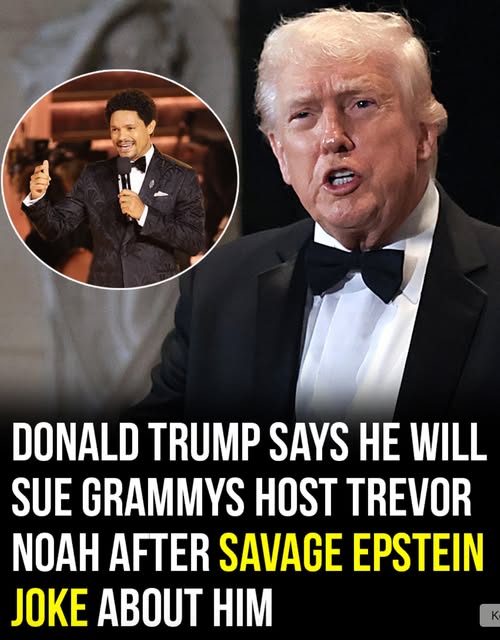
The 2026 Grammy Awards were designed to celebrate music, spectacle, and creative expression, but instead they ignited a political and legal controversy that quickly overshadowed the trophies. Amid bold fashion statements, unexpected winners, and subtle protests woven into the broadcast, one moment in particular detonated across social media and cable news within minutes. Host Trevor Noah, known for blending political satire with pop culture, referenced the explosive release of new Jeffrey Epstein–related documents during his monologue. The joke, sharp and provocative, drew immediate laughter from parts of the audience and instant outrage from others. By the end of the night, it was clear that the Grammys had become the stage for a far larger confrontation—one involving Donald Trump, defamation claims, and a renewed debate over where comedy ends and legal accountability begins.
Noah’s remark came at a moment of heightened tension. Just days earlier, a massive batch of Epstein-related files had been made public, sending shockwaves through political, media, and celebrity circles. Referring to the frenzy, Noah quipped that the coveted Grammy for Song of the Year was something artists wanted “almost as much as Trump wants Greenland,” adding that with Epstein’s island gone, Trump “needs a new one to hang out with Bill Clinton.” The line was deliberately outrageous, crafted in the familiar language of late-night satire. Yet in the current climate, where every word is dissected and weaponized, the joke landed far beyond the room. Clips spread rapidly online, sparking fierce arguments over whether Noah had crossed a line by implying misconduct rather than merely mocking political figures through exaggeration.
Donald Trump’s response was swift and characteristically explosive. Within hours, he took to Truth Social, condemning the Grammys as “virtually unwatchable” and attacking the broadcast network before zeroing in on Noah personally. Trump accused the host of making “false and defamatory” statements, insisting he had never visited Epstein’s island and had never been accused of doing so. In a lengthy post, he framed the joke not as comedy but as a deliberate lie, warning that legal action was imminent. His language was blistering, calling Noah talentless and threatening to “send my lawyers” after him, invoking past legal battles as evidence that such lawsuits could succeed. The message transformed a punchline into a potential courtroom fight, reigniting Trump’s long-standing war with comedians, journalists, and media institutions he believes have defamed him.
The controversy also revived broader discussion around Trump’s historical association with Jeffrey Epstein. While Trump has repeatedly denied any wrongdoing and has not been accused of crimes by Epstein’s victims, his name appears numerous times in recently released documents, as do the names of many powerful figures. Legal experts and government officials have emphasized that being named in the files does not imply criminal conduct, a clarification echoed by the Justice Department and the White House. Trump himself addressed the documents while speaking aboard Air Force One, suggesting they actually absolved him and accusing writer Michael Wolff and others of conspiring with Epstein to harm him politically. These remarks, layered with grievance and suspicion, underscored how deeply the Epstein saga continues to reverberate through American politics, years after the financier’s death.
What makes the Trevor Noah episode particularly charged is the legal question it raises. Can a joke, delivered in a clearly comedic setting, constitute defamation? Free speech advocates argue that satire has long been protected, especially when directed at public figures who must meet an extraordinarily high legal standard to prove defamation. Trump, however, has consistently pushed back against that boundary, framing jokes and commentary as intentional lies rather than rhetorical exaggeration. His threat to sue Noah echoes earlier confrontations with late-night hosts and journalists, reinforcing his belief that entertainment platforms wield unfair power over public perception. For Noah, the moment highlights the increasing risk comedians face when political humor intersects with real-world legal threats.
Beyond the legal mechanics, the incident revealed how entertainment awards shows have become battlegrounds in the culture war. Once dismissed as harmless escapism, events like the Grammys now routinely serve as platforms for political statements, social critique, and satire. Viewers no longer simply watch; they analyze, screenshot, and mobilize. A single line can dominate headlines for days, eclipsing the artists the night was meant to honor. In this case, the spectacle of Trump versus Noah became emblematic of a society where comedy, politics, and outrage are tightly interwoven, each feeding the other in an endless cycle of reaction and escalation.
Whether Trump ultimately follows through on his threat to sue remains uncertain, but the damage—or impact, depending on perspective—has already been done. Trevor Noah’s joke has entered the larger narrative of political humor under pressure, while Trump’s response reinforces his ongoing effort to challenge media narratives through confrontation rather than dismissal. The Grammys, meanwhile, will be remembered less for their music and more for the moment a punchline ignited a national argument. In an era where laughter can provoke lawsuits and satire can spark international headlines, the episode stands as a stark reminder that words—especially on a global stage—carry consequences far beyond the applause they receive in the moment.