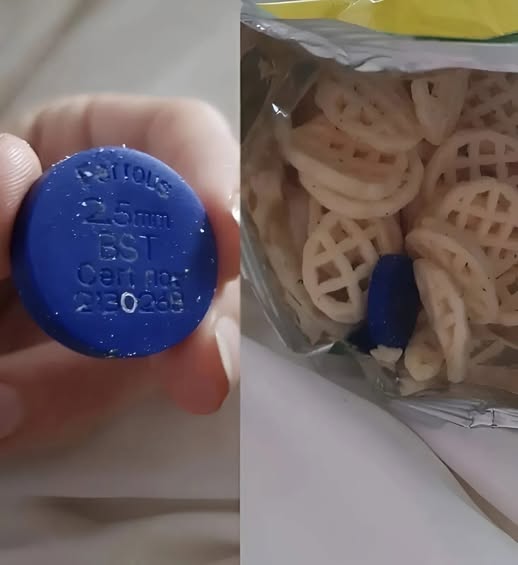
Snack time is usually unremarkable, a brief pause filled with routine comfort and familiar flavors. That sense of normalcy vanished the moment my son opened a sealed bag of sour cream–flavored chips and a small, solid blue object tumbled out onto the table. It was smooth, perfectly round, and unmistakably out of place. I froze instantly, stopping him from eating another chip as questions rushed in. The bag had been factory-sealed, untouched, and purchased like any other. How could something so clearly foreign end up inside? In an age where food safety is taken seriously, the discovery felt unsettling, even alarming. The object’s presence challenged a basic assumption most of us carry—that sealed packaging guarantees predictability and safety.
At first glance, the blue disk inspired fear more than curiosity. Was it plastic? Industrial debris? Something that could be harmful if ingested? The fact that it was solid and vividly colored only intensified concern. We examined the bag, searching for signs of tampering, but found none. The chips looked normal, the seal intact. The strangeness lay entirely in that single object. Rather than guessing, I decided to document it. I took clear photos of the disk beside the chips and shared the images online, hoping someone might recognize it. Within minutes, responses began to pour in, ranging from warnings and speculation to informed explanations that hinted at a far less sinister reality.
As the discussion unfolded, a few voices stood out—people who claimed experience in food manufacturing and quality control. They suggested the blue object was likely a “test piece,” a component deliberately used in factories to ensure that metal detectors and safety scanners are functioning properly. These devices, they explained, are designed to catch contaminants before products are packaged and shipped. To test them, technicians run standardized objects—often brightly colored and embedded with detectable material—through the production line. The vivid blue color is intentional, chosen because it does not resemble food and is easy to identify if spotted. While such test pieces are strictly controlled and never meant to reach consumers, rare lapses can allow one to slip through unnoticed.
Further research confirmed these explanations. Many food manufacturers use test pieces made of food-safe plastic infused with traceable materials that trigger detection systems. They are non-toxic, inert, and designed specifically to avoid causing harm if accidentally handled. Discovering this transformed the situation entirely. What initially felt like a breach of safety turned out to be evidence of safety itself—a glimpse into the rigorous, multilayered processes that operate behind the scenes to protect consumers. The rarity of encountering such an object outside a factory is precisely why it sparked panic; most people never see these safeguards in action.
The emotional shift was striking. Anxiety gave way to relief, and then to something like appreciation. That small blue disk represented not negligence, but diligence. It highlighted the complexity of modern food production, where countless checks occur daily to prevent contamination. While no system is flawless, the presence of such testing protocols demonstrates how seriously manufacturers approach consumer protection. The incident also underscored how quickly uncertainty can escalate in the absence of information—and how valuable transparency and shared knowledge can be in restoring trust.
In the end, the experience reframed a moment of fear into an unexpected lesson. That strange blue object, once a source of alarm, became a symbol of the unseen mechanisms working quietly to keep everyday products safe. It reminded us that ordinary moments often rest on extraordinary systems we rarely notice. A simple bag of chips revealed a hidden layer of care, diligence, and accountability—proof that even when surprises occur, they can sometimes point not to danger, but to the safeguards designed to protect us all.