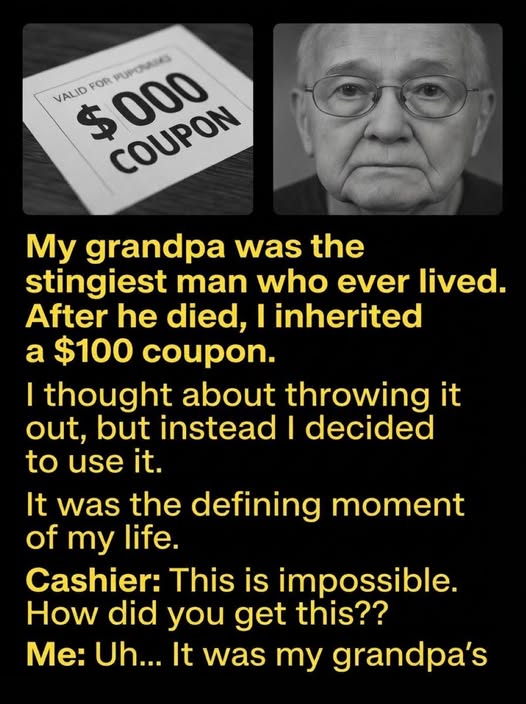
My grandfather had a reputation that preceded him. In the family, stories of his frugality were practically folklore. He reused aluminum foil until it practically dissolved, unplugged appliances the instant they were no longer in use, and would drive out of his way to save pennies on gas—sometimes miles out of his way. Birthdays, holidays, and anniversaries were rarely extravagant, because, as he would remind anyone who asked, “Money saved is money earned.” Jokes about his stinginess circulated endlessly at family gatherings, often accompanied by exaggerated mimicry of his exact words and gestures, but he never laughed along. Humor, he believed, was worth enjoying, but spending unnecessarily? That was an entirely different matter. Over the years, I learned not to challenge his habits. It wasn’t merely about money. It was a philosophy he lived by—patient, precise, and deliberate in every small choice.
When he passed away, the family’s expectations were modestly tempered by decades of stories. And yet, there was still a lingering hope: maybe he had a hidden account tucked away, a stash of cash in a forgotten drawer, or some last-minute windfall he’d meant to pass along quietly. We searched through old papers, letters, and drawers, finding bills, receipts, and grocery lists meticulously preserved over decades, each one a testament to his exacting nature. But there were no envelopes of cash, no secret checks, no sudden bursts of generosity. In the end, the inheritance came down to a single, unassuming item: an old envelope containing one object—an unbranded, nondescript $100 coupon. No expiration date, no clear instructions, no explanation. Just the words: “Valid for purchase – $100.” It felt like a riddle. I almost tossed it into the recycling. A coupon? Of all the things, this seemed almost absurd.
Something stopped me from throwing it away. Maybe it was guilt, the instinctive feeling that discarding a gift from him would feel like rejecting decades of lessons, no matter how opaque. Maybe it was curiosity, the nagging thought that he had left it there for a reason I didn’t yet understand. Or maybe it was a sense I had long learned from observing him: my grandfather never acted without purpose. His smallest gestures often carried lessons layered in patience and thought. After a few restless nights staring at the envelope, I decided to test the coupon in the real world. I took it to the grocery store, walking down aisles with both hope and skepticism, wondering if anyone would even recognize it. Would it be accepted? Rejected? Or worse, laughed at? The uncertainty made my stomach twist. I wasn’t prepared for the reality that awaited.
At the register, I scanned my items, slipping the coupon across the counter with hesitation. The cashier picked it up, and what happened next startled me. She froze, her smile disappearing almost immediately. Her eyes scanned the coupon as if she had never seen its like before, then lifted to me, searching for a reaction I could not supply. “I… I can’t accept this,” she said, her voice almost a whisper, careful and measured. Confused, I asked why, and she explained that the coupon no longer existed in the store’s current systems. It had been part of a decades-old, lifetime customer loyalty program, quietly offered to a handful of customers who had shown unwavering consistency. While most people had discarded theirs or forgotten, my grandfather had kept his. The manager arrived shortly after, examining the coupon as if it were a historical artifact. When he asked where I had gotten it, I said simply, “It was my grandpa’s.” He exhaled slowly and smiled. “That makes sense,” he said, approvingly. My skepticism melted away as the register completed its work, and my total—every item—was covered in full.
The revelation struck deeper than I had anticipated. The manager shared what he knew of my grandfather: a man who had walked into that store week after week, year after year, never redeeming the coupon, always saving it for something he considered important. Suddenly, the frugality I had once mocked or found irritating transformed into something almost reverent. He wasn’t merely cheap; he was patient, disciplined, and thoughtful in a way I had never truly appreciated. In that quiet moment, I began to understand that the coupon was not about $100. It was a symbol, a tangible lesson about delayed gratification, careful decision-making, and seeing value beyond its immediate monetary equivalent. My grandfather’s entire life philosophy—patient, intentional, restrained—had been distilled into this single, unassuming piece of paper.
Walking out of the store, the weight of that lesson settled in. I realized that the man I had thought of as impossibly stingy had been giving me one last, carefully constructed gift. He had trained me, without words, to recognize patience, foresight, and the quiet joy of waiting for the right moment. The $100 coupon was never about spending; it was about understanding. Some things, he seemed to say, are worth holding onto. Some opportunities are worth preserving until the moment is right. Some lessons, like good habits or enduring principles, are priceless precisely because they cannot be rushed or forced. For decades, I had measured him by conventional terms—money spent, generosity given—but in this single inheritance, I saw the full spectrum of his wisdom.
That day, I finally understood my grandfather in a way I never had before. He had never been merely a miser. He had been a teacher, a philosopher disguised as a man obsessed with pennies and practicality. And the lesson of the $100 coupon remains with me, guiding me through decisions both mundane and profound: the value of patience, the power of foresight, and the quiet truth that the worth of something is often not in what it is immediately, but in when and how it is used. Life, he seemed to remind me from beyond, is less about what we grab now and more about what we are willing to wait for, the care we put into our choices, and the integrity with which we handle even the smallest of opportunities. And in that realization, I finally laughed—not at his stinginess, but with him, appreciating a lifetime of lessons I had almost overlooked.