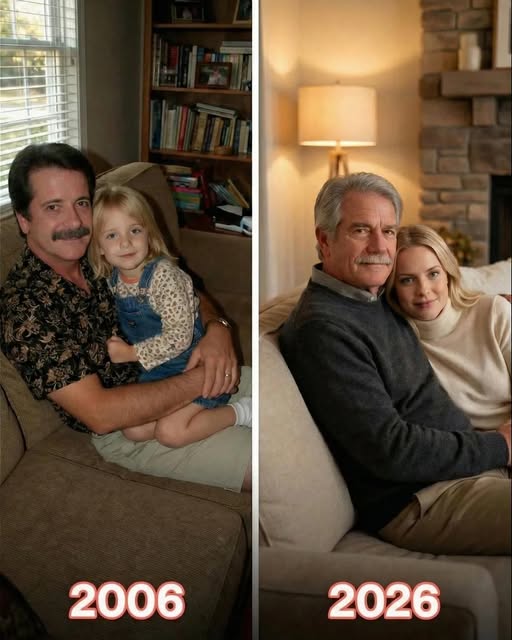
For twenty years, Martin believed he had learned how to live with loss. Not overcome it, not conquer it—just live alongside it, the way one learns to live with an old injury that never fully heals but eventually stops screaming. At seventy years old, grief had become a familiar companion, woven into his routines, his silences, and the small pauses in conversation when memories surfaced uninvited. The winter storm that took his son, daughter-in-law, and young grandson had arrived suddenly, violently, and without mercy. It was the kind of tragedy people speak about in hushed voices, the kind that rearranges a life in a single afternoon. In the years that followed, Martin did what many survivors do: he compartmentalized. He learned which memories to visit gently and which ones to leave untouched. He focused on what remained instead of what was gone. And what remained—miraculously, painfully—was his granddaughter Emily, the only child who survived that night, saved by circumstance, timing, and the randomness that governs tragedy. She was barely three years old when the accident happened, too young to understand death but old enough to sense absence. Martin became her guardian, her anchor, her steady presence in a world that had cracked open before she could name what was missing. He told himself that raising her well was his purpose now, that love could coexist with sorrow, and that silence around certain truths was a form of protection, not avoidance.
As the years passed, Emily grew into a thoughtful, observant child, then a quietly determined teenager, and eventually a composed young woman whose curiosity ran deeper than most people realized. Martin watched her closely but never intrusively, noticing the way she asked questions that seemed casual yet carried weight, the way she paused during conversations about the past, listening more than speaking. He answered what he could without reopening wounds he believed had healed poorly the first time. He spoke of her parents with warmth, of her brother with gentleness, but avoided the specifics of the accident itself. Not because he wanted to hide the truth, but because he believed there was no benefit in reliving pain that had no solution. Healing, he thought, meant moving forward, not backward. And yet, even as Emily built her own life—earning degrees, establishing a career in legal research, forming her own relationships—there was a quiet restlessness beneath her calm exterior. Fragments of early memory lingered like half-remembered dreams: flashing lights, cold air, the sound of voices raised in urgency. She could never place them fully, but they never left her either. Over time, questions that once felt abstract became more precise. What exactly happened that night? Why were certain details never discussed? Why did official explanations feel so thin when revisited as an adult? Emily did not accuse or confront. Instead, she researched. She read old reports, requested archived records, and followed paper trails that most people would have abandoned out of discomfort. She did this not out of suspicion, but out of a need for coherence—for a story that made sense of the life she had inherited.
The moment everything shifted came quietly, without drama or raised voices. One evening, long after dinner had cooled and conversation had thinned into companionable silence, Emily handed her grandfather a folded note. Her hands were steady, but her eyes carried a gravity Martin recognized instantly. The words inside were careful, precise, unmistakably hers. She explained that while reviewing historical transportation safety cases related to her work, she had come across documents that mirrored the circumstances of her family’s accident. That recognition had led her deeper, toward records that were never publicly discussed, procedural oversights that were dismissed as insignificant at the time, and decisions made under pressure that altered outcomes. The accident, she wrote, was not a single moment of fate, but a chain of events—weather warnings minimized, route changes poorly communicated, safety measures delayed by minutes that ultimately mattered. As Martin read, the room seemed to contract around him. Grief he believed had settled years ago stirred again, sharp and immediate. But alongside it was something unexpected: relief. Not relief from pain, but relief from ambiguity. For decades, he had lived with an unanswered “why,” a question that had no voice but constant presence. Emily’s research did not assign blame in a way that invited rage; instead, it offered clarity. The tragedy remained tragic, but it was no longer incomprehensible. Understanding did not undo loss, but it reframed it, allowing grief to exist without the added burden of mystery.
In the days that followed, Martin and Emily talked more openly than they ever had before. Not in a single cathartic conversation, but in many small ones—over morning coffee, during evening walks, in pauses that once would have been filled with distraction. They spoke about the family they lost not as victims of an unknowable force, but as people whose lives were shaped by systems, choices, and circumstances that could now be acknowledged honestly. Emily shared how carrying unanswered questions had subtly shaped her sense of identity, her career choices, and her instinct to seek structure in chaos. Martin admitted that his silence had not only been about protecting her, but also about protecting himself from reopening grief he feared might overwhelm him. Together, they realized that silence can be both shelter and barrier, depending on how long it is maintained. The truth Emily uncovered did not demand anger or justice; it invited acceptance grounded in understanding. It allowed them to mourn not just the loss itself, but the years spent assuming there was nothing more to know. That realization, while painful, also felt like progress—a final piece placed into a puzzle that had remained incomplete for too long.
As winter returned, echoing the season of the original loss, Martin noticed how different it felt this time. The cold no longer carried the same weight of dread. Snow still reminded him of absence, but it also reminded him of continuity—the way seasons repeat, yet never exactly the same. Sitting beside his granddaughter one evening, watching frost gather on the window, he felt a quiet sense of peace that surprised him. The truth Emily had brought into their lives had not shattered what remained; it had strengthened it. Their bond, once defined by protection and restraint, now rested on shared understanding and mutual respect. Martin realized that grief does not diminish simply because time passes. It evolves. It waits. And sometimes, it requires truth—not to reopen wounds, but to allow them to finally heal correctly. Some answers arrive late not because we avoided them, but because we were not yet ready to carry them. In the end, what Emily gave him was not just information, but permission—to remember without fear, to speak without guilt, and to move forward without leaving pieces of the past unresolved. And in that quiet resolution, Martin found something he had not expected after twenty years: not closure, but clarity—and with it, a gentler way to hold everything he had lost and everything that remained.