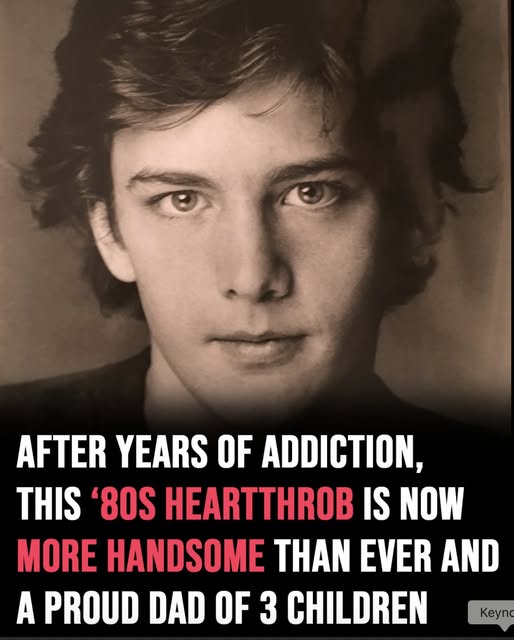
In the 1980s, Andrew McCarthy seemed to exist everywhere at once, his face synonymous with youthful longing, vulnerability, and romantic idealism. To millions, he was not just an actor but a feeling — the embodiment of tender glances, unspoken emotions, and the ache of first love. His performances in films like Pretty in Pink and St. Elmo’s Fire made him a symbol of an era when teenage emotions felt world-shattering and permanent. Yet even as audiences projected their dreams onto him, McCarthy was quietly wrestling with something far less glamorous: a deep discomfort with attention, a sense of isolation, and an inner life that fame only intensified rather than fulfilled. The contrast between the polished image and the private reality would define much of his early career, setting the stage for a life story far more intricate than the roles that made him famous.
Long before Hollywood discovered him, McCarthy was simply a boy growing up in Westfield, New Jersey, the third of four brothers in a family untouched by celebrity culture. His mother worked at a newspaper, his father in investments — a grounded, practical household where ambition was not measured by applause. School was not an easy refuge for him. He later described feeling disconnected, lonely, and out of place, emotions that would quietly follow him into adulthood. Acting became both an outlet and a shield, a way to communicate what he struggled to express directly. When he enrolled at New York University to study acting, it seemed like a logical step, yet his lack of discipline and discomfort with structure led to his expulsion. Ironically, what looked like failure would become the doorway to sudden, life-altering success, one he was emotionally unprepared to navigate.
That success arrived almost overnight with an open casting call for Class, a film that placed the young actor opposite Jacqueline Bisset in a role that instantly drew attention. The experience was surreal — one moment a struggling student, the next sharing scenes that would shock his former classmates and redefine his trajectory. Hollywood moved quickly, and so did expectations. When NYU offered to take him back under special conditions, McCarthy declined, already sensing that the world he had entered no longer fit traditional paths. By the mid-1980s, he was part of a cultural phenomenon, swept into the group of young actors dubbed the “Brat Pack.” While the label brought visibility, it also flattened individuality, lumping him together with louder, more extroverted peers. McCarthy, introspective by nature, felt increasingly miscast in his own life, celebrated for qualities that masked a growing internal strain.
As his star rose, so did the pressures that came with constant scrutiny. Alcohol, which began as a social lubricant, slowly became a coping mechanism. Drinking dulled anxiety, softened self-doubt, and created the illusion of confidence he did not naturally feel. On screen, he appeared sensitive and composed; off screen, he was often exhausted, hungover, and quietly unraveling. The irony was painful — the very performances that audiences praised were delivered while he felt physically and emotionally depleted. He later acknowledged that alcohol gave him a sense of power and ease he lacked internally, becoming less a choice than a necessity. For years, neither he nor those around him fully recognized how deeply the pattern had taken hold, a common blindness when addiction hides behind success.
The late 1980s brought a reckoning. Choosing sobriety just before filming Weekend at Bernie’s, McCarthy attempted to step away from alcohol entirely, retreating from social life to protect his fragile resolve. Though introversion made isolation easier for him than for many, temptation lingered, and relapse followed. The next few years were among the darkest of his life — marked by physical collapse, emotional despair, and the terrifying clarity that comes when denial finally breaks. Checking into rehab at 29 became the turning point he could no longer postpone. Sobriety was not a dramatic transformation but a slow rebuilding, requiring humility, patience, and a redefinition of identity beyond fame. In stepping away from Hollywood’s party culture, he began to rediscover himself not as an icon, but as a man learning how to live honestly.
What followed was not a return to superstardom, but something more durable. McCarthy reshaped his career on his own terms, moving behind the camera as a director and finding fulfillment in storytelling that extended beyond acting. His work on acclaimed television series demonstrated a steadiness and perspective forged through hardship. Writing, particularly travel writing, opened another unexpected path, allowing him to explore vulnerability, presence, and curiosity — qualities he had long carried quietly. In his personal life, marriage, fatherhood, and sobriety grounded him in ways fame never had. Today, he looks back on his ’80s legacy without nostalgia or bitterness, recognizing it as one chapter in a far larger story. The boy who once recoiled from attention became a man comfortable with complexity, proving that survival, growth, and reinvention can be the most compelling roles of all.