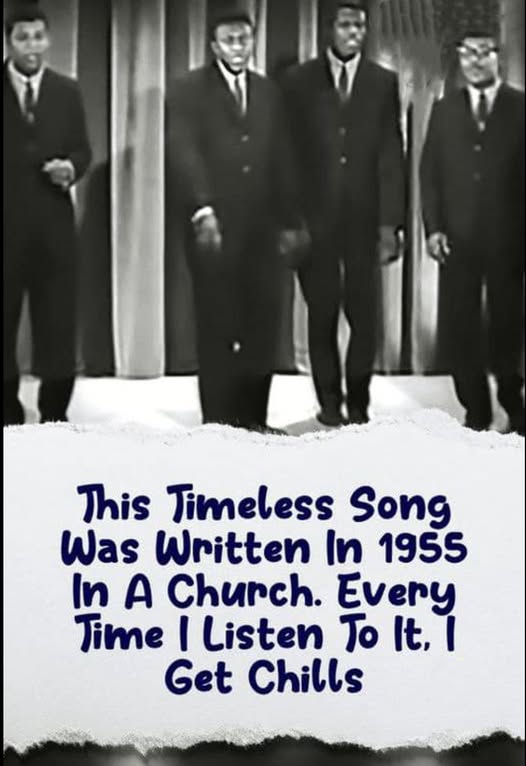
Some songs feel inseparable from memory itself, as though they have always existed, waiting patiently to be discovered by each new generation. “In the Still of the Night” by The Five Satins is one of those rare creations. Its gentle opening syllables and slow, aching harmonies seem to suspend time, carrying listeners back to moments of first love, quiet vulnerability, and tender hope. Though firmly rooted in the doo-wop era of the 1950s, the song has never belonged to just one decade. Instead, it has lived on through dances, films, late-night radio, and deeply personal memories, becoming a shared emotional language across ages.
The story of the song begins not in a professional studio, but in the heart of a young man overwhelmed by love. In 1956, Fred Parris was only nineteen years old and serving in the U.S. Army, stationed in Philadelphia. Like many young soldiers, he lived between discipline and longing, duty and desire. His girlfriend Marla lived back in Connecticut, and after spending a precious weekend together, Parris returned to camp emotionally shaken by the separation. That emotional intensity, still raw and unfiltered, became the fuel for creation. Sitting alone at a piano in the camp’s day room, he began shaping the chords and lyrics that would soon become immortal. Later, during a cold night of guard duty beneath a starlit sky, the song’s mood fully crystallized. It was not written with commercial ambition in mind, but as a private attempt to hold onto a feeling that already seemed fragile.
What makes “In the Still of the Night” so powerful is the honesty embedded in its simplicity. Parris did not try to intellectualize love or dramatize heartbreak. He simply expressed what it felt like to be young, in love, and acutely aware that moments can slip away without warning. Years later, he would explain that while there were many nights spent together, there was only one first time. That awareness of emotional firsts—moments that can never be repeated—gives the song its quiet gravity. It speaks not just of romance, but of memory itself, of the human instinct to pause time and savor what cannot last.
When it came time to record the song, the circumstances were as modest as the writing process. Later that same year, Parris and his group, The Five Satins, gathered in the basement of St. Bernadette’s Church in New Haven, Connecticut. There was no polished studio, no advanced equipment, and no expectation that the session would produce a classic. The space was cold, the setup basic, and the tools limited to a couple of tape recorders. Yet the church basement provided something technology could not: natural acoustics and an atmosphere that encouraged sincerity. The voices echoed softly against concrete walls, blending into harmonies that felt intimate, reverent, and strangely timeless.
Parris would later say that recording the song in a church felt like a blessing, and in hindsight, it is hard not to agree. The performance captures a rare balance between restraint and emotion. His lead vocal is tender rather than showy, while the group’s harmonies wrap around it like a shared confession. Nothing feels forced. Every note seems to exist exactly where it belongs. The result was a recording that sounded less like a product and more like a moment preserved, fragile but enduring.
Commercially, the song achieved respectable success, reaching number 24 on the Billboard Hot 100. Yet its cultural impact far exceeded its chart position. Ironically, the love that inspired it did not last. Marla eventually traveled to California to visit her mother and never returned, a quiet ending to a relationship that had sparked one of music’s most enduring declarations of affection. But the song outlived that personal loss, transforming private heartbreak into something universal. Listeners did not need to know the backstory to feel its truth. They heard their own memories in its slow rhythm and gentle refrain.
Over time, “In the Still of the Night” became woven into the fabric of American culture. Its opening “shoo-doo-shoo-be-doo” instantly evokes images of sock hops, slow dances, and dimly lit gymnasiums where young couples swayed nervously, discovering closeness for the first time. The song’s emotional clarity made it endlessly adaptable, inviting reinterpretation without losing its soul. Artists across decades—from The Beach Boys to Debbie Gibson to Boyz II Men—covered it, each adding their own style while preserving the song’s emotional core. Its appearances in films like Dirty Dancing and The Irishman introduced it to new audiences, reinforcing its role as a shorthand for nostalgia, intimacy, and reflection.
Fred Parris lived long enough to witness the extraordinary afterlife of his youthful creation. Before his passing in 2022 at the age of 85, he often reflected on how a song written in a moment of longing had traveled far beyond anything he could have imagined. What began as a personal expression of love became a shared emotional experience for millions. That transformation speaks to the power of sincerity in art. “In the Still of the Night” does not endure because it is complex or innovative, but because it is honest.
More than just a classic recording, the song stands as a testament to the emotional depth of doo-wop itself—a genre sometimes dismissed for its simplicity, yet capable of capturing profound human truths. Listening to it feels like opening a window into another time, where emotions were expressed openly and vulnerability was not hidden behind irony or noise. Each note carries the weight of a moment once lived and never repeated.
For listeners discovering it for the first time, “In the Still of the Night” offers more than nostalgia. It offers recognition. It reminds us that love, longing, and memory are timeless experiences, unchanged by technology or era. In a world that moves increasingly fast, the song invites stillness, asking us to pause and remember the moments that shaped us. And in that quiet space, its magic continues to live.