For most travelers today, airport security has settled into a familiar, if mildly stressful, routine. Shoes come off, laptops come out, liquids are separated, and passengers step briefly into a scanner that produces a vague, almost cartoon-like outline before sending them on their way. The process feels impersonal, standardized, and largely harmless. Yet not long ago, the experience was far more invasive in ways many passengers never fully understood at the time. In the years following the 2009 attempted Christmas Day bombing, airport security changed rapidly, driven by urgency, fear, and political pressure. What emerged was a form of body scanning technology that revealed far more than most travelers realized, sparking one of the most significant privacy controversies in modern aviation history—one that still unsettles people when they learn the full truth years later.
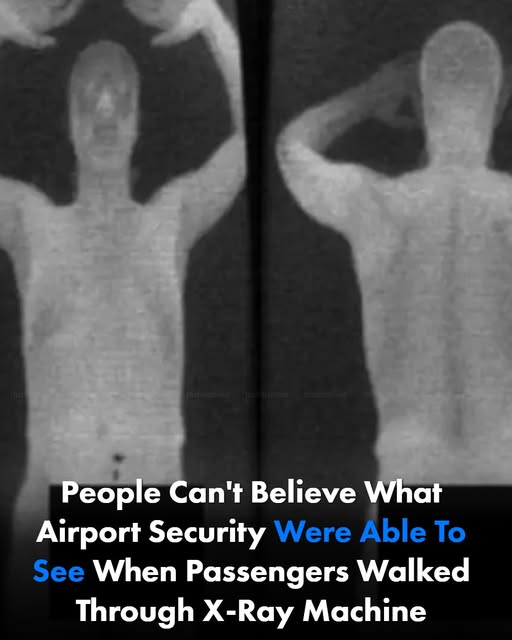
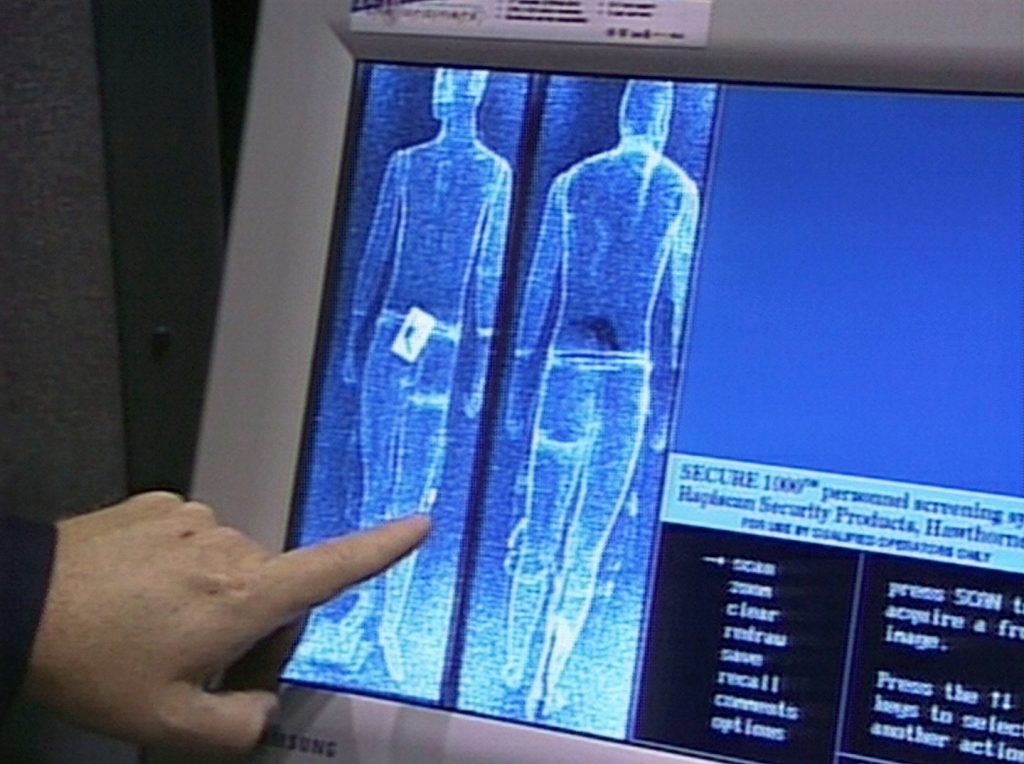
The scanners at the center of the controversy were known as backscatter X-ray machines. Unlike today’s systems, which rely on millimeter-wave technology and abstract imaging, backscatter scanners used low-level X-rays to create detailed images of the human body beneath clothing. These images were not simple silhouettes. They revealed outlines of breasts, buttocks, genitals, and body contours with startling clarity. While faces were often blurred and officials insisted images were not stored, the level of anatomical detail shocked privacy advocates once it became public knowledge. Many passengers, stepping into the machines under the assumption they were undergoing a neutral safety check, had no idea they were effectively being rendered naked on a screen somewhere behind the scenes.
The Transportation Security Administration defended the scanners as a necessary response to evolving threats. After the 2009 incident, where explosives were hidden in underwear rather than luggage, pressure mounted to detect non-metallic weapons concealed on the body. Traditional metal detectors were no longer sufficient. Backscatter technology, already tested in limited settings, appeared to offer a solution. The machines were expensive—costing roughly $180,000 each—but they promised enhanced detection capabilities at a time when public anxiety about flying was still high. Within a few years, more than 170 units were installed across major U.S. airports, quietly transforming the passenger screening experience without widespread public debate or informed consent.
As awareness grew, discomfort turned into outrage. Travelers began questioning how such technology had been introduced with so little transparency. Civil liberties organizations raised alarms, arguing that the scanners crossed a fundamental boundary between security and bodily privacy. The phrase “virtual strip search” entered the public vocabulary, capturing not only the visual reality of the scans but the emotional violation many people felt upon learning what had been done in their name. The TSA emphasized that officers viewing the images were stationed in separate rooms and could not see the passenger directly, but for many critics, that reassurance missed the point. Privacy, they argued, is not preserved simply because the observer is anonymous.
The controversy exposed a deeper issue: how fear can accelerate technological adoption without sufficient ethical safeguards. In moments of perceived crisis, societies often accept measures they would otherwise reject, trusting authorities to balance protection with restraint. In this case, that balance faltered. Internal documents later revealed that some scanners were technically capable of storing images, despite public assurances to the contrary. In at least one documented case, thousands of images were retained during testing. Even if such storage was not standard practice, the mere possibility undermined public trust. Once people realized how much had been hidden behind reassuring language and technical jargon, confidence in airport security leadership eroded.
Pressure mounted for reform, and in 2013, a turning point arrived. New federal privacy requirements mandated the use of Automated Target Recognition software, which eliminated detailed body images in favor of generic outlines highlighting potential threat areas. This technology allowed officers to detect anomalies without seeing a passenger’s anatomy. When Rapiscan, the manufacturer of many backscatter machines, failed to upgrade its systems to comply with the new standard, the TSA removed the scanners entirely from passenger screening. Their disappearance was quiet, almost anticlimactic, but the relief among privacy advocates was palpable. The machines that once revealed so much were gone, replaced by technology designed to see less while still protecting more.
Modern millimeter-wave scanners, now standard in airports, operate on fundamentally different principles. They use radiofrequency waves rather than X-rays and rely heavily on software interpretation rather than raw visual output. The result is an abstract, gender-neutral figure on a screen, with highlighted zones indicating where further screening may be needed. Officers no longer see bodies; they see data. This shift reflects not only technological progress but a philosophical recalibration. Security systems began acknowledging that effectiveness does not require exposure, and that dignity can coexist with vigilance when design priorities change.
For many travelers, learning about the old scanners years later feels unsettling precisely because it challenges assumptions about oversight and consent. Most people complied without protest, trusting that the process was reasonable and proportionate. The realization that this trust was misplaced—even temporarily—forces uncomfortable questions. How often do similar trade-offs occur without public awareness? How many technologies are adopted in moments of fear, only to be reconsidered once emotions cool and consequences become clearer? The backscatter scanner episode serves as a cautionary tale, illustrating how quickly norms can shift when urgency overrides deliberation.
The story also highlights the power of public scrutiny. Without advocacy groups, investigative journalists, and persistent questioning, the scanners might have remained in use far longer. Change did not come from within the system alone; it was demanded from outside. This dynamic underscores an essential truth in democratic societies: security institutions, however well-intentioned, require continuous oversight. Technology does not exist in a moral vacuum. Every design choice reflects values, whether acknowledged or not, and those values must be challenged when they drift too far from public expectations.
Ultimately, the legacy of the old airport body scanners is not defined by the machines themselves, but by the lesson they left behind. Privacy, once compromised, is difficult to fully restore. Trust, once shaken, takes time to rebuild. The scanners are gone, replaced by systems that better respect personal boundaries, but the memory lingers. It reminds us that progress is not merely about innovation, but about wisdom—about knowing when to pause, question, and ask not just what technology can do, but what it should do. In that sense, the shock people feel today is not just about what was seen, but about what was nearly normalized without consent.