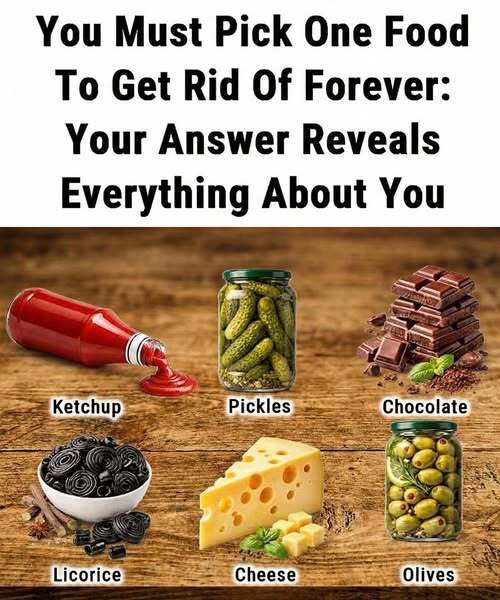
Imagine being asked a question that seems playful on the surface but quickly turns profoundly personal: if you could eliminate only one food from your life forever, which would it be? No exceptions, no special occasions, no “just this once,” and no opportunity to change your mind later. At first, it may feel like a harmless game to share with friends over coffee or in a social media post. Yet as the thought lingers, it becomes far more revealing than most realize. Food is never just sustenance. Each bite carries memory, emotion, routine, and comfort. The items we relinquish and the ones we protect illuminate more than our tastes—they reflect priorities, temperament, and even values. As we consider what we could live without and what we could not, a subtle map of ourselves begins to emerge.
Take ketchup, for instance. For some, giving it up would be effortless. Those who can let ketchup go without hesitation often exhibit adaptability and simplicity in their daily lives. They are comfortable experiencing things as they are, unadorned, and find satisfaction without relying on familiar additions to ease or enhance their experience. Conversely, those who cannot imagine a world without ketchup—whether on fries, eggs, or burgers—often value consistency and predictability. A familiar taste provides comfort, a small anchor in the routine of life, a touchstone in otherwise unpredictable days. Ketchup, in this way, becomes a symbol not of indulgence but of security, routine, and emotional stability, illustrating how even the simplest condiments can connect deeply to how we navigate the world.
Pickles tell an entirely different story. Their sharp, unmistakable bite polarizes opinion. Choosing to give them up may suggest a preference for calm, balance, and harmonious experiences. People who avoid pickles may favor smoother, less confrontational sensations both in taste and in life. On the other hand, those who treasure pickles, who embrace their acidity and intensity, often demonstrate boldness, expressiveness, and a willingness to stand out. These individuals may enjoy strong sensations, whether in culinary experiences or in daily life, and approach challenges with curiosity rather than caution. The decision to keep or discard a pickle is rarely about the vegetable alone—it reflects the underlying personality traits that shape how someone responds to intensity, novelty, and even confrontation.
Chocolate, however, carries profound emotional significance. Giving it up can be a marker of self-discipline, independence, and an ability to derive comfort from sources beyond indulgent treats. It suggests someone who can regulate impulses, delay gratification, and find satisfaction in non-sensory rewards. Meanwhile, for those who cannot imagine life without chocolate, the connection is deeply tied to memory, emotion, and comfort. Chocolate becomes more than candy; it is ritual, nostalgia, and reward. It can serve as a moment of self-care after a long day, a shared pleasure with loved ones, or a comforting taste that recalls warmth and affection. The decision to keep chocolate close reflects the human need for sensory reassurance, emotional indulgence, and continuity in small pleasures amidst the rhythm of everyday life.
Licorice, cheese, and olives add further nuance to this exercise. Licorice, with its polarizing flavor, represents individuality. Those willing to give it up may exhibit flexibility and the willingness to adapt to social norms or group preferences, while those who embrace it despite widespread dislike show confidence in their identity and tastes. Cheese, often tied to tradition and shared meals, reflects connection, culture, and emotional bonds. To relinquish it may demonstrate discipline, restraint, and the prioritization of long-term goals over immediate pleasure. Olives, with their acquired taste, signal patience, appreciation for subtlety, and an acceptance of complexity. Choosing to keep them may reveal maturity and a willingness to embrace nuanced experiences, while discarding them could indicate a preference for straightforward pleasures and intuitive choices. Together, these foods offer a rich palette through which personality traits, life values, and emotional wiring subtly reveal themselves.
Ultimately, the exercise of imagining life without a single food is far more than a casual question or social media challenge—it is a reflection, a mirror held up to the subtle ways we construct comfort, identity, and habit. Food connects to memory, routine, emotional regulation, cultural heritage, and personal expression. What we sacrifice and what we preserve exposes our priorities, reveals our emotional coping mechanisms, and highlights the small yet persistent rituals that shape our daily lives. It reminds us that choices, even seemingly trivial ones, are rarely neutral; they are imbued with personality, context, and history. Whether someone abandons a tangy pickle or fiercely clings to chocolate, the decision speaks volumes about how they navigate life, handle pleasure, and negotiate the familiar versus the unfamiliar.
In the end, there is no “right” or “wrong” answer. The food you would give up, and the one you would never sacrifice, paints a story unique to you. It reflects values, habits, emotional anchors, and personal identity, all wrapped up in a seemingly simple question. By exploring this playful thought experiment, we gain insight into the intricate relationship between food and self—how taste, memory, comfort, and ritual intersect to shape behavior and personality. So if you truly had to choose, what would you let go of, and what might that choice reveal about the person you are, how you cope, and the pleasures you refuse to surrender? It is more than a puzzle—it is a window into the everyday choices that define us, quietly and consistently, bite by bite.