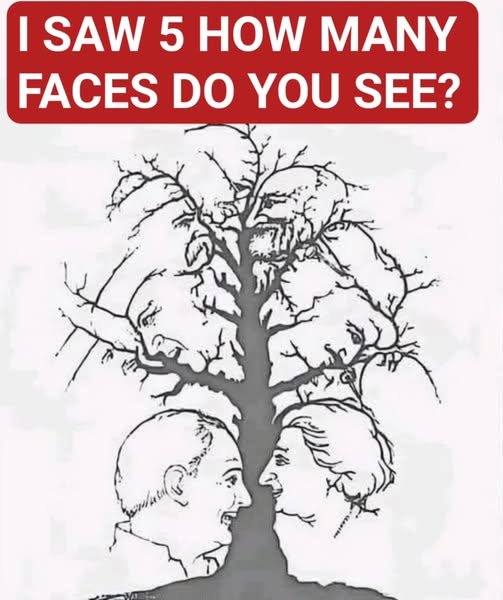
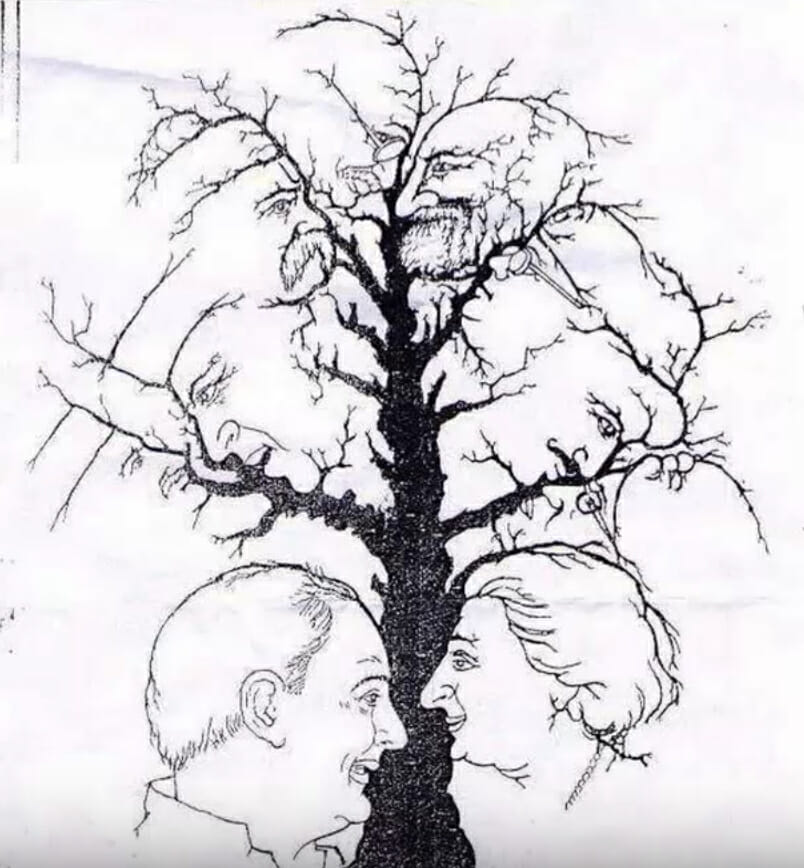
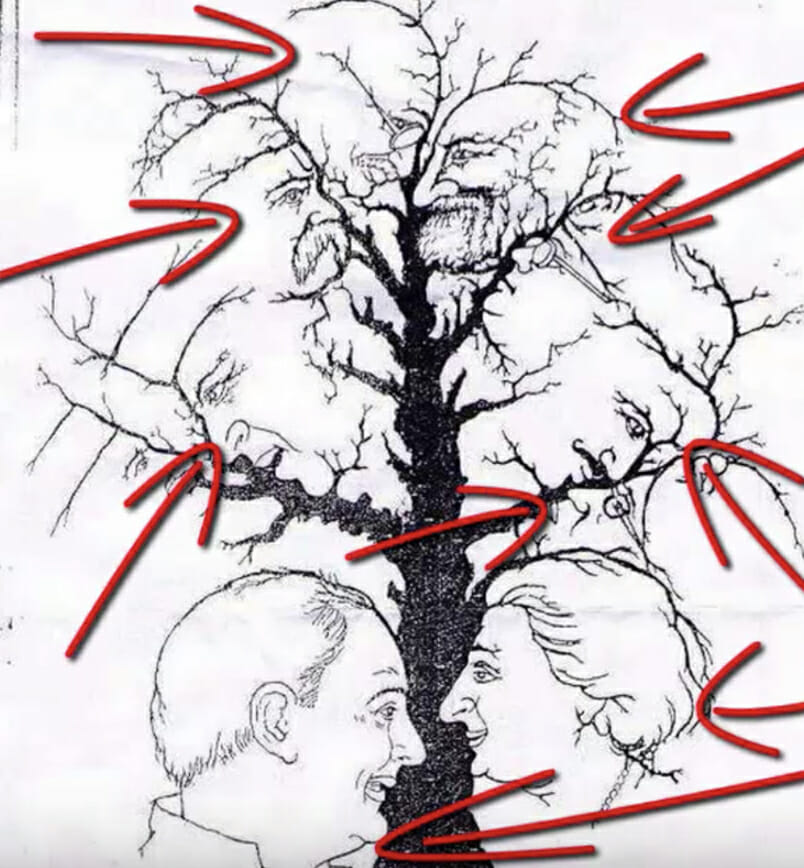
Optical illusions have a peculiar way of pulling us in. They promise a simple challenge, yet almost immediately expose how unreliable our own perception can be. One such image, often referred to as the “National Leaders Tree,” has circulated online for years, daring viewers to find all the hidden faces woven into the bark, branches, and shadows of a single tree. At first glance, the image appears straightforward: a tree with two clearly visible faces near its base. But as the eye lingers, more shapes begin to emerge—profiles formed by negative space, eyes suggested by knots in the wood, and faces implied rather than drawn outright. What begins as a casual glance quickly turns into a focused search, as viewers realize the image rewards patience, imagination, and a willingness to question what they think they see.
The appeal of this illusion lies in how it exploits the brain’s natural tendency to seek order and meaning. Human beings are hardwired to recognize faces; it is one of the earliest and strongest visual skills we develop. This ability, known as pareidolia, allows us to see faces in clouds, rock formations, and even electrical outlets. In the case of the tree illusion, the artist intentionally arranges lines, shadows, and contours to trigger this instinct. The two faces at the bottom act as an anchor, subtly instructing the brain to look for more. Once that instruction is accepted, the viewer’s perception shifts, and the tree becomes a canvas of possibilities rather than a static object. Each newly discovered face reinforces the sense that more must be hiding somewhere else, encouraging deeper scrutiny and repeated viewing.
As the image gained popularity online, it became wrapped in layers of interpretation and competition. Social media users began challenging one another, comparing totals and boasting about how many faces they could find. Lists emerged claiming that the number of faces spotted revealed something meaningful about a person’s memory or cognitive health. According to these interpretations, seeing only a few faces suggested poor memory, while spotting many supposedly indicated exceptional mental sharpness. Some versions went further, implying that low numbers could signal serious conditions such as dementia or Alzheimer’s disease. These claims, while provocative, are not supported by scientific evidence. They persist largely because they add drama and personal stakes to what is, at its core, a visual puzzle designed for entertainment.
In reality, the number of faces someone sees in an optical illusion says far more about perception, attention, and experience than about memory or intelligence. Factors such as how long a person studies the image, whether they have seen similar illusions before, and even their mood or level of fatigue can influence what they notice. Some viewers approach the image playfully, scanning quickly and moving on, while others treat it like a challenge, meticulously tracing every line and shadow. Neither approach is more “correct” than the other. The illusion does not contain a universally agreed-upon number of faces, which makes definitive scoring impossible. What one person perceives as a face, another may dismiss as coincidence, highlighting the subjective nature of visual interpretation.
The persistence of claims linking these illusions to memory disorders reflects a broader pattern in viral content: the tendency to attach pseudo-scientific meaning to simple activities. Optical illusions feel authoritative because they appear to reveal something hidden, and people are naturally curious about what their reactions might say about them. However, cognitive health is assessed through structured evaluations, clinical history, and neurological testing, not through how many faces someone sees in a stylized drawing. While puzzles and visual challenges can be enjoyable ways to engage the brain, they should not be mistaken for diagnostic tools. The danger lies not in the illusion itself, but in taking its claims too seriously.
What makes the “faces in the tree” image enduring is not its supposed ability to measure intelligence or memory, but its capacity to remind us how flexible and imaginative human perception can be. It demonstrates how easily the brain fills in gaps, constructs meaning, and adapts to visual cues. The longer you look, the more you see—not because the image changes, but because your interpretation does. This fluidity is not a flaw; it is one of the brain’s greatest strengths. It allows us to navigate a complex world, recognize patterns quickly, and find meaning even in ambiguity.
In the end, the true value of this optical illusion lies in curiosity rather than comparison. Whether you see four faces or fourteen, the experience invites you to slow down and observe how your mind works. It encourages playful engagement rather than judgment, exploration rather than anxiety. The tree does not reveal secrets about your memory, nor does it predict your cognitive future. What it does reveal is something far simpler and more universal: the human brain loves a challenge, delights in patterns, and rarely agrees with itself about what it sees. And perhaps that, more than any score, is the real fascination hidden in the image.