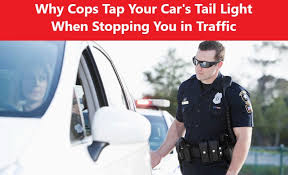
Being pulled over by the police is one of those moments that instantly sharpens awareness. The flashing lights, the slow pull to the shoulder, the quiet ticking of the engine — everything feels amplified. In that brief pause before the officer reaches the driver’s window, many people notice a small but curious action: the officer touches the rear of the car, often the tail light or trunk area. To drivers, this can seem strange, even theatrical, as if it were a ritual performed without clear purpose. Over time, popular explanations have flourished, especially online, suggesting the touch is meant to leave fingerprints for evidence or to “mark” the vehicle in case something goes wrong. While these explanations sound plausible and dramatic, the real reasons behind this practice are more practical, grounded in safety, training, and decades of policing experience shaped by risk, unpredictability, and human behavior.
At its core, the tail light touch is about officer safety, particularly during what law enforcement professionals consider one of the most dangerous routine tasks in policing. Traffic stops are inherently unpredictable. An officer has limited information, minimal control over the environment, and no way of knowing how a driver or passengers might react. Approaching a vehicle from behind exposes the officer to traffic, blind spots, and sudden movements from inside the car. By briefly touching the rear of the vehicle, the officer confirms that the trunk is fully closed and secure. Historically, this mattered more than many modern drivers realize. In earlier decades, ambushes involving suspects hiding in trunks were not unheard of, and training emphasized checking the rear of the vehicle without lingering. Even today, the action provides a quick tactile confirmation that nothing is shifting or opening unexpectedly, allowing the officer to proceed toward the driver’s window with slightly more confidence and awareness.
Another important aspect of the gesture lies in physical orientation and situational awareness. Policing is as much about body positioning as it is about authority or enforcement. Touching the vehicle helps the officer establish a reference point, particularly at night, in poor weather, or on uneven terrain. This brief contact allows the officer to maintain a sense of distance and alignment as they walk forward, keeping their body positioned safely away from traffic and angled to observe the interior of the vehicle. It also reinforces muscle memory developed through training, helping officers move in a controlled, deliberate way rather than rushing forward blindly. In high-stress environments, small grounding actions like this can improve reaction time and reduce mistakes, which is why such habits persist even when drivers may not understand their purpose.
The idea that officers touch tail lights to leave fingerprints, while popular, is largely a misconception rooted in crime television and internet storytelling. From a forensic standpoint, exterior vehicle surfaces are poor candidates for usable fingerprints. Tail lights, trunks, and body panels are exposed to dust, heat, cold, rain, and constant contact, all of which degrade prints quickly. Modern law enforcement does not rely on accidental fingerprints left during traffic stops to establish evidence or timelines. Instead, accountability now comes from far more reliable sources: body-worn cameras, dashboard cameras, GPS data, radio logs, and detailed written reports. While an officer’s touch technically could leave a fingerprint, it is neither intentional nor useful in most real-world investigations. The persistence of this myth speaks less to police procedure and more to public fascination with hidden meanings and secret tactics.
There is also a subtle psychological dimension to the practice, one that has evolved over time. In older training models, officers were sometimes taught that a brief touch on the vehicle could momentarily alert or startle the driver, providing a split-second opportunity to observe reactions. Sudden movements, stiff posture, or frantic behavior could signal nervousness, intoxication, or attempts to hide contraband. While modern policing relies far less on such tactics and more on observation and communication, remnants of these methods still exist in training culture. Many officers continue the tail light touch not because they consciously analyze its benefits, but because it has become a deeply ingrained habit — a small pause before engagement that mentally prepares them for the interaction ahead.
As technology has transformed policing, the original practical need for the tail light touch has diminished, but the behavior itself has not disappeared. Body cameras now record nearly every step of a traffic stop, offering transparency and protection for both officers and civilians. Dash cameras capture vehicle positioning, lighting conditions, and driver behavior long before the officer exits the patrol car. In this context, touching the vehicle no longer serves as documentation or proof of presence. Instead, it functions as a transitional moment — the shift from observation to interaction. For many officers, it marks the mental boundary between assessing the scene from a distance and engaging directly with the driver, reinforcing focus and caution at a critical moment.
Ultimately, the act of touching a car’s tail light during a traffic stop is not random, symbolic, or sinister. It is a small, practical behavior shaped by decades of training, safety concerns, and the realities of working in unpredictable environments. While myths about fingerprints and secret evidence continue to circulate, the truth is far simpler and more human. The gesture reflects caution, habit, and an effort to manage risk in a profession where routine encounters can change in an instant. What drivers perceive as an odd or unnecessary tap is, in reality, a quiet reminder of the vulnerability and alertness that define one of the most common — and most dangerous — moments in law enforcement work.