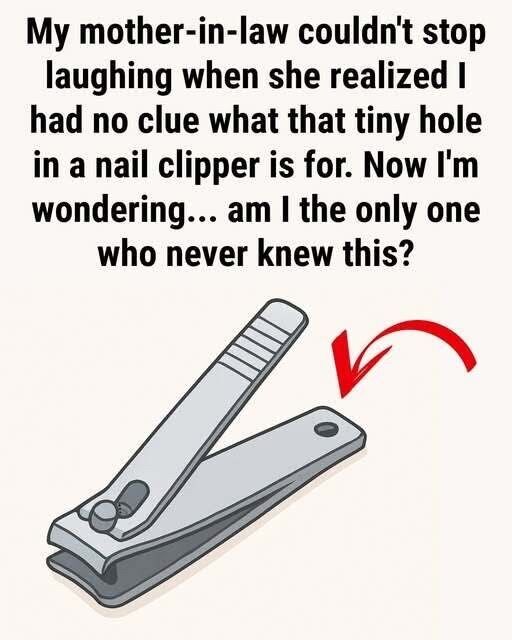
In everyday life, some of the most remarkable examples of human ingenuity are found in the smallest, most overlooked objects. The nail clipper is a prime example: a tool so ubiquitous that it rarely attracts conscious attention, yet so thoughtfully designed that each feature reflects decades of refinement. Among these details, the tiny circular hole at the end of its lever stands out not for its prominence, but for its quiet practicality. While most people never register its existence, this small opening embodies a confluence of history, ergonomics, portability, and industrial efficiency, demonstrating that even the simplest tools carry stories of deliberate thought and careful design. Examining this single feature reveals how minor details can have outsized impacts on everyday life, bridging centuries of design evolution with contemporary habits.
The most immediately noticeable function of the hole lies in portability and organization, concerns that have persisted since the nail clipper’s earliest iterations. By threading a split ring, lanyard, or chain through the hole, the clipper transforms from a small, easily misplaced object into a portable, accessible accessory. This capability aligns perfectly with modern routines, where convenience and accessibility are highly valued. Whether attached to a keychain, tucked in a travel bag, or hung in a grooming kit, the clipper becomes immediately retrievable when needed. This tiny design solution solves a universal problem: ensuring that small personal grooming items are not lost at the most inconvenient moments. By anticipating user behavior and providing a simple, elegant fix, the hole exemplifies thoughtful design that enhances daily life without calling attention to itself.
Beyond portability, the hole offers subtle ergonomic advantages that are often overlooked. For users with limited hand strength or dexterity, the hole can serve as an additional point of control, allowing a finger to stabilize the clipper or apply leverage when trimming thick nails. This feature reduces the risk of slipping and increases precision, making the task safer and more comfortable. In multi-user households, the hole can also be used to group clippers together while keeping them distinct from one another. These quiet, practical benefits demonstrate how a single design element can expand functionality without complicating the object’s form. The clipper remains elegantly simple while accommodating a wide spectrum of needs, proving that small adjustments can have significant ergonomic impact.
The origins of this small design element trace back over a century, to a time when portability was essential for personal grooming tools. In the late 1800s and early 1900s, people often carried essential items on their person—pocket watches, small knives, and grooming implements alike. Nail clippers needed to be accessible throughout the day, and the hole allowed them to be fastened to chains or chatelaines. This historical necessity explains the feature’s persistence: as lifestyles shifted and households gained space for storage, the hole remained, a functional relic from a time when personal items traveled with their owner. Its continued presence is a testament to how design solutions that address real human needs can survive social and technological changes.
As industrial manufacturing evolved, the nail clipper became more widely accessible, affordable, and standardized. Advances in metal stamping, hinge mechanisms, and material finishes allowed production to scale, but the hole remained, serving both user and manufacturer. It assists in alignment during assembly, facilitates consistent handling, and contributes to quality control. Unlike decorative elements that may fade in popularity, the hole delivers practical value at every stage of the product’s life, demonstrating a principle of industrial design: features that serve multiple purposes endure. The nail clipper, in this sense, exemplifies restraint and refinement, favoring simple, reliable functionality over constant reinvention or embellishment.
Ultimately, the small hole on a nail clipper is more than a minor design quirk—it is a quiet testament to thoughtful engineering and human-centered innovation. It improves portability, usability, and manufacturing efficiency without ever calling attention to itself. In an era dominated by complex gadgets and flashy technology, the nail clipper serves as a reminder that effective design often goes unnoticed. Its endurance and continued relevance highlight the power of subtle, intentional design decisions, proving that even the humblest objects can hold profound purpose. Every time the lever is lifted, every time the clipper is retrieved from a keychain or grooming kit, the hole quietly fulfills its century-old role, shaping daily habits with remarkable, unobtrusive utility.