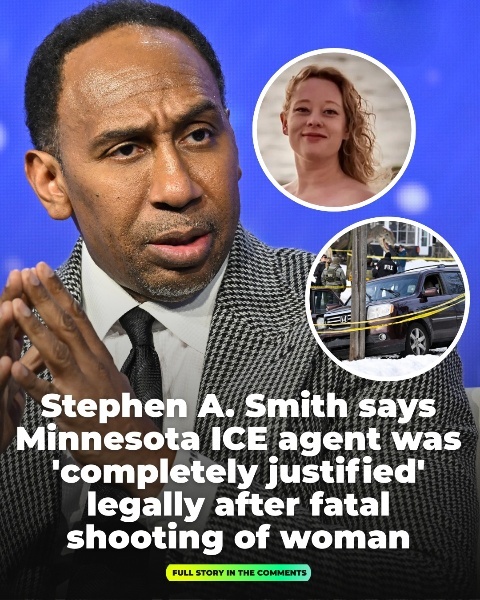
Stephen A. Smith, a high-profile sports commentator and media personality, made headlines in late January 2026 after publicly weighing in on a deeply controversial ICE operation in Minneapolis that ended in tragedy. A federal ICE agent fatally shot 37-year-old Renée Nicole Good during an enforcement action, sparking heated debate over the legality and morality of the encounter. In his widely circulated commentary, Smith stated that, from a strictly legal standpoint, the agent’s use of lethal force was “completely justified,” highlighting the narrow parameters under which federal officers are permitted to employ deadly measures. His words immediately polarized viewers, with supporters praising his adherence to legal reasoning and critics decrying what they saw as a dismissal of human life and ethical responsibility. The statement ignited discussion across television, social media, and mainstream news outlets, prompting a reexamination of both the rules that govern federal enforcement and the moral responsibilities inherent to positions of authority. Smith’s framing emphasized the distinction between lawful action and moral consequence, sparking an essential, if uncomfortable, national conversation about how the law interprets force and how citizens interpret justice.
The circumstances surrounding the shooting have been widely documented and scrutinized. On January 7, 2026, ICE agents, operating in south Minneapolis, attempted to detain Good during a federal immigration enforcement action. Reports indicate that Good attempted to evade the officers in a vehicle, leading to a confrontation that resulted in the agent discharging their firearm. Federal authorities immediately characterized the incident as an act of self-defense, asserting that the vehicle posed a threat to the officers’ safety. Eyewitness accounts, however, present a more complex picture, with neighbors and local officials disputing the necessity and proportionality of lethal force. Video footage and body camera recordings, when released under federal supervision, showed the tense sequence of events, revealing the rapid escalation and the seemingly instantaneous split-second decisions officers faced. Local leaders, including Minneapolis Mayor Jacob Frey, expressed grave concern over the use of deadly force and called for a thorough, transparent investigation, emphasizing the need for accountability. The case has become emblematic of broader tensions between federal enforcement operations and community trust, particularly in urban areas with diverse populations and histories of fraught police-community relations.
From a legal perspective, the framework under which ICE agents operate is both expansive and restrictive. Federal law grants agents considerable leeway to use force in situations deemed immediately dangerous to themselves or others. This standard, often referred to in legal terms as “objectively reasonable use of force,” provides immunity from prosecution when the agent’s actions align with established guidelines and perceived threats. Stephen A. Smith, in his commentary, stressed this aspect, noting that prosecuting the agent under state law would likely fail because federal agents enjoy qualified immunity for acts undertaken during the course of official duties. Yet, the very existence of such protections has become a flashpoint in public debate, raising questions about whether the law sufficiently safeguards citizens’ rights and whether it adequately balances the moral imperative to preserve life. Critics argue that legal justification alone cannot address the human cost of these actions, particularly in situations where alternative, non-lethal options may have been available, such as disabling a vehicle or employing tactical containment measures.
Public reaction to both the incident and Smith’s commentary has been intense and multifaceted. Social media platforms exploded with commentary, ranging from support for Smith’s emphasis on legal correctness to outrage over what many perceived as an insensitivity to the death of an innocent civilian. Advocacy groups focused on immigrant rights highlighted systemic issues, including the risks posed by aggressive enforcement operations and the challenges faced by local communities in navigating federal authority. Families and friends of Good spoke to the media, emphasizing her life, character, and the shock of losing her in such a sudden, violent manner. Community organizers called for reforms, including independent oversight of federal agents operating in local jurisdictions and stricter use-of-force protocols. The coverage underscored the profound emotional and societal consequences of law enforcement actions, illustrating how a single incident can ripple across neighborhoods, media ecosystems, and national discourse, leaving citizens grappling with fear, anger, and the urgent desire for accountability.
The debate also highlights the tension between law and morality in public discourse. Smith’s insistence that the agent acted within legal parameters does not erase the ethical questions raised by the shooting. Was the use of lethal force truly necessary? Could alternative methods have preserved life while maintaining officer safety? These are the questions fueling discussion in think tanks, law schools, and online forums, reflecting the broader challenge of reconciling legal frameworks with communal values. Philosophers, ethicists, and legal scholars argue that legality does not equate to moral righteousness, and the incident has sparked renewed interest in public policy approaches that prioritize de-escalation, crisis intervention, and transparency in enforcement actions. Smith’s commentary serves as a case study in the power of media figures to shape perceptions of justice, demonstrating how framing an event in terms of legality versus ethics can simultaneously clarify and complicate public understanding.
Finally, the Minneapolis ICE shooting, Smith’s remarks, and the ensuing public debate underscore the intricate dynamics of federal enforcement, media influence, and societal expectations. It exemplifies how high-profile commentators can amplify existing tensions, forcing a nation to confront uncomfortable realities about authority, power, and the human impact of law. Beyond the immediate tragedy, the incident has prompted discussions about the need for independent review boards, standardized use-of-force protocols, and a reevaluation of qualified immunity policies for federal agents. As investigations continue and communities mourn, the case will likely remain a reference point in debates about law, morality, and governance. It serves as a reminder that legality, while essential, is only one dimension of justice, and that ethical reflection, public accountability, and human empathy are equally vital in evaluating the decisions of those entrusted with power. The controversy initiated by Smith’s statements reveals a society grappling with the complex interplay between rules, conscience, and the expectations of the public — a conversation that is far from concluded.