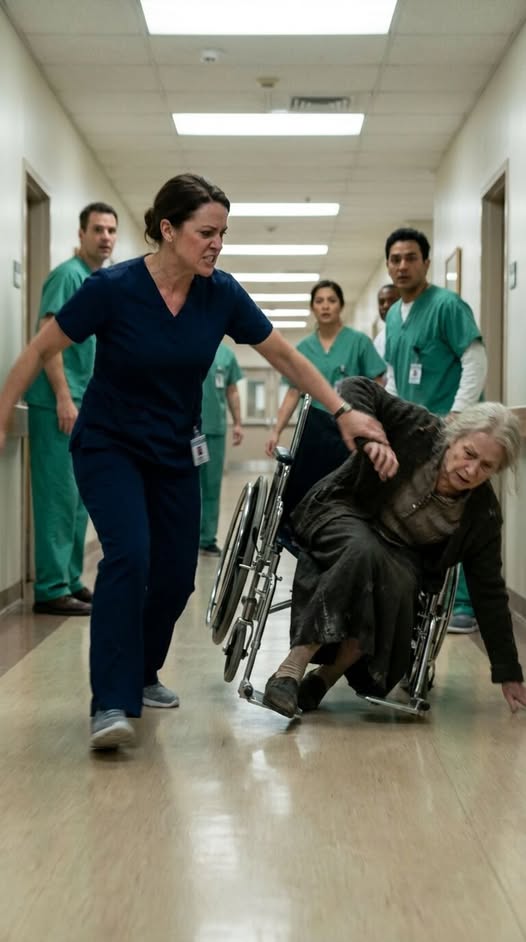
The lobby of St. Jude’s Memorial Hospital did not feel like a place of healing. It smelled of chemical polish and institutional indifference, a space designed for efficiency rather than mercy. Beneath the harsh fluorescent lights, my mother, Clara Miller, looked smaller than I had ever seen her. At seventy years old, she sat hunched in a wheelchair, fingers gripping the edge of her lilac cardigan as if it were armor. Her breathing was shallow, uneven, the oxygen tank beside her a fragile lifeline. She spoke softly, apologetically, to the woman towering over her, explaining that a transfer was delayed and that her son would arrive soon. It was the kind of explanation born of fear—fear of being dismissed, of being reduced to a problem instead of a person. Around them, the waiting area fell quiet, not out of concern, but out of practiced avoidance, the kind that develops in places where suffering becomes routine.
Nurse Brenda Vance, Head of Surgery, did not lower her voice. She did not soften her expression. She treated my mother not as a patient but as an embarrassment. Her words were sharp, public, and deliberately humiliating. She spoke of overdue balances, of private institutions not being shelters, of a “so-called successful son” who was surely irresponsible or imaginary. When a younger nurse tried to intervene, Brenda silenced her with a look that carried years of unchallenged authority. She grabbed the wheelchair and pulled it toward the exit as if discarding trash. My mother begged, reminding her she needed oxygen, her voice cracking with panic. The response was cruel efficiency. During the struggle, my mother’s purse spilled open, scattering peppermint candies and a worn photograph across the floor. When she tried to stop the chair, Brenda struck her—an open-handed slap that echoed in the lobby. In that moment, something fundamental broke. The room froze, not in outrage, but in fear. Brenda stood over her, already preparing to rewrite the moment as insubordination, already threatening security.
The automatic doors opened then, and I walked in. I saw everything at once: the scattered candies, the broken glasses, the red mark on my mother’s cheek. Two men in tailored suits followed me, but it was not their presence that shifted the room—it was recognition that power had entered, even if its source was not yet understood. Brenda’s posture changed instantly. Her voice turned syrupy, her smile artificial. She spoke of “non-compliance,” of procedure, of misunderstandings. I did not respond to her performance. I knelt beside my mother, took her trembling hands, and told her I was there. She whispered my name, confused and hurt, saying she had been told I was not coming. When I stood, I did not raise my voice. I asked a single question, quietly, precisely, the way one asks a question that already contains its own answer. I asked her if she knew whose name was on her paycheck. The smile vanished. The folder my assistant held contained proof of a finalized merger—Miller Capital now owned St. Jude’s. The balance she mentioned no longer existed. Her authority evaporated in real time.
What followed was not shouting or spectacle, but consequences. Security escorted her out. An abuse report was initiated. The licensing board would be notified. I moved my mother to a private suite, assigned her a compassionate nurse, and ensured she was safe before turning my attention to the institution itself. This was not about revenge alone. It was about a system that allowed cruelty to masquerade as policy. In administration offices thick with panic, executives scrambled to justify prioritizing profit over patients. I ordered audits, uncovered shell companies, exposed bonuses funded by stripped care and delayed treatments. Resignations came quickly when evidence was placed in front of them. Authorities waited downstairs. By dawn, St. Jude’s felt different—not redeemed, but interrupted. The machinery of indifference had been forced to stop.
When I returned to my mother’s room, she slept peacefully, the bruise on her cheek a quiet reminder of why this mattered. I had spent my life mastering power in finance, learning how systems bend and who they protect. That night, I understood something else: power is meaningless if it does not defend dignity. Hospitals exist to heal, not to humiliate. Titles do not excuse cruelty. Money does not replace humanity. And sometimes, all it takes to expose injustice is a quiet question—asked at the right moment—to remind someone that authority without compassion is nothing at all.