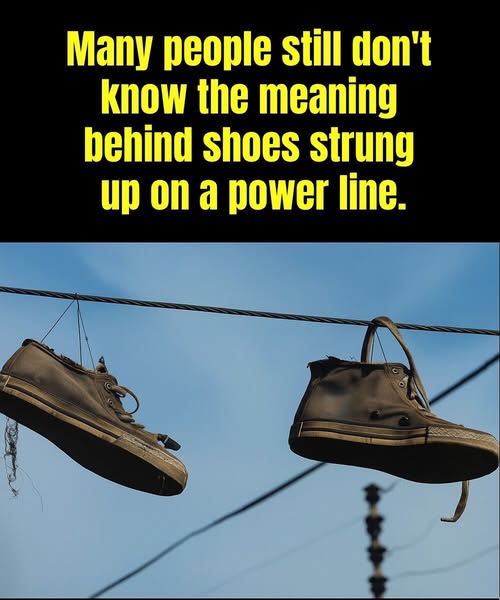
If you have ever walked or driven through a neighborhood and noticed a pair of sneakers dangling from a power line, you are far from alone in slowing down and wondering what, if anything, they are meant to signify. The image is instantly recognizable and oddly compelling: shoes that clearly belong on the ground, suspended high above the street, swaying slightly in the wind. It feels accidental and intentional at the same time, an everyday object placed in a way that defies logic and explanation. Over decades, this sight has sparked countless conversations, debates, and assumptions, turning into a form of modern folklore that exists without a single authoritative origin story. Because the people who toss the shoes rarely explain themselves, observers are left to construct meaning on their own. The result is a shared mystery shaped by rumor, cultural memory, fear, nostalgia, and imagination, with each viewer projecting a different story onto the same silent symbol.
One of the most persistent explanations attached to sneakers on power lines is that they mark gang territory or indicate nearby drug activity. This belief has been reinforced repeatedly through movies, television shows, and sensationalized news reports, embedding itself deeply into public consciousness. For many people, especially those raised hearing warnings about certain neighborhoods, the sight of hanging shoes triggers unease or suspicion. However, studies and statements from law enforcement agencies across multiple countries have consistently pointed out that there is no universal connection between shoes on wires and criminal signaling. While isolated incidents may exist where shoes were used as markers, they are the exception rather than the rule. The endurance of this explanation reveals more about societal anxieties and stereotypes than about the practice itself. When people encounter an unexplained symbol in a public space, especially in urban environments, they often default to narratives of danger, reflecting broader fears about crime, poverty, and unfamiliar communities rather than concrete evidence.
In contrast to fear-based interpretations, many communities understand hanging shoes as memorials—quiet, unofficial tributes to someone who has died. In these cases, the shoes may belong to the person being remembered or symbolize their presence and absence simultaneously. Often associated with young lives lost too soon, these memorials carry a deeply emotional weight. Friends or family members may choose a power line because it offers visibility without formality, a way to honor someone without plaques, ceremonies, or permission. The shoes become a personal marker in a public space, blending private grief with communal awareness. Over time, weather, wind, and gravity eventually bring the shoes down, reinforcing the temporary nature of such tributes. For those who know the story behind a specific pair, the meaning is clear and heavy with emotion. For outsiders, the shoes remain mysterious, their silence masking the pain and remembrance they may represent.
Another explanation often shared traces the tradition to rites of passage, particularly among young people. Some suggest that tossing shoes onto power lines marks milestones such as graduating from school, leaving a neighborhood, completing military training, or ending a significant chapter of life. Whether or not this practice has a single historical origin, the idea resonates because it aligns with how humans have always used symbolic gestures to signal transition. Shoes, objects closely tied to movement and journey, become a fitting metaphor for change. In this context, throwing them upward is less about abandoning them and more about marking a moment that cannot be revisited. Similar rituals appear across cultures, from burning objects to burying them, all serving the same psychological purpose: creating a visible, physical marker for an invisible emotional shift. The power line becomes an accidental stage for these personal declarations, visible to all but fully understood by few.
Of course, not every pair of sneakers hanging overhead carries deep meaning. In many cases, the explanation is far simpler: mischief. Children and teenagers have long entertained themselves by seeing if they can get shoes stuck in hard-to-reach places, driven by boredom, curiosity, or a desire to leave a small mark on their surroundings. The act may start as a joke, a dare, or a spontaneous decision with no thought of symbolism at all. Yet even these moments of casual mischief contribute to the larger mythology. Once the shoes are up there, they enter the same space of speculation as every other pair. Observers rarely know whether they are looking at a memorial, a rite of passage, or a prank. This uncertainty allows even the most meaningless act to be absorbed into collective storytelling, gaining significance simply because it is seen and questioned.
What ultimately makes sneakers on power lines so fascinating is not any single explanation, but the fact that they resist a definitive answer. They occupy a rare space in public life where meaning is entirely fluid, shaped by who is looking and what they believe. In an age saturated with signs, labels, and constant explanations, these silent objects invite curiosity rather than clarity. They remind us that not everything in our environment is meant to be understood immediately, or at all. Sometimes, their value lies in the questions they provoke and the conversations they spark. Whether born of grief, celebration, boredom, or rumor, sneakers hanging from power lines continue to endure as a shared visual mystery—one that connects generations through speculation, storytelling, and the simple human desire to find meaning in the ordinary turned strange.