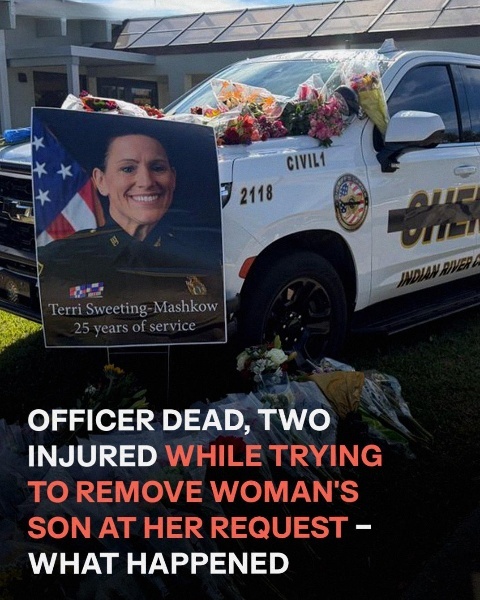
The call came in like countless others that law enforcement officers respond to every day, categorized as routine and carrying no immediate warning of danger. A mother in Vero Beach had asked deputies to come to her home and remove her adult son, a request rooted not in drama but in desperation and concern. These are the kinds of calls officers train for endlessly—calm conversations, careful boundaries, and de-escalation when emotions run high. Deputy Terri Mashkow, a 47-year-old veteran known among her peers for her steady presence and compassionate approach, arrived alongside another deputy and a locksmith. There was no sense of impending violence, no indication that within moments the situation would erupt into chaos. The expectation was paperwork, difficult words, and a resolution that allowed everyone to go home safely. Instead, what unfolded would forever alter the lives of everyone involved and leave an entire community grappling with shock and sorrow.
According to investigators, as the deputies and locksmith attempted to carry out the request, the situation escalated with terrifying speed. Michael Halberstam, the adult son at the center of the call, suddenly armed himself and opened fire. The ambush was swift and devastating. Deputy Mashkow was struck and fell within seconds, her colleagues scrambling to react as gunfire tore through what had been a quiet residential setting moments earlier. The second deputy and the locksmith were both wounded, caught in a situation no one had anticipated. Amid the chaos, return fire stopped the immediate threat, and Halberstam was shot multiple times. He would later die in the hospital, but the damage had already been done. What began as an attempt to protect a woman and restore order had turned into a deadly confrontation, exposing how unpredictable even the most familiar calls can become.
News of Deputy Mashkow’s death spread quickly, sending waves of disbelief through the sheriff’s office and the broader community. Fellow deputies described the moment they learned of her passing as surreal, a numbness settling in as reality slowly took hold. Vigils formed almost spontaneously, with patrol cars lined up in silent tribute and lights flashing not in urgency, but in mourning. Sheriff Eric Flowers addressed the loss with visible emotion, emphasizing that Mashkow had embodied the values of service and compassion that law enforcement strives to uphold. In a solemn ceremony, she was promoted posthumously to the rank of sergeant, a gesture meant not only to honor her dedication but to acknowledge the leadership she demonstrated every day through her actions rather than her title.
Beyond the badge, those who knew Terri Mashkow spoke of a woman whose identity was defined by care and commitment. She was a devoted mother who balanced the demands of a high-risk profession with an unwavering love for her children. Friends and family remembered her as someone who helped others even when she was off duty, often going out of her way to support neighbors, colleagues, and strangers alike. She was known for her warmth, her sense of humor, and what many described as a “heart of gold.” Her dogs, her family, and her community were central to her life, grounding her in a job that often exposed her to humanity’s most difficult moments. To those closest to her, her death was not just the loss of an officer, but the loss of a pillar of strength and kindness.
As the injured deputy and the locksmith began their recovery, questions surfaced that had no easy answers. How could a call deemed routine turn so violent so quickly? Were there warning signs that had been missed, or was this truly an unpredictable act? These questions echoed far beyond the investigation, touching on broader conversations about officer safety, mental health crises, and the risks inherent in responding to domestic situations. Law enforcement officials acknowledged the painful reality that there is no such thing as a truly routine call, only varying degrees of uncertainty. Every knock on a door carries the possibility of danger, even when intentions are peaceful. The incident forced both officers and civilians to confront how thin the line can be between order and tragedy.
In the end, the story of Deputy Terri Mashkow is not solely about the violence that took her life, but about the courage that defined it. One ordinary call, one sudden eruption of violence, and an entire county was reminded of the sacrifices made by those who serve. Her death left behind grief, anger, and unanswered questions, but it also left a legacy of compassion, professionalism, and quiet bravery. As the community continues to mourn, her name stands as a testament to the reality that behind every uniform is a human being—someone who answers the call not knowing what awaits, driven by a commitment to protect others even at the greatest personal cost.