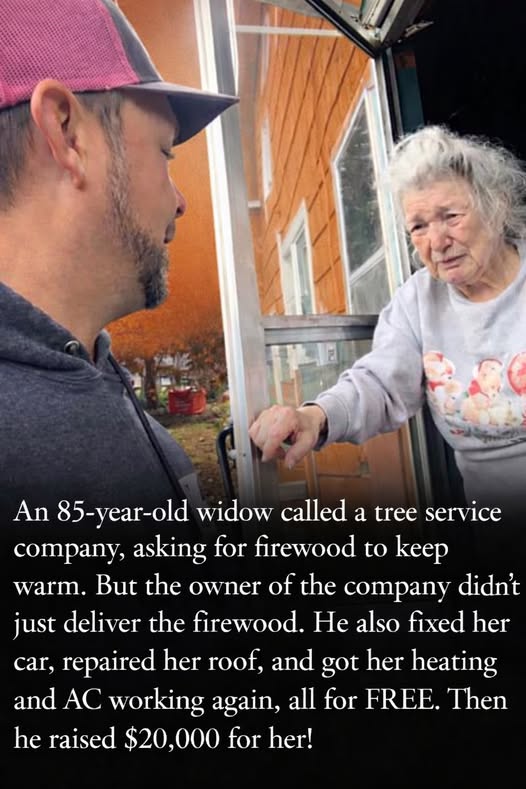
Winter had been creeping closer for weeks, settling into the cracks of an old house where an 85-year-old widow lived alone, listening to the wind scrape against her walls and wondering how much colder it would get before it became unbearable. Her days had grown quiet since her husband passed, marked by careful calculations, rationed groceries, and the constant worry of stretching each check just a little further. Heating costs had risen, her savings were gone, and the stack of firewood she relied on for warmth had dwindled to almost nothing. Pride kept her from asking for help, but survival finally outweighed embarrassment. With trembling hands, she picked up the phone and dialed a local firewood supplier, rehearsing her words so she wouldn’t sound desperate. She wasn’t calling to beg, only hoping she could buy a small load on credit and repay it when her next check arrived. When Paul Brittain answered, she expected a transaction, not compassion, and certainly not a turning point that would alter the course of her winter—and her life.
Paul had taken countless calls like hers before, usually brief and straightforward, but something in her voice made him pause. It wasn’t just age or uncertainty; it was the quiet resignation of someone bracing herself for disappointment. As she explained her situation, apologizing repeatedly for even asking, Paul realized this wasn’t about selling firewood. This was about a woman facing the very real possibility of freezing in her own home. Without hesitation, he told her he would bring the wood she needed and that she didn’t have to worry about payment. She protested softly, insisting she could pay later, but he cut her off gently, assuring her it was no trouble. When he loaded his truck and drove to her address, he expected to drop off wood and move on with his day. What he found instead was a home barely holding together against the winter—a leaking roof, unreliable heat, and a sense that time and hardship had worn everything thin, including hope.
Standing in her living room, Paul understood that firewood alone wouldn’t solve the problem. The cold wasn’t just outside; it seeped in through broken systems and neglect that no one had noticed because she had no one left to notice for her. He saw buckets placed strategically to catch rainwater, felt the uneven warmth of a struggling heating system, and learned her car hadn’t been running properly for months, leaving her isolated. Rather than offering sympathy and leaving, Paul made a decision that went far beyond business. He returned with his crew, not just to stack wood, but to restore dignity. They repaired her roof so rain and snow could no longer invade her space, fixed her heating system to ensure consistent warmth, replaced worn tires on her car, and stacked enough firewood to last her through the harshest months. All of it was done quietly, without contracts, invoices, or expectations of recognition.
As the work progressed, the widow watched with disbelief, tears often welling in her eyes as strangers treated her home as if it were their own. She had spent months convincing herself that needing help was a personal failure, only to learn that kindness didn’t come with judgment attached. Paul listened as she shared fragments of her life—memories of raising children, losing her husband, and the slow shrinking of her world as friends passed away or moved on. For her, the repairs meant more than comfort; they meant safety, independence, and the reassurance that she wasn’t invisible. What struck Paul most was how little she had asked for and how much she had been willing to endure in silence. It became clear that her story was not unique, and that realization stayed with him long after the work was done.
Moved by what he had witnessed, Paul decided to share her story publicly, not to draw attention to himself, but to highlight how easily people can slip through the cracks. He spoke about the call, the house, and the woman who only wanted to stay warm. The response was immediate and overwhelming. Messages poured in from people who had been touched by the simplicity of her request and the sincerity of the response. Donations followed, not in small amounts, but in waves—enough to ensure she wouldn’t have to choose between heat, repairs, or groceries again. Strangers from across the country contributed, many leaving notes that spoke of their own parents, grandparents, or neighbors who might be facing similar struggles behind closed doors.
What began as a single phone call turned into a powerful reminder of what communities can accomplish when empathy replaces indifference. The widow, once bracing herself for another lonely winter, now had security, warmth, and a renewed sense of belonging. Paul, who had simply answered the phone that day, found himself changed as well, reminded that the true measure of a business—or a person—is not profit, but impact. The story spread because it resonated with something universal: the idea that kindness does not require grand gestures, only attentiveness and the willingness to act. In a world often dominated by bad news, this quiet act of compassion became proof that humanity still shows up when it matters most, and that even the simplest request can open the door to life-changing grace.