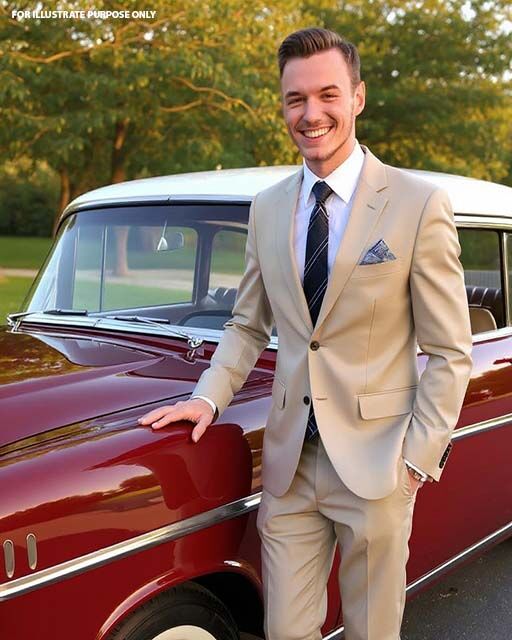
Even now, at seventeen, I can still recall with unsettling clarity the day my grandfather passed away. I had just come home from school when my mother asked my sisters and me to sit together in the living room. That alone felt wrong. She worked night shifts and was rarely home in the afternoons, and the moment she drew a slow, steady breath, I knew something had changed. When she told us, the world shifted in a way I didn’t yet have words for.
My grandfather, Walter, died peacefully at eighty-two. He was remarkably active for his age, sharp-minded and rarely in pain. From the time I was little, he took me to every classic car event within driving distance. Old cars weren’t just a hobby for him; they were his language. Those weekends became the foundation of who I am today. Learning beside him—leaning over open hoods, hands smeared with grease, eyes wide with fascination—quietly shaped my dream of becoming a mechanical engineer long before I understood what that meant.
Grandpa never had the kind of money some of his auto club friends did, the ones who owned multiple fully restored classics. But he had one thing that meant everything to him: a crimson 1957 Chevrolet Bel Air. He poured himself into that car. Every Saturday, my mother would drop me off at his house while she ran errands or met friends. When I was younger, I thought she was encouraging our bond. As I got older, I realized it was also her way of getting a break. Either way, I never minded.
Those Saturdays were some of the happiest moments of my childhood. No matter what went wrong—whether I knocked over an oil can or Grandpa slipped with the buffer and scuffed the paint—we always ended the day smiling. He had a habit of hiding chocolates in the Chevy’s ashtray. “Stick to candy, kid,” he’d say. “Never touch a cigarette.” Every weekend, I’d climb into the passenger seat, open the ashtray, grab a handful of sweets, and then we’d get to work—polishing chrome, checking fluids, fixing whatever small issue he’d decided needed attention that day. My sisters, Clara and Ava, thought it was boring. They never wanted dirty hands or long afternoons with Grandpa. We were different in that way. But Grandpa and I? We were a team.
That’s why the news of his death shattered me. I spent the rest of that day alone in my room, unable to face anyone—not my grandmother, not my sisters. Grandpa wasn’t just family. He was my closest friend.
The next morning, I came downstairs in my pajamas, emotionally drained, expecting comfort—maybe a family breakfast where we’d share memories. Instead, the house felt cold and distant. My sisters avoided my eyes. When I tried to apologize for disappearing the day before, they laughed it off and walked away. Confused and hurting, I turned to my mother.
She didn’t hesitate. “Listen, Graham,” she said, “you need to understand that your sisters are disappointed. If you hadn’t shut yourself away, you would’ve known already—your grandfather left you the Chevrolet.”
I stared at her, stunned. The Chevrolet. Grandpa’s pride and joy. He’d always said it would go to someone who truly appreciated it, but I never expected that to be me.
“Don’t look so pleased,” she snapped. “You’re acting like a vulture. You won’t be keeping the car.”
I couldn’t even respond.
“You’re not old enough to drive,” she continued. “If you’d gotten your license when I told you to, maybe things would be different. But now the car will be sold, and the money will be split between you, your sisters, and your cousins. It’s only fair.”
Fair.
My blood burned. That car wasn’t just an asset. It was years of shared work, trust, and love. Selling it felt like a betrayal—not just of me, but of Grandpa himself.
I begged her for days. She never wavered. Eventually, she found a buyer willing to pay seventy thousand dollars. I watched from my bedroom window as the Chevrolet rolled away, sunlight flashing off its chrome. I swear I could feel Grandpa’s disappointment settle heavy in my chest.
That moment lit something inside me. I made a silent promise: one day, I would get that car back.
The years that followed strained my relationship with my mother. She seemed resentful of the bond I’d had with Grandpa. My sisters never missed a chance to remind me that their inheritance was smaller, as if I had asked for any of it. As if I hadn’t earned it in my own way.
I turned that anger into fuel. At eighteen, I started working part-time, focused fiercely on school, and finally got my driver’s license. I earned my engineering degree through sheer determination and graduated at the top of my class. At twenty-seven, when I landed a position at a prestigious automotive engineering firm, I knew it was time.
I was going to find Grandpa’s Chevy.
It turned out to be easier than I expected. After a few conversations with local car enthusiasts and some searching online forums, one name kept coming up: Michael Bennett, a well-known collector in a nearby town.
I called him. He was kind, clearly passionate about cars. When I explained who I was and why I was calling, there was a long pause. Then he said simply, “Come over.”
A few days later, I drove back to my hometown. The moment I pulled into Michael’s driveway, my heart raced. There it was—the Chevrolet—gleaming as if time had barely touched it.
Michael greeted me with a firm handshake and a knowing smile. “She’s beautiful, isn’t she?” he said. “I don’t drive her much. Just a few shows. Always felt like this one had a soul.”
He let me look her over. The paint was flawless. The chrome shone. The engine sounded exactly as I remembered.
Then he surprised me. “I’ve had a lot of offers,” he said. “But I can tell this car means more to you than money. I’ll sell her back to you for eighty thousand.”
It was more than I’d planned for. Still, I didn’t hesitate.
We shook hands. He placed the keys in my palm.
That same day, I drove the Chevrolet home, grinning like a child. I left my own car behind and came back for it later. Nothing mattered but the drive, the memories, the feeling of being exactly where I belonged.
As I drove, I glanced at the dashboard and smiled. The ashtray. Without thinking, I opened it, expecting candy.
There was none.
Instead, I noticed a small piece of white paper tucked beneath the plastic tray. I pulled into a gas station, carefully removed the ashtray, and found an old, yellowed envelope hidden behind it. My name was written on the front.
Graham.
Grandpa’s handwriting.
My hands shook as I opened it. Inside was a folded letter and something heavy wrapped in tissue.
I read the letter first.
Hi, Graham.
If you’re reading this, you found her again. I knew you would.
I loved this car, and I know you will too. You know how to take care of her—I taught you everything.
Your mother and sisters are probably angry. Let them be. I’ve never considered anyone else my family.
It’s time you knew the truth. Your grandmother had an affair. She thought I didn’t know, but I did. Biologically, your mother isn’t mine. I always knew. But you— you were a son to me from the beginning.
That’s why I didn’t leave you the Chevy outright. And why I left you something else instead. It’s here, wrapped up. I wanted you to find it the old way.
Don’t let her shine too much. Remember, I loved you as my own.
—Grandpa
Tears blurred my vision.
I unwrapped the tissue. Inside was a large, dark green gemstone, flawless and glowing under the station lights. When I turned the envelope inside out, a final message curved across the paper in Grandpa’s looping script:
I knew you’d find the candy.
I sat there for a long time, smiling through the ache, holding the letter in one hand and the stone in the other.
Grandpa hadn’t just left me a car. He left me the truth. A bridge. One final gift.
And this time, no one could take it from me.