I once believed the end of a marriage would be loud, unmistakable, and full of explanations. I imagined arguments that stretched deep into the night, voices raised in desperation, and a final conversation that would give shape and meaning to the pain. Instead, my marriage ended in silence. One ordinary day my husband was there, sharing space beside me in the life we had built, and the next day he was simply gone. There were no long discussions, no attempts to mend what had broken, no closure disguised as honesty. His absence arrived without warning, and with it came a reality I was utterly unprepared for: I was suddenly alone with two children, a household, and a future that now rested entirely on my shoulders. The quietness of his departure made it harder to process, because there was nothing concrete to fight against. There was no dramatic betrayal I could point to, no final speech to replay in my mind. There was only the slow, painful understanding that I had been left to carry everything by myself.
The years that followed were relentless in their demands. There was no space for self-pity or collapse, because survival required focus and discipline. Every decision carried weight—financially, emotionally, practically. I learned quickly that exhaustion did not excuse mistakes and that emotional reactions had consequences not just for me, but for my children, who were absorbing everything I did and didn’t do. I became careful, controlled, and steady because I had no other choice. I worked long hours, managed a home, attended school meetings, and learned how to be both parents in moments when questions had no easy answers. I learned to listen more than I spoke, to stay calm even when fear pressed tightly against my chest, and to move forward even when I felt invisible. Somewhere along the way, without consciously deciding to, I stopped waiting for him to come back. I stopped imagining apologies that never arrived. I didn’t heal by erasing what had happened; I healed by building a life that no longer included him.
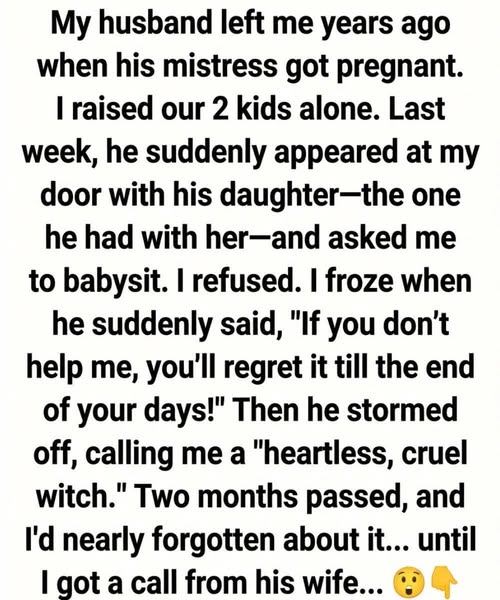
Time, quiet and patient, did what nothing else could. My children grew older and more independent, and I grew stronger in ways that surprised me. The pain softened, not because it disappeared, but because it became something I understood. It no longer dictated my reactions or defined who I was. I learned how to live without needing answers from someone who had chosen silence. I believed that chapter of my life was closed, carefully placed among lessons learned and strength earned. Then, one ordinary afternoon, the past returned without warning. The doorbell rang, and when I opened the door, my ex-husband stood there as though years had folded in on themselves. Beside him was a little girl, no more than seven or eight years old, holding his hand. His daughter. A child from the life he had built after walking away from ours. The moment was disorienting, not because of jealousy or anger, but because it pulled memories forward that I had long laid to rest.
He spoke casually, almost lightly, as if he were asking a small favor from an old acquaintance. He explained that he needed help for a while and asked if I could watch his daughter temporarily. There was no acknowledgment of the years of absence, no recognition of the weight of what he was asking. It was presented as a simple request, as though I had been waiting all this time to step back into his life in a supporting role. I didn’t feel rage in that moment. I felt stunned by the assumption. I looked first at the child—innocent, unaware of the history she was standing inside—and then back at him. My mind filled with memories: the nights I stayed awake worrying alone, the milestones he missed, the emotional labor I carried without help, the strength I had built in his absence. And in that quiet space, a realization settled with surprising clarity. I did not owe him anything. Compassion did not require self-sacrifice, and kindness did not mean reopening wounds that had taken years to heal.
So I said no. Not with bitterness or cruelty, but with calm honesty. I explained that I could not take on that responsibility, that my life was full, and that I had boundaries I intended to protect. His reaction was immediate. His voice hardened, his expression shifted, and disappointment quickly turned into accusation. He called me heartless, suggested I lacked compassion, and framed my refusal as a moral failure. Then he turned and left, pulling the child gently with him, anger sharp in his movements. When the door closed, the silence that followed felt heavier than the one he had left behind years earlier. For days afterward, doubt crept in. I questioned whether I had been too rigid, whether I could have handled it differently, whether protecting myself had come at the expense of empathy. But as time passed, the doubt loosened its grip. I understood something essential: setting boundaries did not make me unkind. It made me honest about what I could and could not carry.
Two months later, my phone rang again. This time, it was not him, but his wife. Her voice was calm, deliberate, and careful with every word. She apologized for the situation, for the assumption that I would say yes, for not fully considering the history I had lived through. She acknowledged that I had been placed in an unfair position and asked to carry something that was never mine to carry. The call was brief, but it mattered. When it ended, I sat quietly, feeling a sense of closure I hadn’t realized I was still missing. Not because everything had been forgiven or resolved, but because I had finally trusted myself. I learned that strength does not always announce itself loudly. It is not always dramatic or visible. Sometimes, strength is simply knowing when to say no—and understanding that you do not need permission to protect the life you worked so hard to rebuild.
The past does not always return seeking forgiveness or understanding. Sometimes it comes looking for convenience, assuming access where none exists. Learning to protect your peace is not an act of cruelty; it is an act of self-respect. Growth is not measured by how much you can endure, but by how clearly you recognize what no longer belongs to you. Saying no can be an ending, a boundary, and a quiet declaration that your healing matters—and that is enough.