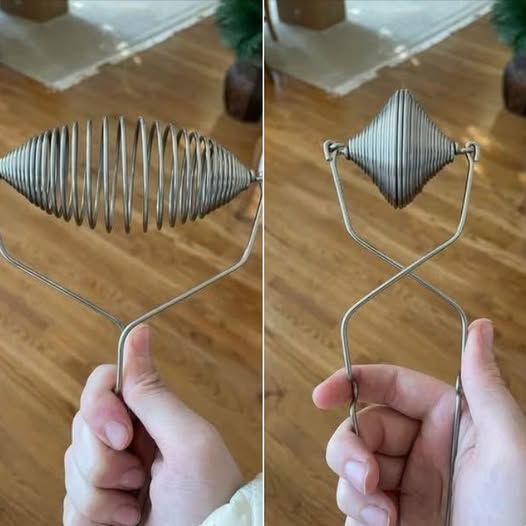
At first glance, the flour wand looks like a mistake left behind in a drawer, an object that seems to belong to no clear category in a modern kitchen crowded with polished gadgets and promised efficiencies. Its coiled wire form appears awkward beside sleek silicone spatulas and powerful stand mixers, and its handle, often dulled and softened by decades of use, offers no instructions, no measurements, and no claim of saving time. Yet for generations, this humble tool quietly governed the outcome of everyday baking. In kitchens where bread, biscuits, cakes, and pies were not weekend hobbies but daily sustenance, the flour wand determined tenderness, protected texture, and safeguarded success. It existed in an era when ingredients were precious and failure meant more than inconvenience. Flour could not be casually wasted, and butter was not always plentiful. Under those conditions, technique mattered deeply. The flour wand was designed not to dominate ingredients but to cooperate with them. Its springy coil loosened flour without compressing it, folded wet ingredients without beating out air, and encouraged a gentleness that modern tools often erase. What looks primitive now was deeply intentional, built to work with the physics of dough rather than against it. Long before mixers standardized motion and force, the wand taught bakers how to feel resistance, how to recognize readiness, and how to stop at exactly the right moment. Its wisdom lived in motion rather than words.
The flour wand belonged to kitchens ruled by rhythm rather than automation, where baking followed the pace of the day instead of the speed of a motor. Recipes were guides, not commandments, and intuition filled in what measurements could not explain. Hands learned what written instructions rarely captured: how flour should fall when properly aerated, how batter should move when just combined, how dough should yield when gluten was developing but not yet strained. The wand became an extension of that sensory knowledge. Its movement lifted instead of crushed, swirled instead of whipped, nudged instead of forced. This mattered profoundly because gluten development is not a simple on-and-off switch. It exists on a spectrum shaped by pressure, repetition, and time. Too much force toughens dough, steals tenderness, and dulls flavor. The flour wand physically limited aggression. It resisted violence. Even an inexperienced baker would struggle to overmix with it. In this way, it protected results without requiring technical language or scientific explanation. When older recipes advised to “mix lightly” or “combine gently,” they assumed the presence of a tool that embodied those instructions. The flour wand encoded technique into its design, allowing skill to pass quietly from one generation to the next, often without explicit teaching, simply through observation and repetition.
Throughout the early and mid-twentieth century, the flour wand was as common as measuring cups, yet far more personal. Unlike standardized tools mass-produced to identical specifications, each wand developed a relationship with its user. Some featured tighter coils suited for heavier batters, others looser spirals ideal for delicate cakes and quick breads. Handles were bent, wrapped, smoothed, or shortened to suit a particular grip. These small alterations reflected habit, strength, and preference, transforming each wand into a kind of signature. Over years of use, the tool adapted to the hand, and the hand adapted in return. Watching an experienced baker use one was witnessing choreography shaped by repetition rather than conscious thought. She did not pause to consider technique because technique lived in her wrist, her timing, her restraint. She knew when to stop not by counting strokes but by sensing the moment ingredients surrendered to cohesion. The flour wand did not teach speed. It taught patience. And patience, more than power, is what produces tenderness. In this way, the wand preserved not only texture but also a philosophy of cooking rooted in attention and care.
Modern kitchens prioritize convenience, and understandably so. Electric mixers save time, reduce physical strain, and make baking accessible to many who might otherwise avoid it. Yet this convenience comes with subtle trade-offs. Machines remove friction between baker and batter. Speed replaces feedback. Force replaces feel. Many contemporary bakers struggle with dense cakes, tough biscuits, or bread that lacks nuance not because their recipes are flawed, but because the mechanics of mixing have changed. Motors apply consistent power long after the ingredients are already combined, encouraging overdevelopment before the baker has time to notice. The flour wand operated under an entirely different logic. Its coil cut through dough just enough to bring ingredients together, lifting rather than compressing them. Fat remained cooler, air stayed trapped, and structure formed gradually. Biscuit dough mixed with a wand behaved differently, producing flakiness that modern bakers often attempt to replicate through complex folding techniques and specialized tools. The wand achieved the same result through simplicity, restraint, and tactile awareness. It did not rush, and it did not allow the baker to rush either, reinforcing the idea that good results emerge from attentiveness rather than acceleration.
Beyond mixing, the flour wand quietly replaced several tools at once. In an era before standardized sifting equipment, it broke flour clumps effortlessly, aerating dry ingredients as part of the mixing process itself. There was no dramatic cloud of dust, no extra bowl, no wasted motion. Its coil tapped gently against ceramic or metal bowls, lifting flour until it fell lightly back into place. This integrated efficiency explains why many older recipes feel vague by modern standards. Steps we now isolate and label were once fluid parts of a single movement. The wand also democratized baking. Children could use it without fear of ruining dough, learning early what gentleness felt like. Elderly bakers relied on it when strength waned, because it demanded attention rather than force. In many households, it became the trusted tool brought out when results truly mattered, the quiet assurance that effort would not be wasted. Its value lay not in dominance but in cooperation, reinforcing the idea that successful cooking is a dialogue between hand and ingredient.
Finding a flour wand today often happens by accident, uncovered while clearing a drawer or sorting through a relative’s kitchen after years of disuse. At first, it may appear obsolete, something to discard in favor of modern efficiency. Yet its presence carries memory embedded in metal. It recalls kitchens where food was made daily, where care was measured in consistency rather than display, and where pride lived in small victories like a tender crumb or a loaf that rose just right. The wand represents labor that was once invisible yet essential, often performed by women whose skills sustained families and shaped traditions without recognition. Keeping the wand is not about romanticizing hardship, but about honoring mastery. It reminds us that good food once depended less on gadgets and more on practiced hands. Even today, bakers who rediscover it often find themselves slowing down, listening to texture and sound, and reconnecting with the process in ways machines rarely encourage. The flour wand may never reclaim its place as a mainstream tool, but it does not need to. It stands as a quiet witness to a time when skill mattered more than speed, and when patience was built directly into the tools themselves, waiting for hands willing to learn again.