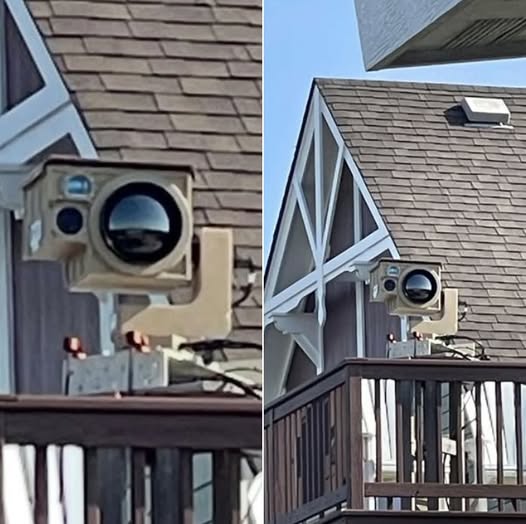
It began the way many modern disturbances do, not with alarms or sirens, but with a photograph taken casually on a phone and shared quietly among neighbors. A strange metallic shape had appeared on a balcony overlooking a row of ordinary backyards, the kind filled with grills, bicycles, and fading patio furniture. At first glance, it might have been mistaken for modern art, an eccentric weather instrument, or an experimental camera mount. Yet the longer people looked, the harder it became to dismiss. The object possessed a weight and symmetry that felt deliberate rather than decorative. Its armored casing, its rotating spherical head, and the clustered optics suggested function, not whim. To anyone with even passing familiarity with military or security hardware, the resemblance was unmistakable. This was a counter-drone turret, a device designed to track, identify, and potentially neutralize aerial threats. Its sudden appearance shattered the quiet assumption that suburban life exists far from the technologies of conflict. Without warning or explanation, a tool built for hostile environments had entered a civilian one. The psychological shift was immediate and visceral. Neighbors who once waved absentmindedly began studying sightlines, wondering what the device could see, what it could record, and what kind of mindset had led someone to install it above children’s playsets, garden fences, and bedroom windows.
As more details circulated, unease deepened into something more complex than fear. Even without active countermeasures, such systems are engineered around advanced surveillance capabilities. High-resolution optics, thermal imaging, motion tracking, and precise rotational control are not optional add-ons; they are foundational to the platform’s purpose. In a battlefield, a military base, or a government facility, these features are justified by context, oversight, and clear chains of authority. In a residential neighborhood, they feel profoundly out of place. The idea that a private individual could possess technology capable of monitoring heat signatures at night or tracking movement across wide distances forced an uncomfortable realization: legality does not always align with legitimacy. The turret did not need to fire, emit signals, or visibly move to exert influence. Its presence alone altered behavior. Curtains stayed closed longer. Backyard conversations lowered in volume. Evening routines shifted indoors. Ordinary acts acquired a layer of self-consciousness, as if an unseen observer might be cataloging them. Surveillance, when unaccountable, reshapes spaces through implication rather than action. It introduces a silent hierarchy, one in which the observer holds power and the observed must guess at boundaries that were never agreed upon.
What troubled residents most was not just the device itself, but the silence surrounding it. No notice had been given. No explanation offered. No sign clarified whether the system was active, experimental, disabled, or merely symbolic. In communities, silence often speaks louder than confrontation. People tolerate cameras, floodlights, and alarms because they understand their function and limits, and because those tools are familiar within shared norms. A counter-drone turret violates those expectations. It signals a perception of threat wildly disproportionate to suburban reality, or at least a willingness to escalate defensive measures far beyond what neighbors recognize as reasonable. That escalation carries an implicit message whether intended or not. It suggests anticipation of conflict, acceptance of dominance, and indifference to how such choices affect others. This message erodes the informal trust that holds neighborhoods together. Residents began asking questions that extended beyond zoning or legality and into character and intent. Who installs battlefield-grade technology at home? What fears or fantasies justify it? And what happens when one person’s sense of security depends on making everyone else feel watched?
As conversations spread from kitchen tables to online forums and city council agendas, broader concerns about precedent emerged. Technology rarely remains isolated. Once a boundary is crossed and normalized, it becomes easier for others to follow. Today it is a stationary counter-drone turret. Tomorrow it could be integrated radar systems, radio-frequency monitoring equipment, or autonomous aerial patrols circling private property lines. Each step could be defended as legal, protective, or incremental, yet the cumulative effect would be transformative. Suburbs could slowly morph into patchworks of individualized security zones, shaped not by public policy but by personal anxiety and disposable income. This raises a fundamental question about governance in shared spaces. Residential areas function because of mutual restraint, shared expectations, and the assumption that no one will unilaterally introduce tools that fundamentally alter the environment for everyone else. When that assumption collapses, regulation often arrives too late. Laws and ordinances tend to follow innovation, not anticipate it. By the time rules are clarified, norms may already have shifted, making reversal socially and politically difficult.
The legal landscape surrounding such technology offers little comfort. Ownership of advanced surveillance or defensive devices may not be explicitly prohibited, yet their use can still conflict with privacy laws, zoning regulations, aviation rules, or nuisance statutes. Devices capable of monitoring beyond property lines exist in a gray zone where enforcement is reactive rather than preventative. Homeowners’ associations, municipalities, and federal agencies may all claim partial authority, but navigating these overlapping systems requires time, expertise, and collective effort. Ordinary residents should not have to become amateur legal scholars simply to feel at ease in their own homes. The burden created by unchecked technological escalation is unevenly distributed, falling most heavily on those who value privacy but lack the resources or influence to challenge it. When security becomes an individual arms race, community cohesion erodes. Trust is replaced by vigilance, and neighbors become potential threats rather than allies.
Ultimately, the appearance of a counter-drone turret on a suburban balcony is not merely a curiosity or an isolated eccentricity. It is a signal of how easily tools designed for extreme circumstances can migrate into everyday life, carrying with them assumptions about danger, control, and authority. This is not an argument against innovation or personal safety, but a call for transparency, dialogue, and restraint. Security that intimidates, isolates, or surveils without consent ceases to be protective and becomes corrosive. Neighborhoods thrive on shared understanding, not silent machines scanning the horizon. If communities fail to question these developments now, they risk waking up to a future in which militarized technology is commonplace, accountability is diffuse, and the idea of home as a neutral, private refuge has quietly disappeared.