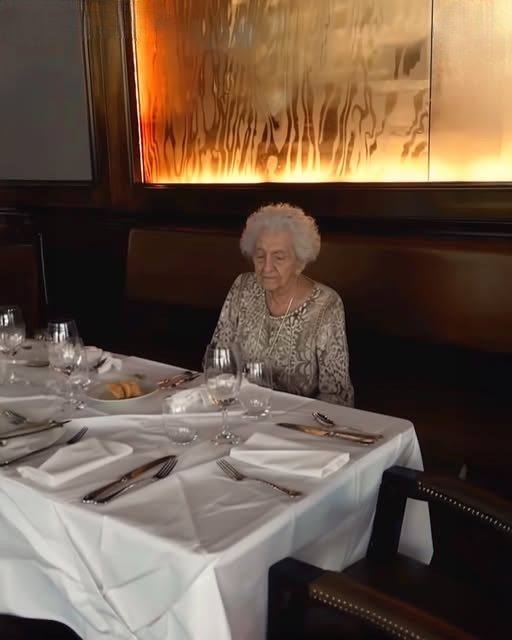
Grandma had been clear about what she wanted for her eighty-fifth birthday, and her request was gentle in its simplicity. She didn’t want noise, spectacle, or extravagance. She wanted a quiet dinner at a familiar place, somewhere she could hear every voice at the table and take her time with each bite. For her, birthdays were no longer about excitement but about connection. She had lived a long life filled with both celebration and sacrifice, and what mattered most to her now was feeling present, included, and valued. I promised her that was exactly what we would do. Somewhere between that promise and the reservation, however, the rest of the family decided her wishes were negotiable. Aunt Linda reframed the night as an “occasion,” insisting Grandma deserved something “special,” by which she meant expensive. Cousins Katie and Mark latched onto the idea instantly, turning the conversation toward premium steaks, cocktails, and indulgent desserts before Grandma had even been asked how she felt. I felt the shift immediately, that familiar tightening in my chest that came from years of watching generosity get twisted into expectation. Still, I stayed quiet. I told myself it was her birthday, that conflict could wait, that maybe—just maybe—this time would be different.
From the moment we sat down at the upscale steakhouse, it was obvious the evening had stopped being about Grandma. The menu became a performance, prices treated like jokes rather than realities. Katie ordered without hesitation, barely glancing at the numbers. Mark made loud comments about “celebrating properly” and “not holding back.” Aunt Linda encouraged it all, smiling broadly, telling everyone not to worry because “it’s a celebration.” Grandma smiled too, but it was the polite, careful smile she used when she didn’t want to disrupt the mood. She ordered the simplest dish on the menu and apologized to the waiter for not being adventurous. That apology broke something in me. No one should apologize for restraint, especially not on their birthday. Plates arrived heavy with excess, drinks were refilled without question, and side dishes were added casually, as if money were abstract. I noticed the jokes change tone as the night went on—comments about how “someone’s always got this” and how “it all evens out.” When the server mentioned the check would be coming soon, I caught the sideways glances toward me. Without ever asking, they had decided I would pay. They always did. And they believed, confidently, that I would again.
When the check finally arrived, the transformation was immediate and chilling. Laughter evaporated. Conversations stalled mid-sentence. Suddenly, everyone had a problem. Katie claimed she’d forgotten her card. Mark sighed and said his bank account was acting up. Aunt Linda fumbled through her purse and announced she’d miscalculated her budget this month. The coordination was almost impressive. Grandma looked from face to face, confusion turning into embarrassment as realization settled in. Her shoulders curved inward, and she whispered that she could help if needed. That was the moment I stood up—not loudly, not dramatically, but firmly. I excused myself and asked to speak to the manager. I explained what had happened calmly, naming who ordered what and how the situation had been engineered. He listened without judgment and handled it professionally, documenting the unpaid bill and those responsible. When I returned to the table, it was empty. They had left. They had abandoned an eighty-five-year-old woman on her birthday to avoid paying for the meal they had insisted on ordering.
I sat back down with Grandma and took her hand. She kept apologizing, saying she should have insisted on a cheaper place, that she didn’t want to cause problems. I told her the truth: that love doesn’t require self-erasure, that dignity isn’t something you earn by being quiet, and that none of this was her fault. The staff brought her tea and a small dessert, their kindness a quiet contrast to what had just happened. We talked, slowly and softly, about her childhood birthdays, about dances she used to attend, about moments that mattered far more than steak or wine. The next morning, my phone exploded. Aunt Linda accused me of humiliating the family. Mark said I’d overreacted. Katie cried and begged me to “fix it” because there could be consequences. I didn’t argue. I didn’t explain myself repeatedly. I stated facts. They made choices. Choices have consequences. Grandma was safe, respected, and cared for, and that was not negotiable.
What surprised me most wasn’t their anger but their disbelief. They were stunned that I hadn’t played my usual role. For years, they had relied on my silence, my sense of responsibility, my fear of being labeled difficult. They had mistaken kindness for weakness and generosity for obligation. This time, they learned otherwise. Boundaries, once enforced, have a way of stripping relationships down to their truth. Some family members stopped calling. Others tried to justify themselves. A few admitted, quietly, that they were ashamed. Grandma never once asked me to smooth things over. She said she felt proud and relieved, and that mattered more to me than any apology I might ever receive. Next year, we already have a plan. A small table, a familiar place, and no audience for entitlement. Just warmth, conversation, and the understanding that real family loyalty protects the vulnerable instead of exploiting them.