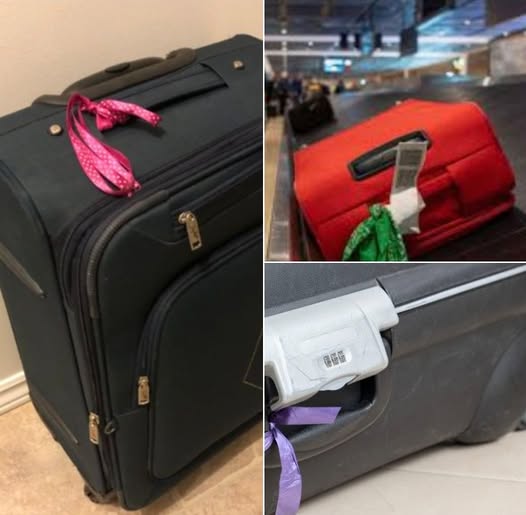
Air travel encourages small personal rituals that offer comfort and a sense of control in an environment defined by queues, rules, and uncertainty. One of the most enduring habits is tying a ribbon, strip of fabric, or decorative tag to a suitcase handle to make it easier to recognize at baggage claim. Travelers pass this advice down casually, convinced it is clever, harmless, and even helpful. The logic seems sound: add something bright, and your bag will stand out instantly. Yet what feels intuitive to passengers often conflicts with how airports actually function behind the scenes. The viral warning shared by a baggage handler did not emerge from irritation with travelers, but from years of witnessing the same preventable problems unfold day after day. Airports are not chaotic free-for-alls; they are tightly engineered ecosystems built to move enormous volumes of luggage with speed and accuracy. When even a small, unplanned variable enters that system, it can disrupt processes designed to operate with near-perfect consistency. A ribbon may appear insignificant, but to an automated baggage network, it is an unpredictable element capable of triggering errors that cascade through the entire operation, affecting not just one bag but many others traveling alongside it.
Modern baggage handling systems rely heavily on automation and precision timing. From the moment a suitcase is checked in, it becomes part of a high-speed logistical network governed by scanners, sensors, conveyor belts, and sorting mechanisms. Each bag receives a barcode tag that contains essential information, including the passenger’s flight number, destination airport, transfer points, and sometimes even the specific carousel where the bag should appear. As the suitcase speeds along conveyors, scanners read the barcode in fractions of a second, instantly directing the bag through a complex maze of tracks and diverters. This process works remarkably well when the barcode is clearly visible and unobstructed. Problems begin when something interferes with that brief scanning moment. Ribbons tied to handles are especially problematic because they move unpredictably. As a bag travels, the ribbon can swing, twist, or flop directly over the barcode, blocking the scanner’s view or distorting the image just enough to cause a misread. When the system cannot confidently read a tag, it does not pause to figure things out. The bag is automatically rejected and diverted away from the main flow into a secondary channel for manual handling. This single interruption removes the suitcase from the fast, streamlined path designed to get it onto the aircraft efficiently.
Once a bag is diverted for manual processing, its journey becomes slower and far more vulnerable to delay. Manual handling areas are often congested, especially during peak travel seasons, weather disruptions, or staffing shortages. Workers must locate the correct routing information, re-scan or reattach tags, and physically place the bag back into the system or onto a cart headed for the aircraft. Each additional step introduces time pressure and the possibility of error. Flights operate on tight schedules, and bags that miss their loading window do not get special treatment. They simply stay behind, even if the passenger boards the plane on time. From the traveler’s perspective, the result feels baffling and unfair: a missing bag despite arriving early and following instructions. From the handler’s perspective, it is a familiar scenario often traced back to a blocked barcode caused by a ribbon or loose accessory. The irony is sharp. A traveler adds a ribbon to make their bag easier to spot, only to make it harder for the system to process, increasing the chance that it will not arrive at all.
Scanning failures are only part of the problem. Ribbons and similar attachments also pose physical risks within baggage systems. Conveyor belts operate at high speeds and include tight turns, rollers, lifting mechanisms, and diverter arms that push bags into specific lanes. Loose fabric elements such as ribbons, bows, straps, or tassels can easily become caught in these moving parts. When that happens, the ribbon may tear away, sometimes taking pieces of the bag with it, including stitching, zipper pulls, or handle seams. In more severe cases, the ribbon does not break, and instead the entire suitcase is pulled off balance, dragged sideways, or abruptly stopped. This can result in cracked shells, broken wheels, crushed corners, or torn fabric. Even worse, a bag snagged in machinery can trigger emergency stops or slowdowns, delaying not just one suitcase but dozens or hundreds traveling behind it. Passengers often assume that rough handling is the cause of damaged luggage, but handlers frequently point out that many incidents originate with something the passenger attached themselves, unintentionally turning their bag into a mechanical hazard.
Another overlooked reality is that ribbons often fail at their primary purpose: identification. The journey through an airport is harsh. Bags are jostled, lifted, dropped, scanned, and sometimes inspected. Ribbons are frequently torn off long before the suitcase reaches its destination. Handlers regularly find loose ribbons tangled in machinery, scattered across sorting floors, or swept up during routine cleanups. Travelers who rely on these decorations for quick identification arrive at baggage claim expecting an obvious visual cue, only to find their suitcase indistinguishable from dozens of others. The frustration is compounded by the fact that ribbons are no longer unique. As the habit became popular, more passengers adopted it, resulting in carousels filled with bags sporting similar red, blue, or patterned strips. Instead of standing out, these decorations blend together, increasing confusion and slowing down the very process they were meant to simplify. In some cases, multiple bags look so similar that travelers mistakenly grab the wrong one, creating yet another layer of disruption and inconvenience.
Security procedures further undermine the usefulness of ribbons. If a bag is selected for additional screening, inspectors may remove any items that interfere with opening, scanning, or re-sealing the suitcase. Ribbons are often untied or cut off and rarely reattached. This is not done out of disregard, but practicality. Security personnel are focused on safety and efficiency, not cosmetic details. Passengers are not notified when ribbons are removed, so they only discover the change after landing. In some instances, removed ribbons are discarded entirely. This reality highlights how little control travelers actually have once a bag enters the system and how unreliable ribbons are as identifiers. The belief that a ribbon adds security or assurance is largely an illusion, offering comfort without function while quietly increasing the risk of complications.
Baggage handlers and airport engineers consistently recommend alternatives that work with airport systems rather than against them. The simplest and most effective option is choosing luggage that is inherently distinctive, such as a bold color or uncommon design that cannot detach or interfere with scanning. Bright hard-shell cases or patterned fabric bags are immediately recognizable without adding loose elements. Properly fitted luggage covers can also be effective, provided they leave barcode tags fully visible and do not include dangling straps. Large, flat ID tags placed away from the barcode offer another layer of identification without obstructing scanners. Removing old airline tags and sticker residue is equally important, as outdated barcodes can confuse automated systems and send bags to incorrect destinations. For travelers seeking extra reassurance, placing a tracking device inside the suitcase provides independent visibility into the bag’s location, offering peace of mind without disrupting airport infrastructure. These small adjustments align with how baggage systems are designed to function, reducing friction rather than creating it.
The viral spread of the baggage handler’s warning resonated because it finally explained experiences many travelers had endured without understanding the cause. Stories poured in from people whose ribbons vanished mid-journey, whose bags were delayed without explanation, or whose luggage arrived damaged despite careful packing. The message was not about blaming passengers, but about sharing insider knowledge rarely communicated to the public. Airports are precision-driven environments where predictability is essential. Even minor deviations can have outsized effects when scaled across thousands of bags per hour. By keeping suitcases streamlined and scanner-friendly, travelers help their luggage move smoothly through the system. The lesson is both simple and revealing: when passengers understand how airport systems actually work, small changes in habit can prevent frustration, reduce delays, and ensure that bags arrive where and when they are supposed to—without the hidden costs of a ribbon tied with the best of intentions.