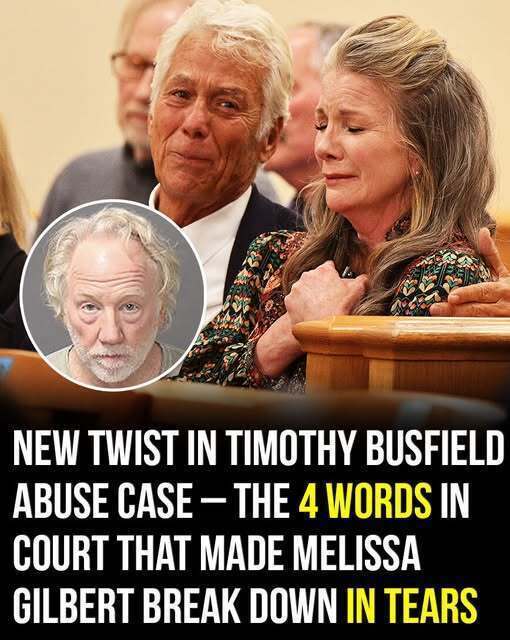
The New Mexico courtroom was filled with a tense, almost reverent silence as Judge David Murphy prepared to deliver a ruling that would shape the immediate future of Timothy Busfield and reverberate far beyond the walls of the courthouse. Seated beside him, Melissa Gilbert appeared composed but visibly strained, her body language reflecting weeks of emotional exhaustion, private anguish, and public scrutiny. As legal arguments concluded and the judge began to speak, the weight of the moment became undeniable. Prosecutors had argued forcefully that Busfield should remain in custody, underscoring the seriousness of the allegations and the moral obligation of the justice system to prioritize the safety of the community, particularly when accusations involve minors. Defense attorneys countered with a portrait of an aging actor with no prior criminal record, a decades-long career, and deep roots in family life, emphasizing that detention before trial should not serve as punishment. When the judge announced that Busfield would be granted pretrial release under strict conditions, Gilbert’s composure gave way. Tears surfaced not as a celebration or a declaration of vindication, but as an expression of raw relief mixed with fear, loyalty, and the profound uncertainty that still loomed. The ruling did not signal the end of the ordeal; it marked a pause in confinement, a temporary easing of immediate pressure in a case still shadowed by unresolved and deeply troubling questions.
The conditions attached to Busfield’s release reflected the court’s attempt to strike a careful balance between constitutional principles and public safety concerns. He was ordered to remain under the supervision of pretrial services, to appear at all scheduled court proceedings, and to comply fully with monitoring requirements. The judge imposed a prohibition on firearms and weapons, mandated abstinence from alcohol and illegal substances, and restricted Busfield from any contact with the alleged victims or their families. Additional limitations included strict boundaries around interactions with minors, a requirement to avoid discussing the case with potential witnesses, and an obligation to immediately report any change in residence. These measures transformed release into a highly regulated state rather than a return to normalcy. Daily life would now unfold under the watchful eye of the court, with little margin for error. For Gilbert, the ruling brought complicated emotions: relief that her husband would not remain behind bars, paired with the sobering reality that their private lives would continue to be governed by legal constraints and public attention. The decision underscored that pretrial freedom, in this context, came at the cost of constant oversight and enduring emotional strain.
Prosecutors voiced strong objections to the release, presenting arguments aimed at persuading the court that continued detention was necessary. They referenced previous allegations made by actress Claudia Christian, who claimed that Busfield assaulted her during a professional engagement years earlier, noting that she had reported the incident at the time to an assistant director. While no charges resulted from that claim, prosecutors argued that it suggested a troubling pattern of behavior that should not be ignored. They also raised concerns about Busfield’s actions after learning that an arrest warrant had been issued. Rather than surrendering immediately, he traveled a significant distance and underwent a polygraph examination before turning himself in. The state emphasized that while defendants have the right to consult attorneys and prepare their defense, such actions could be interpreted as evasive or indicative of a willingness to delay accountability. Given the gravity of the current allegations, prosecutors contended that detention was the safest course to ensure compliance and protect the public. The judge, however, determined that these concerns could be mitigated through stringent supervision and conditions, concluding that pretrial release did not pose an unacceptable risk at this stage of the case.
A central pillar of the defense’s argument was a psychosexual evaluation submitted to the court ahead of the hearing, a type of assessment commonly used to inform judicial decisions about risk rather than guilt in cases involving sexual misconduct allegations. According to filings, the evaluation included extensive interviews, standardized psychological testing, and collateral discussions with individuals close to Busfield, including Gilbert. The report described his marriage as stable, emotionally supportive, and deeply rooted in mutual respect, portraying a long-term partnership characterized by companionship and shared values. Evaluators noted Busfield’s cooperation throughout the process, his consistent work history, and his strong family ties. Based on these factors, the assessment classified him as “very low risk” for reoffending, a conclusion defense attorneys argued weighed heavily in favor of supervised release. While such evaluations do not determine innocence or predict trial outcomes, they often influence how judges assess potential danger to the community during pretrial periods. In this case, the evaluation became a key factor in framing Busfield not solely as a defendant facing serious charges, but as an individual embedded within a network of personal relationships and responsibilities.
The court also considered an extensive collection of more than seventy-five letters submitted in support of Busfield, many written by family members, friends, and colleagues from across his professional life. Several of the most personal letters came from Gilbert herself. In them, she described her husband as her emotional anchor and creative partner, referring to him as her “rock” and emphasizing his compassion, reliability, and devotion to family. She wrote candidly about the sense of helplessness she felt navigating a legal process that had pulled their private world into the public eye, expressing anguish over watching someone she loved face devastating accusations without being able to shield him from the consequences. Other letters echoed similar themes, portraying Busfield as kind, professional, and deeply invested in the well-being of those around him. These statements were intended to humanize him in the eyes of the court, offering a fuller picture of his life beyond the allegations. At the same time, the presence of such strong personal support exists in uneasy tension with the severity of the charges, illustrating the complex interplay between loyalty, belief, and the pursuit of justice that often defines high-profile cases.
Despite the emotional courtroom scene and the detailed arguments surrounding pretrial release, the core allegations remain unresolved and profoundly serious. According to the criminal complaint, Busfield is accused of engaging in inappropriate conduct involving two minors while working on a television set, with claims that the behavior occurred over an extended period. Medical professionals later advised the children’s parents that certain behaviors were consistent with grooming, prompting a formal investigation and the eventual issuance of an arrest warrant. Busfield has denied all allegations and has stated his intention to contest the charges vigorously. If convicted, he could face significant prison time and lasting professional consequences. The case remains in its early stages, with evidence review, legal motions, and potential testimony still to come. Gilbert’s emotional response in court served as a stark reminder of the human toll such proceedings exact, not only on the accused and the alleged victims, but also on families caught in the middle. The judge’s ruling did not resolve the questions at the heart of the case; it merely established the conditions under which those questions will be examined, leaving the future suspended between accusation, defense, and the slow, deliberate process of judgment.