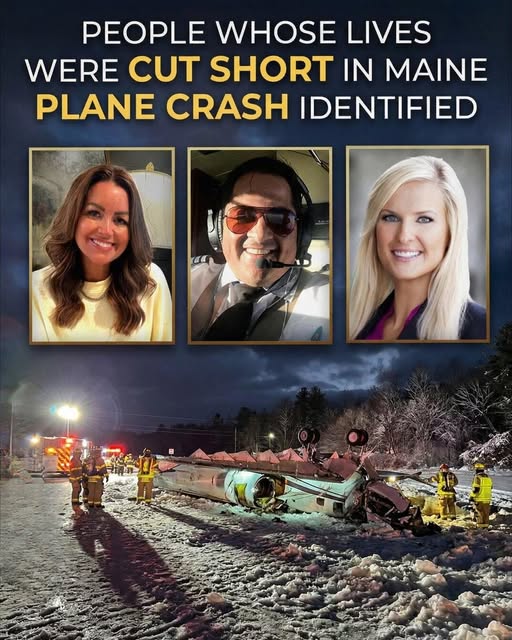
The crash of a private jet at Bangor International Airport in Maine has sent shockwaves through both the aviation community and the professional circles connected to those who lost their lives. What began as a routine winter departure quickly became a devastating tragedy, claiming six lives and raising urgent questions about safety, preparation, and the unforgiving realities of severe weather. The Bombardier Challenger 600, associated with a Houston-based law firm, failed to achieve liftoff on a snow-covered runway, ending its journey before it truly began. Emergency responders arrived within minutes, battling harsh winter conditions as they worked to reach the wreckage, but despite their swift efforts, all six occupants were pronounced dead at the scene. An airport accustomed to challenging winter operations suddenly became the focus of national attention as investigators began the painstaking process of determining what went wrong.
Authorities confirmed that the aircraft was en route to France, with at least one planned stop, indicating a carefully coordinated international trip. Winter weather in Maine is notoriously unpredictable, and on the day of the crash, snow and freezing temperatures created conditions known to complicate aircraft performance. Investigators are now examining a wide range of factors, including runway conditions, de-icing procedures, aircraft weight and balance, mechanical systems, and human decision-making. Aviation experts emphasize that takeoff is among the most critical phases of flight, requiring precise calculations and narrow margins for error. When environmental stressors such as ice, reduced traction, or limited visibility are present, even minor misjudgments can escalate into catastrophic outcomes. While officials have urged patience as the investigation unfolds, early attention has centered on weather-related challenges and how quickly routine operations can turn perilous.
Among the victims was Tara Arnold, a respected attorney widely known for her work in offshore workplace litigation and her commitment to advocating for clients in complex and high-risk cases. Colleagues described her as meticulous, compassionate, and deeply dedicated to her profession—someone who combined sharp legal insight with genuine empathy. Her presence on the flight underscored how business travel, even aboard private aircraft, is often viewed as a practical necessity rather than a significant risk. Also on board was pilot Jacob Hosmer, remembered by peers as a skilled and conscientious aviator with a calm demeanor and a strong sense of responsibility. Friends and family spoke of his devotion as a father and his pride in maintaining the highest standards of professionalism in the cockpit. The loss of both passengers and crew has rippled through multiple communities, leaving behind grief and unanswered questions.
As investigators review flight data, maintenance records, and witness accounts, the human dimension of the tragedy remains impossible to overlook. Families are left grappling with sudden loss, mourning loved ones who departed expecting to arrive safely at their destination. Legal communities in Houston, aviation networks nationwide, and local residents in Maine have paused to reflect on the lives and contributions of those lost. Vigils, tributes, and messages of condolence have emerged as collective expressions of grief. In moments like these, tragedies become more than headlines or investigation reports; they are stark reminders that behind every incident are individuals with stories, relationships, and futures abruptly cut short.
The Maine crash occurred just days after another heartbreaking incident in rural Georgia, where a wrong-way vehicle struck a family, killing a mother, Bernedine Spann, and two of her children. One child survived, while the father endured the unimaginable trauma of losing his youngest child at the scene. Though unrelated in cause, the closeness of these events has intensified public reflection on the fragility of everyday life. Whether in the air or on the road, ordinary moments can transform irrevocably within seconds. Authorities in Georgia are conducting a thorough investigation into how the vehicle entered the roadway and what measures might prevent similar tragedies. As in Maine, local communities have rallied around the grieving family, offering support, prayers, and practical assistance.
Together, these incidents highlight the shared responsibility borne by individuals, organizations, and the systems designed to safeguard human life. In aviation, that responsibility includes continual evaluation of procedures, training, and infrastructure, particularly in demanding environments such as winter operations. On the roads, it demands vigilance, enforcement, and public awareness to reduce the likelihood of catastrophic errors. While no investigation can undo the losses suffered, each carries the hope that lessons learned may prevent future tragedies. As communities in Maine and Georgia continue to mourn, they also demonstrate resilience through unity and compassion. The lives lost—remembered for their professionalism, love, and dedication—stand as solemn reminders of why safety, awareness, and care must remain paramount in every journey, no matter how routine it may seem.