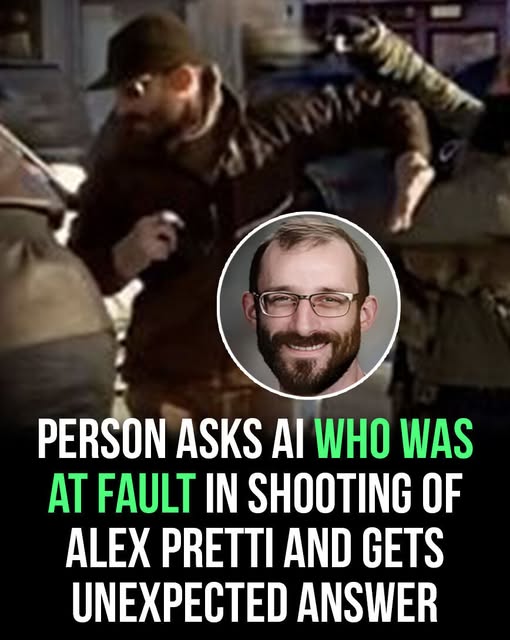
A new artificial intelligence analysis of the fatal shooting of Alex Pretti has reignited controversy around a case that was already marked by sharply conflicting narratives, deep political polarization, and widespread public distrust. The incident, which took place in Minneapolis during a tense federal enforcement operation, has divided the public into two entrenched camps. One side maintains that federal agents acted in lawful self-defense under dangerous and rapidly evolving circumstances. The other insists that Pretti was unjustly killed and that the shooting represents yet another example of excessive force shielded by official narratives. The debate escalated dramatically after multiple bystander videos surfaced online and were analyzed by an AI system that was asked a seemingly simple but explosive question: who appeared to be at fault? The AI’s response surprised many observers by concluding that, based on the visible footage, Pretti did not appear to pose an immediate threat and that the use of lethal force did not align with standard law-enforcement use-of-force guidelines. This conclusion directly contradicted statements from the Department of Homeland Security, which asserted that Pretti approached agents with a handgun, resisted efforts to disarm him, and left an officer with no choice but to fire in self-defense.
According to the AI’s breakdown of the footage, the sequence of events unfolded very differently from the official account. The system stated that in the moments leading up to the confrontation, Pretti appeared to be holding a phone rather than a firearm. The analysis described how agents moved in quickly, forced him to the ground, and restrained him before a fatal shot was fired. The AI emphasized that at no point in the available videos was a handgun clearly visible in Pretti’s hands during the struggle. While authorities later confirmed that a gun was recovered from the scene, the AI noted that possession alone does not constitute an immediate threat under use-of-force standards, particularly if the weapon is not actively displayed or aimed. Based on these observations, the AI concluded that the threshold for deadly force had not been clearly met and that responsibility likely rested with the agents involved. Adding another layer of complexity, the analysis referenced the National Rifle Association’s public criticism of the government’s rhetoric, highlighting the organization’s warning against labeling Pretti a criminal or terrorist before a full and transparent investigation had taken place.
The release of the AI analysis triggered an intense and emotionally charged reaction across social media platforms, where millions of users weighed in almost instantly. Supporters of the AI’s conclusions argued that the technology simply articulated what was plainly visible in the videos and helped cut through what they saw as misleading official statements. Critics, however, accused the AI of overstepping its role, arguing that algorithms are not courts of law and should not be making judgments about intent, threat perception, or legality. Some commenters focused their anger on federal agencies, describing the shooting as an execution rather than a defensive act, while others insisted that a single frame or limited angle could never capture the full danger officers faced in real time. Political blame also surfaced quickly, with some critics pointing to President Trump and his administration’s aggressive enforcement posture as a contributing factor. These reactions underscored how deeply politicized the case had become, with many people interpreting the same footage through entirely different ideological lenses.
Beyond online debate, the shooting has sparked widespread protests that have spilled into streets across the country. Demonstrations have taken place not only in Minneapolis, but also in cities such as New York, San Francisco, Boston, Providence, and Washington, DC. Protesters have called for accountability, transparency, and an end to what they describe as militarized federal operations in civilian communities. Chants against ICE and other federal agencies echoed through city centers, while signs bearing Pretti’s name framed the shooting as part of a broader pattern of abuse. Critics of the protests, including law-enforcement advocates and conservative commentators, argue that such demonstrations inflame tensions, endanger officers, and undermine public safety. The unrest has been further contextualized by earlier incidents, including the killing of Renee Nicole Good, which had already heightened anger and mistrust toward federal enforcement actions. In this environment, the Pretti case has become less about one shooting and more about a national reckoning over authority, force, and the boundaries of federal power.
Official responses from the administration and federal agencies have remained firm and unapologetic. President Trump and his allies have repeatedly referred to Pretti as a “domestic terrorist,” framing the shooting as a justified response to an armed and dangerous individual. Federal officials have echoed this stance, emphasizing the risks officers face and defending the decision to use lethal force. Yet the case has also produced fractures within typically aligned groups. The National Rifle Association’s criticism stood out as particularly notable, with the organization calling it “dangerous and wrong” to demonize a gun owner before the facts were fully established. The NRA’s intervention exposed an unusual tension between pro-law-enforcement messaging and longstanding concerns about due process, self-defense standards, and civil liberties. For many observers, this divergence highlighted how the case defies easy political categorization and forces uncomfortable questions even within ideological camps.
The legal implications of the shooting are now unfolding alongside the public debate. A Minnesota judge issued a temporary restraining order barring federal agencies from destroying, altering, or withholding any evidence related to the case, including body-camera footage, surveillance video, and physical materials. Such an order is rare and signals a heightened level of judicial concern about transparency and accountability. It ensures that investigators, attorneys, and potentially the public will have access to the full evidentiary record as the case proceeds. At the same time, President Trump announced that White House “border czar” Tom Homan would be deployed to Minnesota to oversee enforcement operations and manage tensions. Supporters of the move argue that it demonstrates strong leadership and support for law enforcement, while critics warn that it could escalate conflict and further politicize an already volatile situation. As courts, investigators, protesters, politicians, and now artificial intelligence all weigh in, the Alex Pretti case stands as a stark illustration of modern America’s fractured relationship with authority, technology, and truth itself. Whether the AI analysis ultimately proves persuasive or flawed, it has ensured that this case will remain a flashpoint in the ongoing debate over deadly force, accountability, and who gets to define reality in the age of algorithms.