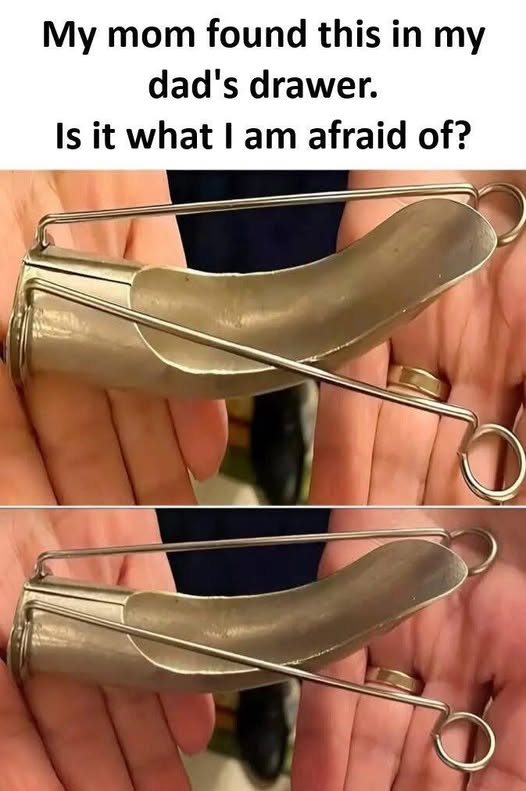
Some objects have a remarkable ability to confuse, intrigue, and even amuse people when they are encountered without context, especially in an age where most tools are designed to look intuitive at a glance. One such object recently made the rounds online, shared in photos that prompted thousands of comments, wild guesses, and humorous theories. At first glance, it appeared strange and almost abstract: a metal attachment with a spout, wire components, and an overall shape that seemed more like industrial art than a household tool. Internet users debated whether it was a scientific instrument, a plumbing part, or even a prop from a science fiction movie. In reality, the mysterious object was far more ordinary and far more charming. It was a vintage juicer attachment designed for the Sunbeam Mixmaster, one of the most beloved kitchen appliances of the mid-20th century. What made it fascinating was not just what it was, but how unfamiliar it seemed to modern eyes, revealing how dramatically kitchen technology, design language, and user expectations have changed over time.
To understand why this attachment existed, it helps to understand the role of the Sunbeam Mixmaster itself. Introduced in the 1930s and reaching peak popularity in the 1940s and 1950s, the Mixmaster was not just a mixer but a centerpiece of the modern kitchen. It symbolized convenience, progress, and domestic efficiency at a time when home cooking was central to daily life. Unlike many modern appliances that are built for a single purpose, the Mixmaster was designed as a modular system. With a single motor base, users could attach a variety of tools to handle different tasks, from mixing cake batter to grinding meat or crushing ice. The juicer attachment fit neatly into this philosophy. Rather than owning a separate juicing machine, households could rely on one dependable appliance that adapted to many needs. This approach reflected a mindset focused on durability, versatility, and long-term value, where appliances were investments meant to last decades rather than disposable conveniences.
The juicer attachment itself was a thoughtful piece of engineering, even if it looks odd by today’s standards. Its most noticeable feature was the spout, carefully angled to guide freshly extracted juice directly into a glass or bowl. Integrated into the design was a wire strainer that served a crucial purpose: separating pulp from liquid as the juice flowed out. This meant users could enjoy smoother juice without needing an additional straining step, saving time and reducing mess. The wire component may appear primitive compared to modern plastic filters or fine mesh screens, but it was highly effective and easy to clean. Every part of the attachment had a clear function, shaped by practical considerations rather than aesthetics alone. The design prioritized efficiency, simplicity, and reliability, qualities that defined many mid-century household tools and contributed to their enduring reputation for quality.
For modern users, however, this kind of design can be confusing. Today’s appliances often hide their inner workings behind sleek casings and rely on standardized forms that are immediately recognizable. A juicer looks like a juicer, a blender looks like a blender, and anything that deviates from those visual norms can feel alien. When the Sunbeam juicer attachment is removed from its original context and discovered in a drawer, thrift store, or inherited box of kitchenware, it loses the visual cues that once made its purpose obvious. Without the Mixmaster itself or the original instruction manual, the attachment becomes a puzzle. This disconnect between past and present design languages is one reason the object sparked such intense curiosity online. People were not just trying to identify a tool; they were confronting a reminder that everyday objects from earlier eras often required a different kind of familiarity and knowledge.
The internet’s reaction to the juicer attachment also highlights a broader cultural phenomenon: the joy of collective problem-solving and rediscovery. Social media platforms thrive on moments of shared curiosity, where strangers come together to solve small mysteries. An unfamiliar object invites speculation, storytelling, and playful debate. Each incorrect guess adds to the entertainment, while the eventual reveal provides satisfaction and a sense of closure. In this case, learning that the strange object was a juicer attachment did more than answer a question. It opened a window into domestic life from decades ago, sparking conversations about how people cooked, shopped, and thought about food. It reminded viewers that kitchens once revolved around fewer machines that did more, and that learning to use them was part of everyday knowledge passed down through families.
Beyond the humor and intrigue, the fascination with this vintage attachment speaks to a growing appreciation for older tools and the values they represent. Mid-20th century appliances were often built with repairability in mind, using metal components and straightforward mechanisms that could be maintained rather than replaced. Attachments like the Mixmaster juicer were designed to integrate seamlessly with a core appliance, reducing waste and maximizing usefulness. In contrast, many modern devices are sealed, specialized, and short-lived. Rediscovering a tool like this can prompt reflection on what has been gained and lost in the evolution of household technology. While modern appliances offer speed, convenience, and sleek design, they sometimes lack the tactile honesty and longevity that characterized earlier eras of manufacturing.
Ultimately, the vintage Sunbeam Mixmaster juicer attachment is more than just a quirky piece of metal that confused the internet. It is a small artifact of culinary history, representing a time when household tools were thoughtfully engineered to serve multiple purposes and to endure years of daily use. Its viral moment illustrates how easily context can be lost and how quickly curiosity can be reignited when that context is restored. Finding such an object today is like uncovering a fragment of everyday history, a reminder that even the most ordinary tools carry stories about how people lived, cooked, and solved problems in the past. In an age of disposable gadgets and fleeting trends, this humble attachment stands as a testament to practical ingenuity, inviting admiration, nostalgia, and a renewed appreciation for the clever simplicity of vintage design.