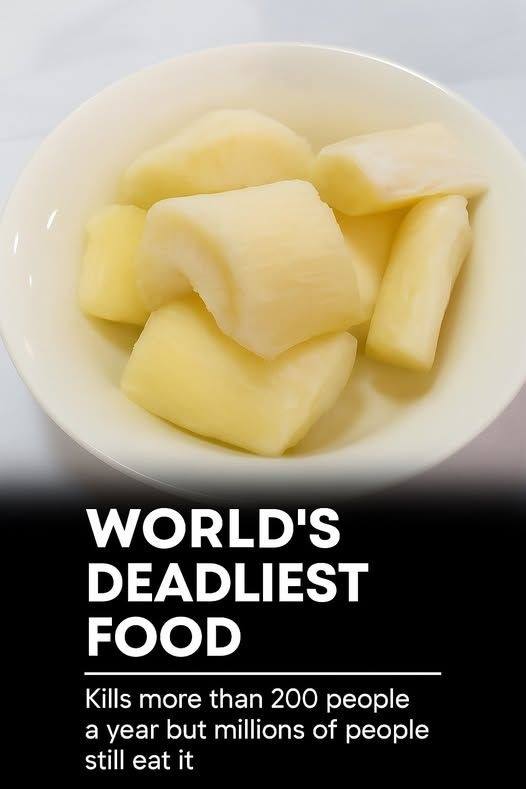
Cassava exemplifies how a single food can embody both life and death, depending entirely on knowledge, preparation, and circumstance. For nearly half a billion people, cassava is not an exotic ingredient but a daily necessity, central to culture, agriculture, and survival. It thrives where other crops fail, tolerating drought, poor soil, and harsh climates that devastate wheat, rice, or maize. Its resilience makes it invaluable in regions where food insecurity is constant. Families rely on it to stave off hunger, governments promote it as a food-security crop, and entire local economies depend on its cultivation. Yet beneath its rough exterior lies a chemical defense that can turn nourishment into poison if handled incorrectly. In communities with strong traditional knowledge, cassava is processed safely generation after generation. Where poverty, displacement, or conflict disrupts these practices, the margin for error shrinks—and the consequences can be deadly.
The danger of cassava stems from naturally occurring cyanogenic glycosides, most notably linamarin, which release cyanide when the plant’s cells are broken. This occurs during peeling, grating, chewing, or insufficient cooking. Sweet cassava contains relatively low toxin levels and is generally safe when prepared properly. Bitter cassava, however, can harbor lethal concentrations if not detoxified through careful, time-consuming processes, including peeling, soaking, fermenting, drying, and cooking thoroughly. When done correctly, these methods reduce cyanide to safe levels; when rushed or skipped, the toxins remain. Acute cyanide poisoning can occur within hours, causing severe illness and sometimes death. Chronic exposure can lead to konzo, a neurological disorder causing irreversible paralysis of the legs, or tropical ataxic neuropathy, impairing vision, hearing, and coordination. These conditions are most common where cassava is eaten daily and protein intake is insufficient, leaving the body less able to detoxify cyanide naturally.
Cassava’s danger is compounded by the social and economic context of its consumption. Many communities are aware of its risks yet have no alternative. Droughts, conflict, or crop failure often force families to shorten soaking times, skip fermentation, or rely on bitter varieties, which grow more reliably and resist pests. In these situations, survival today outweighs invisible risks tomorrow. Children and pregnant women are especially vulnerable, with effects that can last a lifetime. Education campaigns promoting safe preparation exist but often face obstacles such as lack of clean water, cooking fuel, or access to less toxic varieties. In wealthier countries, cassava appears as tapioca, flour, or frozen yuca, already processed and safe before reaching consumers. Here, risk has been removed through infrastructure and regulation—conditions not universally available.
Despite its hazards, cassava remains indispensable for global food security. It provides calories where few alternatives exist, sustaining millions from starvation. Its leaves, consumed in some regions, supply essential vitamins and minerals when prepared correctly. Beyond nutrition, cassava supports livelihoods from smallholder farmers to industrial processors producing starch, animal feed, and biofuel. Labeling it as “the world’s deadliest food” can be misleading if one ignores this broader context. The estimated 200 annual deaths are tragic but preventable, occurring primarily where resources, education, and infrastructure are lacking. The real issue is systemic vulnerability, not the inherent nature of the crop. Understanding this distinction shifts the conversation from fear toward responsibility and intervention.
Efforts to reduce cassava-related poisonings increasingly focus on science, education, and community-driven solutions. Researchers are developing low-cyanide cassava varieties that retain resilience while reducing risk. Public health programs teach safer processing techniques using locally available tools, emphasizing adequate soaking and fermentation even during hardship. Nutrition initiatives encourage pairing cassava with protein-rich foods, like beans or fish, to improve cyanide detoxification. Simple innovations, including improved graters or drying methods, have already reduced exposure in some communities. Yet progress is uneven, and poverty, instability, and climate change—especially drought—continue to push people toward bitter varieties, shortening traditional processing times. Without sustained investment, the patterns of preventable harm persist.
The story of cassava illuminates a profound truth about food, risk, and survival. A single food can be essential and dangerous simultaneously—not out of malice, but because human systems are imperfect and unequal. For some, cassava is a harmless ingredient in pudding or bread; for others, it is a daily gamble dictated by necessity. The danger arises less from the plant itself and more from the conditions under which it is consumed. Understanding this paradox encourages a nuanced view of global nutrition: safety depends on context, resources, and knowledge. When these exist, cassava nourishes. When they do not, it can harm. Addressing inequity, improving education, and supporting communities in sustainable preparation practices are the keys to ensuring that this vital crop continues to feed millions safely.