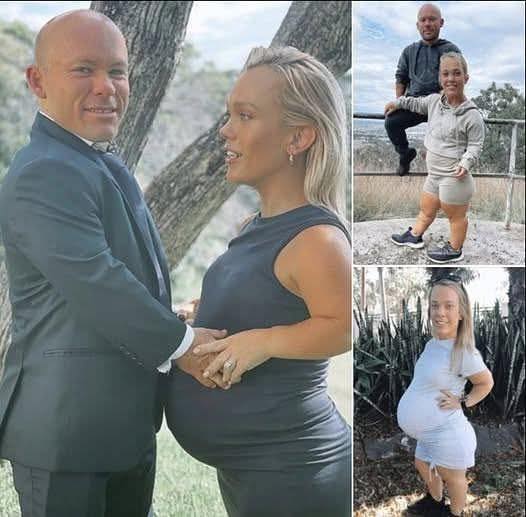
Charli and Cullen Worgan’s story unfolds not as a sensational headline but as a profoundly human journey marked by patience, preparation, and extraordinary emotional resilience. Living in Sydney, Australia, the couple has spent much of their adult lives navigating a world that often underestimates them before they even speak. Both Charli and Cullen have different forms of dwarfism, conditions that influence mobility, daily routines, and long-term planning, yet neither defines their totality. Like many couples, they dreamed of creating a family built on love, stability, and shared values. Unlike most, they faced intense scrutiny and medical complexity from the moment they voiced that desire. Strangers questioned their decisions, some openly suggesting parenthood was impossible or irresponsible for people with their conditions. Rather than retreat, Charli and Cullen chose education, preparation, and transparency, determined to make informed choices instead of fear-driven ones. Their relationship became a partnership not only of love but of resilience, where difficult conversations were embraced rather than avoided.
The medical realities surrounding their desire to have children were both daunting and intricate. Each pregnancy carried multiple potential genetic outcomes, some manageable, others severe. Doctors explained that a child could inherit Cullen’s form of dwarfism, Charli’s form, neither, or—worst case—both simultaneously, a combination considered incompatible with life. These were not abstract risks but tangible possibilities requiring careful emotional processing. Pregnancy itself posed physical challenges for Charli, whose body required close monitoring to accommodate changes safely. Every step, from conception through prenatal testing, demanded consultation with specialists, detailed planning, and mental preparation for outcomes beyond their control. Yet the couple approached these realities not as barriers, but as tools for informed decision-making. Their courage was defined not by blind optimism, but by the willingness to move forward while fully aware of potential difficulties.
During Charli’s third pregnancy, the emotional weight of uncertainty reached its height. She underwent chorionic villus sampling, an early prenatal test capable of identifying specific genetic conditions—a procedure both physically invasive and emotionally taxing. Waiting for results was marked by anxiety, vulnerability, and quiet mutual support. There was no dramatic panic, only the steadiness of a couple committed to honesty and preparation. Charli and Cullen recognized that love for a child also meant facing outcomes they might not prefer, together. When results returned favorable, relief was profound, yet it did not erase the emotional strain of the journey. Instead, it reinforced their belief in meticulous preparation and open communication. Parenthood, they realized, begins long before birth, in the choices and readiness cultivated during uncertain moments.
Welcoming their children did not erase challenges but transformed them into opportunities for purposeful adaptation. Their home became a space of creativity, modification, and warmth, where parenting tools, routines, and expectations were shaped by reality rather than comparison. Charli and Cullen demonstrated that capability is not measured by height or physical strength, but by consistency, attentiveness, and love. Their children grew up surrounded by empathy and openness, learning early that difference is not shameful but simply part of human experience. Instead of shielding their children from questions, the couple encouraged age-appropriate honesty, fostering confidence and understanding. In doing so, they challenged not only medical assumptions but societal stereotypes, proving that disability does not negate competence, responsibility, or joy. Their family life became a quiet yet powerful rebuttal to pervasive misconceptions.
Public attention followed, sometimes supportive, sometimes intrusive. Charli and Cullen embraced visibility as advocacy, not by presenting themselves as flawless or inspirational caricatures, but by showing the full spectrum of their lives. They spoke openly about fear, fatigue, and frustration alongside pride and joy. This honesty resonated with parents everywhere, highlighting a universal truth: parenting is hard, unpredictable, and deeply meaningful for all, regardless of physical ability. Sharing their journey helped dismantle the notion that only certain bodies or lives are suited to family-building. It also underscored the importance of access to quality healthcare, genetic counseling, and respectful medical guidance—tools that allowed informed choice rather than coercion. Their story shifted the narrative from judgment to respect, advocating autonomy and understanding.
Ultimately, Charli and Cullen Worgan’s journey is not about defying nature, but about embracing knowledge, preparation, and love to create the family they desired. Their life demonstrates that responsible parenthood is defined not by physical norms, but by commitment, presence, and emotional engagement. They did not ignore risk, nor let fear dictate their future; they faced uncertainty together, grounded in mutual trust and thoughtful planning. Their story challenges society to reconsider assumptions about disability and parenting, replacing doubt with respect, and pity with understanding. More than anything, it reminds us that families are defined not by external appearance, but by the care, protection, and love shared within—a testament to the human capacity to turn courage and preparation into tangible, enduring joy.