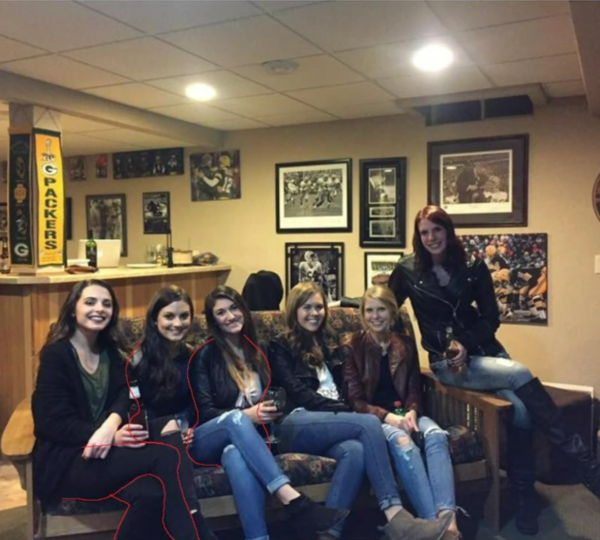
Optical illusions have always captivated humans because they reveal the astonishing ways our brains interpret, misinterpret, and occasionally misread visual information. Even the sharpest observers can find themselves pausing, questioning what they see, and wondering how their own eyes might be deceiving them. Recently, one particular illusion has captured widespread attention across social media: a photograph of six girls sitting on a couch that appears, at first glance, to show only five pairs of legs. The image is deceptively simple yet profoundly baffling, prompting intense debate, speculation, and attempts to reconstruct what is happening in the frame. For those unfamiliar with the mechanics behind optical illusions, this photograph is a perfect demonstration of how perspective, positioning, and subtle visual cues can combine to produce a scene in which the brain fills in gaps or makes incorrect assumptions. Each viewer’s interpretation is shaped by expectation, experience, and innate pattern recognition, which explains why reactions to the image range from utter confusion to triumphant decoding.
To understand why illusions like this work, it is essential to examine how humans process visual input. The Queensland Brain Institute explains that an optical illusion occurs when the communication between the eyes and brain becomes “mixed-up,” resulting in a perception that does not match objective reality. Essentially, our brains are constantly interpreting cues, predicting patterns, and filling in missing information in order to make sense of the world. These cognitive shortcuts generally allow humans to navigate complex environments efficiently, recognizing threats, identifying resources, and responding quickly to movement or change. However, optical illusions exploit these shortcuts, tricking the brain into perceiving elements that are not there or misassigning what is present. This capability evolved as a survival mechanism: in prehistoric environments, heightened sensitivity to movement, pattern recognition, and spatial awareness improved the chances of detecting predators or prey. When applied to artificial or controlled settings, such as photographs, these same evolutionary advantages produce confounding phenomena that challenge our perception. Shadows, overlapping objects, and ambiguous perspectives exploit the brain’s assumptions, creating visual experiences that seem impossible but are entirely explainable through cognitive science.
The viral six-girls photograph demonstrates these principles in a strikingly clear way. At first glance, it appears as though one girl has no legs, yet closer inspection reveals that all limbs are present, cleverly obscured by positioning and overlapping. Social media users initially speculated about Photoshop errors or deliberate pranks, while others meticulously analyzed the photograph, noting clothing details, the placement of each limb, and subtle visual cues. The illusion largely arises from strategic overlapping and the manipulation of perspective: for example, one girl’s legs might be hidden behind another’s, while crossed legs, torn knees, or mismatched socks serve as signals that, once recognized, allow the observer to decode the image. Online communities, particularly on Reddit, have produced diagrams illustrating the exact positions of each girl, demonstrating that the “missing” legs are, in fact, in plain sight but visually misassigned by the brain. Faced with a complex tangle of limbs, the brain simplifies the scene, making a convenient but incorrect interpretation, which is precisely what produces the perception that a girl is legless.
Several factors contributed to the image’s rapid viral spread. Its relatability is key: many people enjoy puzzles and challenges, and the allure of spotting hidden elements encourages sharing and discussion. Its complexity is carefully balanced: it is intricate enough to captivate viewers, yet not so convoluted as to feel impossible to solve, promoting repeated examination. Social media platforms amplify this effect, enabling collective problem-solving through comments, diagrams, and theories, creating a dynamic feedback loop of engagement. Beyond mere entertainment, this illusion highlights the limitations of human perception, showing how easily assumptions can mislead even the most attentive observers. It serves as a reminder that what we perceive is not always a perfect reflection of reality but rather a constructed interpretation shaped by neural processing, expectation, and context. The image simultaneously entertains, challenges, and educates, offering insight into the ways cognition interacts with visual information in everyday life.
For viewers attempting to decode illusions of this type, a systematic approach proves helpful. Begin by identifying overlapping limbs and subtle visual cues such as torn knees, socks, or shoes. Observe perspective carefully, noting which figures are obscured, leaning, or partially hidden, and how shadows and lighting affect perception. Pay attention to details that distinguish one person’s limbs from another’s, such as foot direction, knee bends, or angles of clothing folds. This methodical scrutiny ultimately reveals that no limbs are missing and that the brain’s initial misperception was a natural, predictable error. This decoding process not only solves the immediate puzzle but also underscores broader cognitive principles: the brain constructs coherent interpretations from fragmented or ambiguous input, occasionally prioritizing simplicity over accuracy. With patience and focused observation, the apparent paradox resolves, demonstrating the remarkable adaptability and, occasionally, the fallibility of human perception.
Optical illusions like the six-girls photograph are more than a source of amusement—they are a window into the complex, adaptive machinery of the human brain. They reveal how perception is shaped by assumptions, prior knowledge, and evolutionary design, and they encourage playful engagement with visual information. Beyond entertainment, illusions provide a lens through which cognitive processes become tangible, showing how the mind constructs reality from partial, often ambiguous, input. The shared experience of decoding such illusions fosters curiosity, social interaction, and problem-solving, making them both educational and enjoyable. The image also reminds us that perception is rarely absolute: subtle changes in perspective, context, or framing can dramatically alter our understanding of a scene. Ultimately, optical illusions challenge our confidence in our senses, offering a humbling yet enlightening glimpse into the remarkable ways the human brain interprets, organizes, and sometimes misreads the world around it, while sparking discussion, analysis, and collective fascination that stretches far beyond the bounds of the original image.