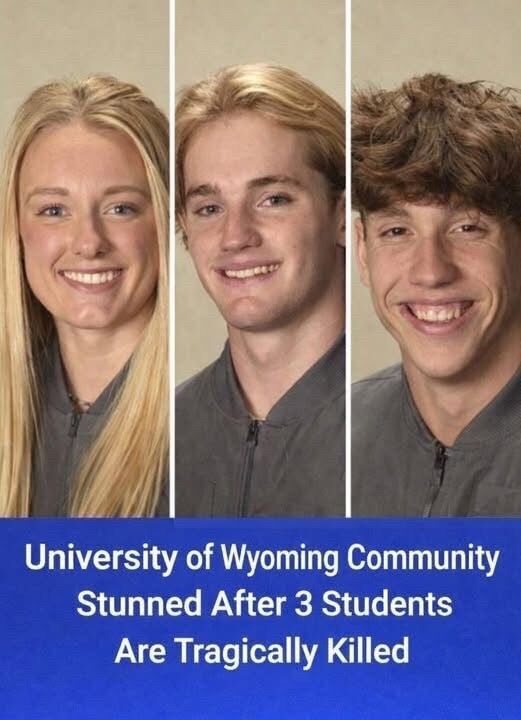
The University of Wyoming was plunged into collective shock when confirmation arrived that three members of its men’s swimming and diving team had been killed in a traffic accident near the Wyoming–Colorado border, a moment that instantly altered the emotional landscape of the campus. Charlie Clark, 19, Luke Slabber, 21, and Carson Muir, 18, were more than student-athletes; they were young people in the midst of building identities shaped by discipline, camaraderie, and hope. Traveling together with teammates, their Toyota RAV4 left the roadway at the intersection of U.S. Highway 287 and Red Mountain Road and rolled multiple times, ending three lives in a matter of seconds. News of the crash moved quickly through residence halls, classrooms, and athletic facilities, replacing ordinary routines with stunned silence. Friends struggled to comprehend how people they had laughed with, trained beside, and planned futures alongside could simply be gone. The suddenness of the loss made it especially cruel, leaving no time for preparation, no gradual reckoning, only the stark finality of absence. For a university community accustomed to celebrating potential and progress, the tragedy forced an abrupt confrontation with mortality, reminding everyone how fragile even the most promising lives can be.
As investigators from the Colorado State Patrol began their work, officials emphasized that the cause of the crash remained undetermined, with no factors ruled out, including speed, distraction, or impairment. This uncertainty has weighed heavily on those left behind, as unanswered questions often intensify grief rather than soothe it. The knowledge that the vehicle carried five occupants, two of whom survived, underscores how thin the line can be between life and death. The stretch of highway where the crash occurred, familiar to many students and residents, has taken on a new and somber meaning, transforming from an unremarkable route into a symbol of vulnerability. For families and friends, the investigative process represents both a search for truth and a painful reminder that clarity, even when it arrives, cannot undo what has been lost. Each update is awaited with hope for understanding, yet tempered by the realization that no explanation will ever feel sufficient. In moments like these, facts coexist uneasily with emotion, offering structure without solace, and leaving a community to wrestle with grief that has no easy resolution.
The survival of the two other teammates involved in the crash has brought its own complex emotional aftermath. While their injuries were described as non-life-threatening and they were released from hospital care, recovery extends far beyond physical healing. They now carry the weight of loss alongside gratitude for survival, a burden that can be difficult to articulate and even harder to bear. Within the swimming and diving program, the absence of Clark, Slabber, and Muir is felt in countless small ways: empty lockers, quieter practices, routines interrupted by memory. Teammates recall shared road trips, early morning workouts, and the unique bonds forged through competition and mutual sacrifice. These were not distant acquaintances, but people woven into daily life, whose presence shaped motivation and morale. Across campus, students who may never have met the athletes still feel the impact, because tragedies of this magnitude ripple outward, touching even those on the periphery. The loss serves as a reminder that a university is not just an institution, but a living community, bound together by relationships that make grief deeply communal rather than isolated.
University leadership moved quickly to acknowledge the scale of the tragedy and to offer support, making clear that although the students were not traveling on official university business, they were an integral part of the institution’s identity. President Ed Seidel spoke of a sorrow that extends far beyond athletics, emphasizing that the entire campus shares in the loss. Counseling and mental health resources were expanded, recognizing that people process grief in different ways and on different timelines. Some students experience shock and numbness, others deep sadness or anxiety, and still others a renewed fear that lingers long after the initial news fades. Vigils and informal gatherings emerged as students, faculty, and staff searched for ways to honor the lives lost and to comfort one another. In these moments, community becomes both refuge and reminder, offering connection while underscoring the shared nature of the pain. The presence of support does not erase grief, but it creates space for it to be acknowledged, expressed, and slowly integrated into collective memory.
Beyond the immediate mourning, the tragedy has prompted broader reflection on road safety and the realities of college life, particularly for student-athletes balancing demanding schedules with academic, social, and personal commitments. Long drives between competitions, practices, and home are often treated as routine, undertaken without much thought or hesitation. In the wake of the crash, conversations have shifted toward awareness and caution, not in a spirit of blame, but in recognition of shared vulnerability. Parents watching from afar have been reminded of the delicate balance between independence and protection, between trusting young adults to navigate the world and knowing that risk can never be fully eliminated. For the university community, the loss has underscored the importance of looking out for one another, of speaking up, slowing down, and recognizing that ordinary moments can carry extraordinary consequences. These reflections do not bring comfort, but they offer a way to honor the lives lost by reaffirming a commitment to care and responsibility.
As the University of Wyoming continues to mourn Charlie Clark, Luke Slabber, and Carson Muir, their legacy endures not only in records or accolades, but in the memories and values they leave behind. They are remembered for their dedication, their teamwork, their friendships, and the futures they were working toward with determination and optimism. Over time, the sharp edges of grief may soften, but the imprint of their absence will remain part of the university’s story. Healing will not be linear or uniform, and there will be moments when the loss feels newly raw, triggered by anniversaries, empty spaces, or quiet reflections. Yet within that pain lies a collective resolve to remember them as more than victims of a tragic accident. Through remembrance, shared support, and a willingness to confront difficult questions without allowing tragedy to define the community, the university seeks a path forward that honors three young lives and affirms the enduring importance of compassion, connection, and care in the face of irreparable loss.