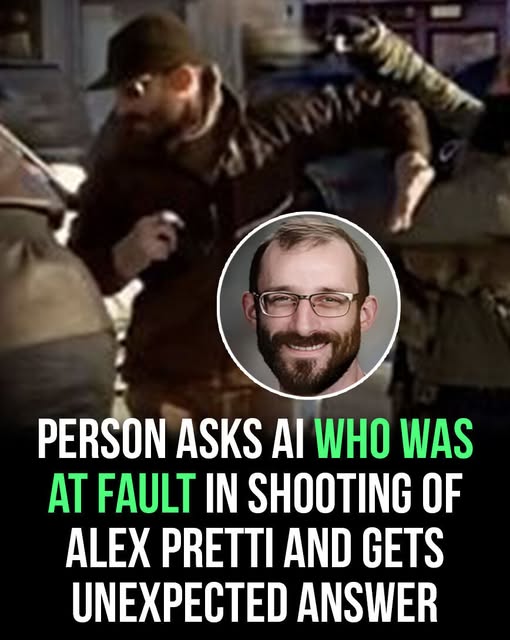
New AI Analysis of the Alex Pretti Shooting Fuels National Debate Over Federal Use of Deadly Force, Conflicting Video Evidence, Claims of Self-Defense, Public Protests, Political Polarization, and the Growing Role of Artificial Intelligence in Shaping Narratives, Accountability, and Trust in Law Enforcement During High-Stakes Encounters
An artificial intelligence analysis of the Alex Pretti shooting has injected new intensity into a case that was already dividing the public along political, cultural, and emotional lines. What began as a deadly encounter between federal agents and a civilian in Minneapolis has evolved into a national argument over truth, authority, and accountability. After multiple bystander videos circulated widely on social media, an independent user prompted an AI system to analyze the footage and assess whether the use of lethal force aligned with standard law-enforcement protocols. The system’s conclusion stunned many observers. Based on visible evidence alone, it stated that Pretti did not appear to present an immediate threat at the moment force was used and that deadly force, as shown in the footage, appeared unjustified. This assessment stood in stark contrast to official statements from the Department of Homeland Security, which asserted that Pretti approached agents while armed, resisted efforts to disarm him, and forced an agent to fire in self-defense. The gap between these two narratives has become the foundation of the controversy.
According to the AI’s breakdown of the footage, the sequence of events does not align with federal claims. The analysis noted that Pretti appeared to be holding a phone, not a firearm, during the initial confrontation. The system identified moments where agents physically engaged him, bringing him to the ground, and observed that the fatal shot appeared to be fired while Pretti was pinned. While a handgun was later recovered at the scene, the AI emphasized that it was not visibly in his hands during the moments leading up to the shooting. From a procedural standpoint, the system argued that law enforcement standards generally require an immediate and unmistakable threat to life before lethal force is justified. Based solely on what could be seen in the available footage, the AI concluded that responsibility appeared to rest with the agents rather than the individual who was killed. This conclusion did not claim to be a legal verdict, yet it challenged the official account strongly enough to reignite public scrutiny and skepticism.
The reaction online was swift and deeply polarized. Supporters of the AI’s assessment argued that it merely articulated what many viewers already believed the videos showed: a man subdued and shot without clear justification. Critics, however, accused the AI of overstepping its role, arguing that no algorithm can fully understand context, intent, or split-second decision-making in life-or-death encounters. Some users questioned whether the footage captured the entire incident, suggesting critical moments may have occurred outside the frame. Others framed the debate through a political lens, blaming the broader climate fostered by the Trump administration and its aggressive rhetoric around immigration and federal enforcement. Accusations that the shooting resembled an “execution” clashed with counterclaims that agents faced an unpredictable and potentially lethal threat. In this environment, facts often became secondary to ideology, with interpretations shaped less by evidence and more by deeply held beliefs.
Beyond social media, the case quickly spilled into the streets. Protests erupted not only in Minneapolis but also in cities such as New York, San Francisco, Boston, Providence, and Washington, DC. Demonstrators demanded accountability, transparency, and an end to what they described as unchecked federal power. Chants against ICE and federal enforcement agencies echoed through city centers, while critics of the protests warned that such demonstrations risked escalating tensions and undermining public safety. The Pretti shooting did not occur in isolation; it followed the earlier killing of Renee Nicole Good, an incident that had already intensified anger toward federal immigration operations. Together, these cases have come to symbolize broader fears about civil liberties, militarized policing, and the impact of federal enforcement actions in local communities. For supporters of the protests, Pretti’s death represents a breaking point. For opponents, it exemplifies the dangers officers face in an increasingly hostile environment.
Official responses from the federal government have remained firm and defensive. President Trump and several administration officials labeled Pretti a “domestic terrorist,” framing the shooting as a justified act of self-defense by agents operating under threat. Yet this framing has not gone unchallenged, even among typically supportive constituencies. The National Rifle Association issued a public statement criticizing the government’s rhetoric, warning against demonizing a lawful gun owner before the completion of a full investigation. The NRA’s position added an unexpected dimension to the debate, highlighting tensions between unwavering support for law enforcement and longstanding commitments to due process and gun-owner rights. The organization’s response underscored how the case defies easy categorization, disrupting traditional political alliances and exposing fractures within groups that often speak with one voice on issues of force and authority.
As the public debate rages, the legal process is moving forward with unusual intensity. A Minnesota judge issued a temporary restraining order preventing federal agencies from destroying, altering, or mishandling evidence related to the shooting, including video footage and physical materials. Such an order is rare and reflects widespread concern that critical evidence could be lost or compromised. At the same time, the White House announced that border czar Tom Homan would be sent to Minnesota to oversee enforcement operations and manage the fallout. Supporters view this as a show of resolve, while critics argue it risks further inflaming an already volatile situation. In the end, the AI analysis has not resolved the question of guilt or justification, but it has reshaped the conversation. By challenging the official narrative and forcing a closer look at the evidence, it has amplified calls for transparency and accountability. Whether its conclusions endure or are ultimately rejected, the Pretti case now stands at the intersection of technology, law enforcement, and public trust, illustrating how artificial intelligence is beginning to influence not only how events are interpreted, but how justice itself is debated.