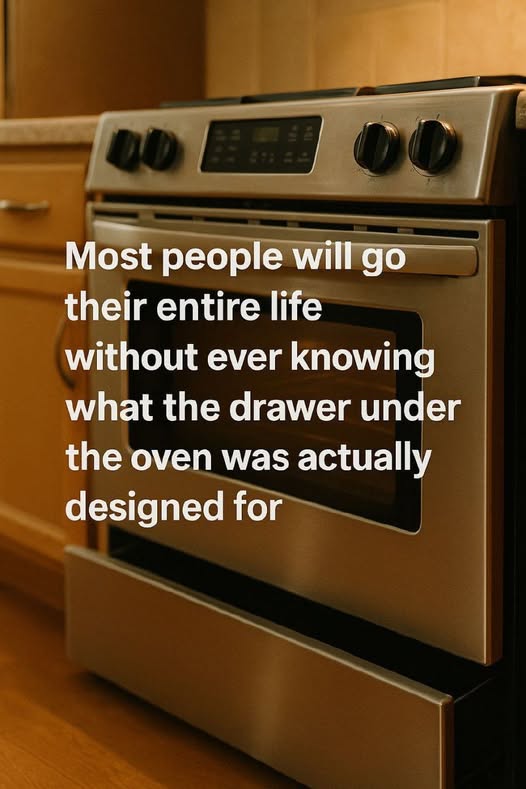
Most people will go their entire lives without realizing that the drawer beneath their oven was never intended to be a convenient hiding place for pots, pans, and baking sheets. This misunderstanding is not the result of a hidden feature or complicated design, but rather a habit formed over years of assumption and convenience. In most kitchens, space is always at a premium, and any empty compartment is quickly claimed for storage. Because the drawer sits directly under the oven and is large enough to hold bulky cookware, it feels natural to treat it as overflow space. Yet its original purpose was far more intentional. In many ovens, that drawer was designed as a warming drawer, meant to keep food at a safe, ready-to-serve temperature without continuing to cook it. This distinction matters more than most people realize. A warming drawer supports the rhythm of cooking, helping dishes come together at the right moment and reducing the stress that comes with juggling multiple foods. The irony is that while cooks often complain about timing issues and cold dishes, the very tool designed to solve those problems is frequently stuffed with metal pans and forgotten.
The evolution of the oven drawer tells a broader story about how kitchen design adapts to changing lifestyles and how easily purpose can be lost over time. Early household ovens did not always include a drawer underneath, and when they did, its function varied by model and manufacturer. As home cooking became more elaborate and entertaining at home grew more common, appliance makers began borrowing ideas from professional kitchens. In restaurants, maintaining proper food temperature between preparation and service is critical. Warming drawers became standard equipment, allowing chefs to stage dishes without sacrificing quality. Translating that concept into home kitchens was a logical step, but one that required user awareness to be effective. Over time, as manuals were discarded and appliances were replaced or inherited, the warming function faded from common knowledge. Without clear labels or frequent use, homeowners defaulted to the most obvious solution: storage. This quiet shift illustrates how even well-designed features can become invisible when daily habits take over, and how easily function gives way to convenience.
The drawer’s transformation into a storage compartment also reflects how modern kitchens are used. Cabinets fill quickly with cookware, small appliances, and specialty tools, leaving homeowners constantly searching for extra space. Flat items like baking sheets and roasting pans are especially awkward to store, making the oven drawer feel like a perfect solution. Its location reinforces the assumption that it belongs to oven-related tools, and its size invites overuse. Once filled, the drawer becomes part of the background of the kitchen, rarely questioned and almost never reconsidered. This habit is understandable, but it obscures the drawer’s true role in supporting the cooking process. Instead of being an active tool that helps manage timing and temperature, it becomes passive storage. The shift reveals how easily we prioritize immediate convenience over long-term efficiency, even when the latter could make cooking smoother and more enjoyable.
Understanding how a warming drawer actually works helps explain why it was included in the first place. Unlike an oven, which cooks food through high, direct heat, a warming drawer maintains a low, steady temperature—usually between 140°F and 200°F. This range is warm enough to keep food safe and pleasant to eat without drying it out or continuing the cooking process. Insulation and controlled heat allow dishes to rest until everything is ready to be served. This function is invaluable when preparing meals with multiple components that finish at different times. Instead of rushing or reheating, a cook can hold finished dishes at their peak while focusing on what remains. During holidays, dinner parties, or even busy weeknight meals, this can dramatically reduce stress. Food arrives at the table hot, coordinated, and intact, rather than staggered or overcooked. The warming drawer was designed to act as a buffer, smoothing out the natural timing challenges of cooking.
One reason the warming drawer remains misunderstood is that many people never check whether their oven actually has one. The difference between a warming drawer and a simple storage drawer is often subtle but important. Warming drawers usually include temperature controls, indicator lights, or labeled settings, sometimes even specialized options like bread proofing or plate warming. Storage drawers lack any controls and are simply hollow compartments. The safest way to know is by consulting the oven’s manual, which clearly states the drawer’s function. This step is more than a matter of curiosity; it is also about safety. Using a warming drawer as storage can be risky. Heat-sensitive items, blocked airflow, or trapped materials can lead to damage or even fire hazards. Knowing what the drawer is designed to do ensures it is used correctly and prevents problems that could easily be avoided with a bit of awareness.
The widespread misunderstanding of the oven drawer points to a larger issue in how we interact with everyday appliances. Many kitchen features are designed to make cooking easier, more efficient, and more enjoyable, yet they remain unused simply because their purpose is not obvious. Professional cooks routinely use warming drawers for tasks that home cooks rarely consider, such as proofing dough, keeping plates warm, or holding delicate foods at the perfect temperature. These small advantages can elevate the entire cooking experience. Even for ovens with storage-only drawers, intentional use still matters. Organizing the space thoughtfully or assigning it a clear purpose prevents clutter and frustration. Ultimately, the drawer under the oven serves as a reminder that thoughtful design often goes unnoticed until we take the time to understand it. When we do, everyday routines become smoother, meals come together more easily, and the kitchen transforms from a place of quiet stress into one of confident control and calm coordination.