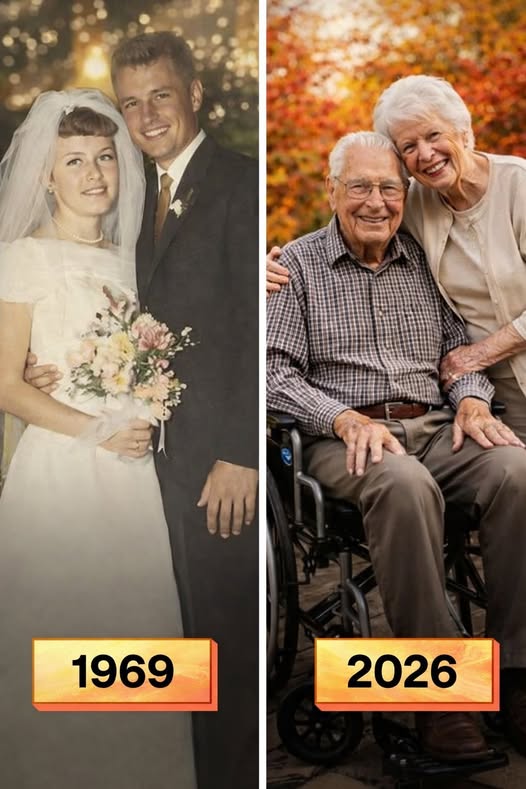
For fifty-seven years, every Saturday morning, my grandpa rose early, slipping quietly out of bed to select a bouquet for my grandma. He never hesitated, never forgot, never let the world interfere with this weekly ritual of devotion. Wildflowers, tulips, roses, or whatever he found that morning—each bloom was chosen carefully, each stem arranged as if he were speaking directly to her soul. In our family, we understood that the flowers were not simply decoration; they were a language, a silent expression of love that transcended words, a commitment renewed every seven days. For my grandma, the moment she stepped into the kitchen to find the vase brimming with color was a comfort, a reminder that she was seen, cherished, and endlessly loved. Those flowers were more than petals—they were proof, in living form, that love could be steady, unshakable, and generous without fail.
Then, after nearly six decades of unbroken routine, my grandpa passed away. The first Saturday without flowers hit with a cruel, sudden emptiness. Grandma wandered into the kitchen, expecting the familiar sight of blooms waiting for her, and found nothing. The empty vase seemed to echo through the silent room, amplifying her grief. Each day following felt heavier than the one before, a quiet weight pressing against her chest, punctuated by the absence of a ritual that had anchored their lives together. In those moments, grief was not just sorrow—it was a profound, destabilizing force that unsettled routines, memories, and the comforting rhythm of shared life. My grandma sat there, holding the vase as if it could somehow contain his presence, and whispered fragments of longing that only the dead could hear.
A week later, as if summoned by grief itself, there was a knock on the door. A stranger stood there, tall and quiet, holding a bouquet and a sealed envelope. My grandma, startled and unsure, accepted the gift. The man explained that my grandpa had arranged for this delivery before he died, leaving instructions to ensure that his devotion would continue even in absence. Her hands trembled as she opened the envelope, discovering a letter penned in my grandpa’s unmistakable handwriting. “There’s something I hid from you. Go to this address,” it read. Fear mingled with curiosity as she drove to the location, her imagination racing through possibilities: a secret lover, a confession, a mistake. Grief, I realized, can seed doubt even in the most secure love, planting questions that would never have existed in ordinary circumstances.
The address led to a small, secluded cottage tucked behind a grove of trees, where a woman named Ruby greeted us and welcomed my grandma inside. There, behind the house, lay a breathtaking sight: a garden unlike any I had ever seen. Flowers stretched in every direction, a riot of color and fragrance—roses, tulips, wildflowers, meticulously planned and nurtured over years. Ruby explained that my grandpa had purchased the property three years earlier and cultivated it in secret, intending it as a perpetual gift. Each section of the garden was carefully designed, each flower a continuation of the Saturday morning tradition. My grandma fell to her knees, tears streaming, realizing that her husband had crafted a tangible, living testament to his love, ensuring it would endure far beyond his presence in the kitchen. Every petal, every stem, every bloom was a message from the past, a promise kept, a life dedicated to her joy.
The garden became more than a private space—it became a sanctuary. Visiting it each week, my grandma felt my grandpa’s presence in the rustle of leaves, the sway of blooms, and the fragrance carried on the wind. Each visit was a conversation, a ritual, a chance to witness the enduring nature of love manifested in living form. I began to notice the little details he had orchestrated: paths that encouraged contemplation, clusters of flowers meant to surprise, benches tucked into shaded corners for reflection. The garden was not just an artistic endeavor but a message about patience, thoughtfulness, and the care required to nurture something truly beautiful. It was a daily reminder that love is a practice, sustained not only by words but by actions, consistency, and attention to another’s heart.
Now, decades later, the ritual continues. Every Saturday, my grandma walks through the garden, carefully cutting blooms to bring home. She places them in the same vase that once marked the start of her husband’s day-long devotion, filling her kitchen with color, scent, and memory. Children and grandchildren watch, learning that love is tangible, that devotion can survive absence, and that the quiet acts we perform daily may ripple across generations. My grandpa’s secret garden is no longer just a hidden testament; it is a living classroom about life, love, and fidelity of spirit. It teaches that even in loss, love can find ways to endure, bloom, and remind us that some bonds are too deep to break, too beautiful to be constrained by time, and too essential to fade. The flowers speak louder than words, whispering a truth my grandpa understood all along: some love never ends.