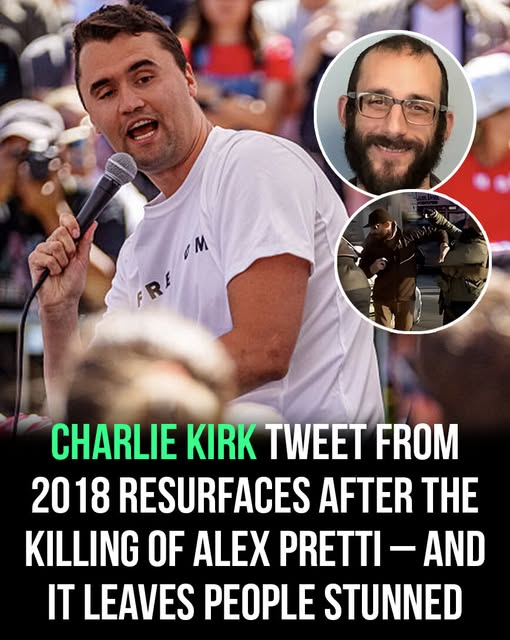
The fatal shooting of Alex Pretti by ICE agents in Minneapolis has already exposed deep fractures in public trust, but the resurfacing of a 2018 quote by conservative activist Charlie Kirk has given the controversy a new and more ideological dimension. Kirk’s statement—that the Second Amendment exists not for hunting or even personal self-defense, but as a safeguard against government tyranny—has reentered public discourse at a moment when many Americans are struggling to understand whether federal authority is being exercised responsibly or abusively. In the wake of Pretti’s death, the quote has spread rapidly across social media, detached from its original context and repurposed as both a warning and a provocation. For critics of the government’s handling of the shooting, Kirk’s words feel eerily prescient, reflecting a long-standing fear that unchecked power can turn lethal when citizens are cast as threats. For others, the quote is seen as dangerously inflammatory, risking justification for distrust, escalation, or even violence against law enforcement. That a single tweet from years ago can now shape how people interpret a modern tragedy underscores how fragile the national conversation has become, where past rhetoric collides with present trauma and amplifies an already volatile debate.
At the center of that debate remains the unresolved question of what actually happened in Minneapolis. The Department of Homeland Security has insisted that the ICE agent who fired the fatal shots acted in self-defense, claiming that Pretti approached officers with a firearm and posed an imminent threat. According to official statements, the agent feared for his life, and lethal force was justified under those circumstances. Yet this narrative has been challenged repeatedly by video footage circulating online, which appears to show Pretti holding what looks like a phone rather than a weapon in the moments before he was tackled. Other clips suggest he was wrestled to the ground by multiple agents and shot while restrained. Pretti’s family has categorically rejected the government’s account, calling it “sickening lies” and insisting that their son was not armed when he was taken down. They say he was trying to protect a woman who was being pepper-sprayed and knocked to the ground, a claim that aligns with some eyewitness accounts. The stark contrast between these versions of events has created a vacuum of trust, where every new piece of information is scrutinized not only for accuracy but for motive.
It is within this climate of suspicion that Charlie Kirk’s old tweet has taken on renewed significance. Written during a different political moment, the quote argued that the right to bear arms exists as a final check against oppressive government power. In isolation, it was a familiar talking point in Second Amendment advocacy. In the context of the Pretti shooting, however, it has become something else entirely: a symbolic lens through which many people are interpreting the incident. Critics of the administration have shared the quote as a grim commentary on what they see as the consequences of militarized enforcement and narrative control. Some have used it sarcastically, suggesting that the very government that champions law and order now appears to embody the fears the Second Amendment was meant to address. Others have expressed genuine anxiety, worrying that repeated fatal encounters between federal agents and civilians signal a breakdown in the social contract. At the same time, supporters of law enforcement argue that invoking such rhetoric in the aftermath of a shooting is reckless, framing agents as tyrants rather than public servants and undermining the legitimacy of lawful authority. The quote has thus become less about Kirk himself and more about the unresolved tension between fear of government overreach and fear of disorder.
The political stakes of the Pretti case have only grown as national leaders weigh in. The Trump administration and its allies have doubled down on their defense of ICE, emphasizing the dangers agents face and the necessity of firm enforcement to uphold immigration laws. President Trump has criticized the idea of carrying firearms at protests while simultaneously defending the agents involved, a stance that some see as contradictory and others view as pragmatic. Meanwhile, civil rights advocates and protesters argue that federal agents have overstepped their mandate, particularly given the deadly outcomes of recent operations in Minneapolis. The fact that Pretti was an ICU nurse has intensified public reaction, creating a painful contrast between a profession dedicated to saving lives and a death at the hands of the state. Adding to the gravity of the situation, a rare court order has been issued to prevent evidence related to the shooting from being altered or destroyed, signaling that the legal system recognizes the seriousness of public concern and the need for transparency. This judicial intervention has been interpreted by some as validation of skepticism toward official narratives, and by others as a routine but necessary safeguard in a high-profile case.
Another layer of complexity lies in the question of the weapon itself. DHS released images of a customized Sig Sauer P320 pistol and a loaded magazine allegedly carried by Pretti, emphasizing the seriousness of the perceived threat. The firearm, however, is common among law enforcement and military personnel, prompting debate over whether its mere presence—if it was indeed present—automatically justifies lethal force. Legal experts have pointed out that the standard for using deadly force is not simply whether a person is armed, but whether there is a reasonable belief of imminent danger. Some analysts argue that if Pretti had been disarmed or restrained at the moment he was shot, the justification for lethal force becomes far weaker. Others maintain that in chaotic protest environments, agents must make split-second decisions based on incomplete information, and that hindsight analysis can unfairly judge those decisions. This legal and ethical ambiguity has made it difficult for the public to reach consensus, especially when video evidence appears to support multiple interpretations depending on angle, timing, and expectation.
As protests continue across multiple cities, the Pretti shooting has evolved into a national moment of reckoning. Political leaders from across the spectrum have issued statements that often pull in opposite directions, deepening confusion rather than clarifying facts. Calls to defend democracy and warnings about lawlessness coexist uneasily in the public discourse, leaving many Americans unsure which values are truly being upheld. The resurfaced Charlie Kirk quote fits into this environment as a kind of rhetorical accelerant, framing the debate not just around a single incident, but around fundamental questions of power, rights, and accountability. For some, it captures a long-standing fear that government authority can become detached from the people it serves. For others, it represents the danger of normalizing distrust in institutions that are essential to public order.
Ultimately, the truth about Alex Pretti’s death has yet to be fully established, and it may only emerge through a transparent, independent investigation that commands broad public confidence. Until then, symbols and statements—videos, tweets, political speeches—will continue to fill the void left by uncertainty. The resurfaced Charlie Kirk quote has become part of that symbolic landscape, not because it provides answers, but because it reflects the anxieties shaping how Americans interpret this tragedy. Whether the Pretti case ultimately reinforces faith in accountability or deepens mistrust in federal authority will depend not only on legal findings, but on whether the nation can move beyond reflexive narratives and confront the harder work of truth, restraint, and responsibility in a deeply divided era.