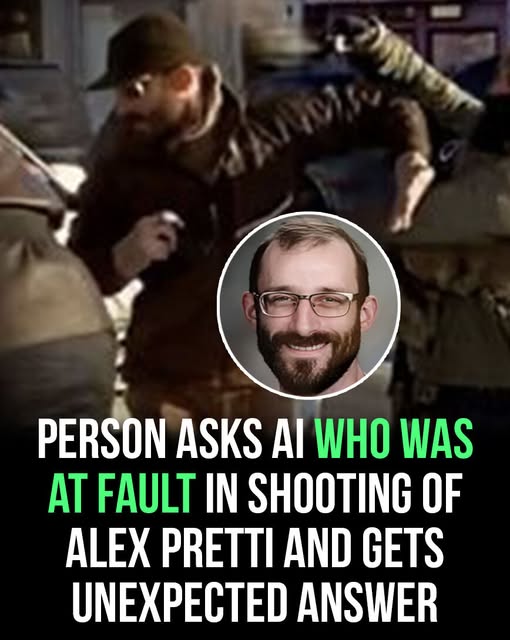
The fatal shooting of Alex Pretti in Minneapolis has already strained public trust in federal law enforcement, but the introduction of an artificial intelligence analysis into the debate has pushed the controversy into even more uncharted territory. What began as a tragic and contested use-of-force incident has now evolved into a broader argument about who gets to interpret reality in the digital age. After multiple bystander videos circulated online, an AI system was asked to analyze the footage and assess whether the shooting appeared justified under common law-enforcement standards. Its conclusion—that Pretti did not appear to pose an immediate threat and that the use of lethal force was likely unjustified—landed like a match in dry grass. For supporters of Pretti, the analysis validated what they believed they could already see with their own eyes. For defenders of the federal agents, it represented an overreach by technology into legal and moral territory it was never meant to occupy. The result has been a sharp escalation in an already volatile national argument, one that now encompasses not only policing and protest, but also the growing role of AI in shaping public understanding of violent events.
According to the AI’s assessment, the sequence of events visible in the videos contradicts key elements of the federal government’s narrative. The analysis emphasized that Pretti appeared to be holding a phone rather than a firearm in the moments before officers engaged him, and that he was forced to the ground by multiple agents. It further noted that the footage suggests he was shot while pinned, raising serious questions about whether he posed an immediate danger at the moment lethal force was used. While acknowledging that a handgun was later recovered from the scene, the AI pointed out that no available video shows Pretti aiming or brandishing a weapon during the confrontation. Under widely accepted law-enforcement principles, deadly force is meant to be a last resort, justified only by a clear and imminent threat to life. The AI’s conclusion that such a threat was not evident in the footage directly challenged statements from the Department of Homeland Security, which maintained that agents fired in self-defense after Pretti resisted disarmament. This contradiction has become one of the central fault lines in the case.
The reaction to the AI analysis has been swift, emotional, and deeply polarized. On social media, many users argued that the system merely articulated what human viewers had already concluded after watching the videos repeatedly. They shared the AI’s reasoning as if it were an expert witness, using it to bolster claims that Pretti’s killing amounted to an execution rather than a defensive act. Others, however, rejected the analysis outright, accusing the AI of lacking situational awareness, legal authority, and access to all relevant evidence. Critics warned that relying on AI to assign blame risks oversimplifying complex, high-stress encounters and could unfairly prejudice ongoing investigations. Some went further, arguing that technology should never be used to render moral judgments about life-and-death decisions made in chaotic environments. The debate revealed a deeper anxiety about the growing power of algorithms to influence public opinion, especially in cases where trust in official institutions is already eroding.
The controversy has unfolded against a backdrop of widespread protest and political tension. Demonstrations sparked by Pretti’s death spread far beyond Minneapolis, reaching cities such as New York, San Francisco, Boston, Providence, and Washington, DC. Protesters have framed the shooting as part of a broader pattern of excessive force by federal agents, particularly ICE, whose presence at protests has drawn increasing scrutiny. Chants and signs have called for accountability, transparency, and the curtailment of what demonstrators describe as unchecked federal power. Supporters of law enforcement, meanwhile, argue that these protests ignore the dangers agents face and contribute to an environment where officers are vilified before facts are fully established. The earlier killing of Renee Nicole Good, also involving ICE, looms large over the Pretti case, reinforcing perceptions that Minneapolis has become a flashpoint for unresolved tensions between federal enforcement and local communities. In this charged atmosphere, the AI analysis has functioned less as a neutral tool and more as a catalyst, intensifying emotions on all sides.
Official responses from the federal government have remained firm and defensive. President Donald Trump and his allies have continued to describe Pretti as a dangerous individual, with some officials labeling him a “domestic terrorist” and portraying the agents involved as victims of escalating hostility toward law enforcement. Yet the case has also produced unexpected fractures within traditional political alliances. The National Rifle Association, typically aligned with pro-law-enforcement and conservative positions, criticized the administration’s rhetoric, warning against demonizing a lawful gun owner before a full and independent investigation. That intervention underscored the unusual nature of the moment, where debates over gun rights, due process, and federal authority intersect in uncomfortable ways. The NRA’s stance highlighted concerns that the rush to assign blame—whether by politicians or through viral narratives—risks undermining fundamental principles of fairness and presumption of innocence.
As the public argument raged, the legal system began to assert its own authority. A Minnesota judge issued a temporary restraining order preventing federal agencies from destroying or altering any evidence related to the shooting, including video footage and official records. Such an order is rare and signals the seriousness with which the court views concerns about transparency and preservation of evidence. The decision reassured many critics who feared that crucial material could be lost or withheld, while also underscoring how little trust exists between the public and federal institutions in high-profile cases like this one. At the same time, the White House announced that border czar Tom Homan would be sent to Minnesota to manage tensions and oversee enforcement operations. Supporters framed the move as a show of resolve, while opponents warned it could further inflame an already volatile situation by doubling down on enforcement rather than de-escalation.
Ultimately, the AI analysis did not resolve the central question of whether the shooting of Alex Pretti was justified, but it profoundly altered how that question is being debated. By offering a structured interpretation of video evidence that contradicted official claims, the AI inserted itself into a space traditionally occupied by investigators, courts, and expert witnesses. For some, this represents a dangerous precedent, where complex human judgments are outsourced to algorithms. For others, it is an inevitable development in a world where technology increasingly mediates truth and trust. What is clear is that the Pretti case has become about more than one man’s death. It now encompasses broader struggles over authority, accountability, and who gets to define reality in moments of national crisis. As investigations continue and courts weigh evidence, the challenge facing the country is not only to determine what happened in Minneapolis, but to decide how truth itself is established in an age where videos, narratives, and artificial intelligence collide.