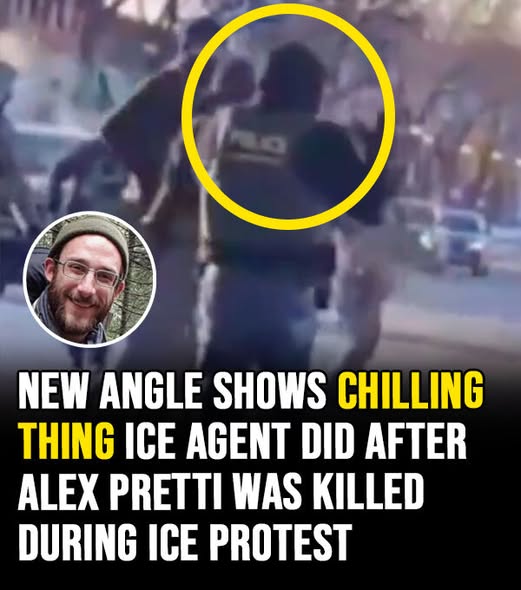
The emergence of a new video angle from the Minneapolis anti-ICE protest has injected fresh intensity into an already volatile national debate surrounding the killing of Alex Pretti, a 37-year-old intensive care nurse whose death has come to symbolize broader anxieties about federal authority, protest policing, and the use of lethal force. In the footage, which has spread rapidly across social media platforms, an ICE agent appears to clap his hands moments after gunfire erupts and Pretti is fatally shot. The brief but jarring gesture has been interpreted by many viewers as deeply disturbing, not because it conclusively proves misconduct, but because of what it seems to communicate in the immediate aftermath of a civilian’s death. In an environment already saturated with distrust and grief, the image has taken on an emotional power that far exceeds its few seconds of runtime. For supporters of Pretti and critics of ICE, it reinforces the belief that the shooting reflected a broader culture problem within federal enforcement. For others, it raises uncomfortable questions about optics, professionalism, and how actions—intentional or not—are perceived in moments of extreme consequence.
This new footage enters a narrative space already crowded with sharply conflicting accounts. Federal authorities, including the Department of Homeland Security, have consistently maintained that the shooting was justified, describing Pretti as armed and dangerous and asserting that agents acted in self-defense during a chaotic and threatening situation. Senior officials were quick to frame the incident as an attack on law enforcement, emphasizing the risks faced by federal agents operating amid protests that had grown increasingly tense. At the same time, Pretti’s family, eyewitnesses, and civil rights advocates have rejected that characterization, pointing to other videos that appear to show him holding a phone, attempting to help a woman who had fallen, and being taken to the ground before shots were fired. The clapping video does not directly answer the central legal questions about whether lethal force was justified, but it has profoundly shaped public perception by adding an unsettling emotional layer to the debate. In a case where trust is already fragile, even ambiguous gestures can take on enormous symbolic weight.
Understanding why this particular clip has resonated so strongly requires attention to the broader context in which Pretti was killed. Minneapolis was already on edge following the recent death of Renee Nicole Good in another ICE-related shooting, and protests against federal immigration enforcement had intensified across the city. Demonstrators viewed ICE not merely as a law enforcement agency but as a symbol of policies they believed were harming vulnerable communities and operating with insufficient oversight. Federal agents, for their part, were deployed into an environment where hostility toward their presence was open and often vocal. This convergence of anger, fear, and political polarization created a setting in which every interaction was charged with meaning. In such a climate, actions that might otherwise be dismissed as misinterpreted or insignificant are instead scrutinized as potential indicators of deeper attitudes. The appearance of an agent clapping after a fatal shooting therefore became, for many observers, less about that individual’s intent and more about what it seemed to reveal regarding institutional values and accountability.
The emotional reaction to the footage has been amplified by what is known about Pretti himself. Those who lived near him, worked with him, or loved him have described a man defined by compassion rather than confrontation. As an ICU nurse at the Minneapolis VA Medical Center, Pretti spent his professional life caring for people at their most vulnerable, navigating life-and-death decisions with restraint and empathy. Neighbors recalled him as helpful and attentive, someone who looked out for others and engaged with his community. His family has emphasized that his participation in anti-ICE protests stemmed from moral conviction, not hostility, and that he believed federal enforcement practices were inflicting unnecessary harm. Against this backdrop, the image of an agent appearing to clap after his death feels especially stark to many viewers. It seems to collide violently with the idea that a life dedicated to saving others ended amid what appears, at least superficially, to be a moment of disregard. Whether that perception is fair or not, it has become a powerful driver of public outrage.
At the same time, supporters of federal agents caution against drawing definitive conclusions from a single clip divorced from full context. They argue that video footage can be misleading, especially in chaotic situations where gestures may be misread or taken out of sequence. From this perspective, the clapping could have been a signal to other officers, a stress response, or an unrelated action occurring in the fog of a rapidly unfolding crisis. Law enforcement advocates emphasize that agents operating in volatile protest environments face split-second decisions and extreme psychological pressure, and that post-incident behavior does not necessarily reflect malice or celebration. They warn that viral clips can inflame passions and prejudice investigations, making it harder to arrive at an objective understanding of events. This tension between emotional reaction and evidentiary caution lies at the heart of the controversy, highlighting the challenge of interpreting human behavior through fragmented digital records.
Nevertheless, the video has intensified demands for transparency that were already growing before its release. Civil rights organizations, protest leaders, and many members of the public are calling for a fully independent investigation that includes the release of all body-camera footage, unedited surveillance recordings, forensic evidence, and a detailed timeline of events. They argue that only comprehensive disclosure can resolve contradictions between official statements and what appears in publicly available videos. The clapping footage has become a rallying point in these calls, not because it definitively proves wrongdoing, but because it underscores how little the public feels it knows about what truly happened in Pretti’s final moments. Without transparency, critics contend, trust will continue to erode, and every new piece of evidence—no matter how ambiguous—will be interpreted through suspicion rather than confidence in the investigative process.
The political dimension of the case has further complicated matters. Early and forceful statements from senior officials framed Pretti as a dangerous aggressor before independent investigations could be completed, shaping the narrative in ways that many believe were premature. Critics argue that such statements risk prejudicing public opinion and potentially influencing investigative outcomes, while supporters maintain that leaders have a responsibility to defend federal agents against what they see as unfair accusations. The new video has reignited debate over whether the administration’s communication strategy prioritized institutional defense over factual restraint. In highly polarized times, these questions take on added significance, as public confidence in government institutions depends not only on outcomes but on the perceived integrity of the process.
Beyond the immediate case, the Pretti shooting and the reaction to the clapping video have broader implications for how federal law enforcement operates in protest settings. The incident has prompted renewed scrutiny of training, rules of engagement, and oversight mechanisms governing ICE and other federal agencies. Critics argue that agencies primarily tasked with immigration enforcement may lack appropriate preparation for crowd control and de-escalation in politically charged demonstrations. Supporters counter that federal agents must be equipped to protect themselves and others regardless of the setting. The debate reflects a deeper national struggle over the balance between security and civil liberties, particularly when protests challenge government policy. In this sense, the clapping video has become more than an isolated controversy; it is part of a larger conversation about how authority is exercised and perceived in democratic societies.
As investigations continue, the image of the agent clapping after the gunshot will likely remain etched in the public imagination, not because it resolves the case, but because it encapsulates the unease and anger surrounding it. For some, it will stand as a symbol of alleged callousness and impunity; for others, as a cautionary example of how incomplete evidence can inflame judgment. What remains clear is that the death of Alex Pretti has left deep scars, both personal and political, and that restoring trust will require more than official assurances. It will require transparency, accountability, and a willingness to confront uncomfortable questions about power, perception, and responsibility. Until those questions are answered with clarity rather than rhetoric, the controversy will persist, and each new piece of footage will continue to reverberate far beyond the streets of Minneapolis.