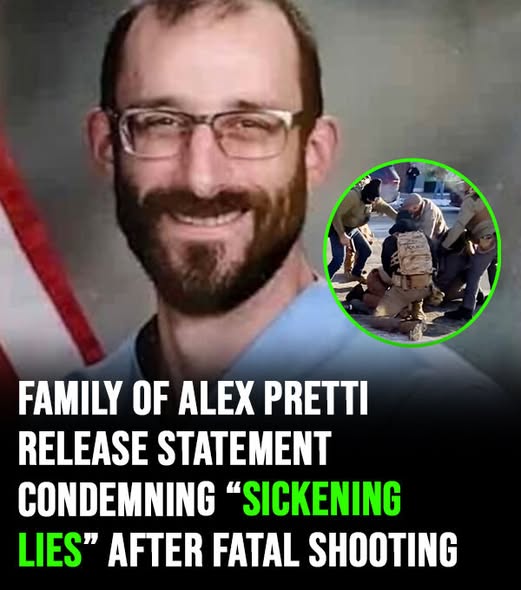
The killing of Alex Pretti has detonated a new wave of national anger, grief, and distrust, transforming what federal officials initially framed as a routine act of self-defense into a profound crisis of credibility for the Trump administration. Pretti, a 37-year-old intensive care nurse and U.S. citizen, was fatally shot by an ICE agent during an anti-ICE protest in Minneapolis, an event that unfolded amid already heightened tensions following another ICE-related killing weeks earlier. Almost immediately after his death, senior administration figures moved to define the narrative, asserting that Pretti was armed, violent, and posed an imminent threat to federal officers. But as video footage spread and eyewitness accounts surfaced, the family of Alex Pretti forcefully rejected those claims, calling them “sickening lies” and accusing the administration of smearing their son to justify lethal force. Their statement did more than express grief; it directly challenged the legitimacy of the official story and reframed the incident as a test of whether truth or power would prevail when federal authority is under scrutiny.
From the earliest hours following the shooting, the administration’s messaging was decisive and unambiguous. Homeland Security Secretary Kristi Noem claimed Pretti arrived at the protest intent on inflicting harm, asserting that agents faced a grave and immediate danger. Border Patrol Commander Gregory Bovino reinforced that framing, emphasizing that Pretti allegedly carried a semi-automatic weapon and characterizing federal agents as victims narrowly escaping catastrophe. White House senior adviser Stephen Miller escalated the rhetoric further, labeling Pretti an “assassin” and invoking the language of terrorism to describe the encounter. President Donald Trump echoed these themes, criticizing Pretti for bringing a firearm to a protest and suggesting the shooting was an unfortunate but justified outcome of irresponsible behavior. These statements were issued rapidly, before independent investigators had completed reviews and before the public had access to comprehensive evidence. To critics, the speed and certainty of these claims suggested a coordinated effort to lock in public perception, minimizing doubt and foreclosing scrutiny by portraying the victim as inherently dangerous.
As those assertions circulated, a parallel narrative emerged from video footage and eyewitness testimony that complicated, and in some cases directly contradicted, the administration’s account. Multiple videos recorded by bystanders show Pretti moving through a chaotic protest scene, speaking with officers, and attempting to help others who appeared injured or distressed. In several clips, he is clearly visible holding a phone in his hand, not a firearm, moments before officers converge on him. Other footage captures Pretti being pepper-sprayed and forced to the ground by multiple ICE agents, after which a rapid series of gunshots can be heard. Witnesses reported hearing at least ten shots fired. Particularly troubling to many observers are videos that appear to show a firearm being removed from Pretti’s body after he was already pinned on the ground, raising the possibility that he may have been disarmed before lethal force was used. While the footage does not provide a complete, uninterrupted account of the encounter, it has introduced reasonable doubt into claims that Pretti posed an immediate, lethal threat at the moment he was shot.
The Pretti family responded with a statement marked by grief, fury, and moral clarity, directly confronting the administration’s portrayal of their son. They described the official claims as “reprehensible and disgusting,” insisting that Alex was not holding a gun when he was attacked and emphasizing that he was holding a phone while trying to protect a woman who had been pushed to the ground by officers. According to the family, his left hand was raised defensively as agents descended on him, a detail they say is visible in multiple videos. They rejected characterizations of Alex as violent or malicious, describing him instead as a compassionate ICU nurse who spent his life saving others, including during the COVID-19 pandemic. His presence at the protest, they explained, was motivated by conscience and concern for human dignity, not aggression. By naming the administration’s statements as lies rather than misunderstandings, the family shifted the conversation from factual dispute to ethical reckoning, accusing those in power of sacrificing truth to protect authority.
The family’s accusations have intensified demands for transparency and accountability well beyond Minneapolis. Civil rights organizations, medical associations, protest groups, and legal scholars have called for independent investigations, the immediate release of all body-camera footage, and a detailed timeline reconstructing the moments before and after the shooting. Critics argue that the administration’s early framing mirrors a familiar pattern in high-profile law enforcement killings: victims are rapidly depicted as threats, official statements are amplified through sympathetic media channels, and doubts raised by evidence are dismissed as partisan or anti-law-enforcement. This pattern, they contend, corrodes trust in institutions and undermines the principle that lethal force must be justified by clear, demonstrable necessity. Supporters of ICE counter that agents operate under extraordinary danger, that split-second decisions cannot be judged through fragmented videos, and that critics risk demoralizing law enforcement by assuming bad faith. The collision of these perspectives has made the Pretti case a lightning rod in broader debates over immigration enforcement, protest rights, and the acceptable limits of state power.
The outrage surrounding Pretti’s death has also been amplified by its timing. Minneapolis was still reeling from the killing of Renee Nicole Good, another civilian shot by an ICE agent weeks earlier, creating a sense among residents that federal operations were spiraling into unchecked violence. Protests expanded not only in size but in tone, with demonstrators expressing fear that ordinary citizens were being treated as enemy combatants. For many in the city, Pretti’s killing confirmed their worst suspicions: that federal enforcement actions were being carried out with a mindset more akin to occupation than policing, and that accountability would be elusive once lethal force was used. The administration’s aggressive rhetoric, rather than calming tensions, deepened the divide, reinforcing perceptions that dissent itself was being criminalized. In this climate, the Pretti family’s insistence on truth resonated far beyond personal loss, becoming a rallying cry for those demanding systemic change.
As investigations proceed, the outcome remains uncertain, but the significance of the moment is already clear. Alex Pretti’s death has become more than a tragic encounter; it is a referendum on how power is exercised, how narratives are constructed, and whether accountability can survive polarization. The family’s refusal to accept the administration’s version of events has forced the public to confront uncomfortable questions about credibility, transparency, and the human cost of enforcement policies. Whether the evidence ultimately supports or refutes federal claims, the damage to public trust is undeniable. In a nation already fractured by political division, the case stands as a stark reminder that when authorities rush to judgment and families are left to fight for their loved one’s humanity, the legitimacy of institutions themselves is put at risk. What happens next will not only determine responsibility for Alex Pretti’s death, but will also signal whether truth can still assert itself against power in moments of national crisis.