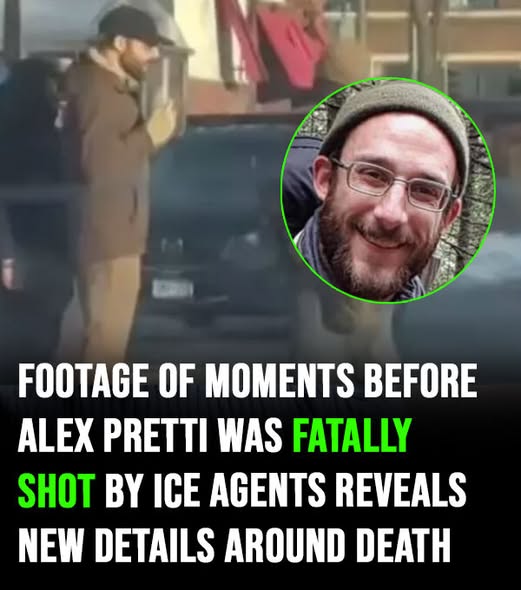
Newly surfaced footage documenting the final minutes before Alex Pretti was fatally shot by ICE agents has injected renewed urgency and complexity into an already volatile national controversy. Pretti, a 37-year-old intensive care nurse and outspoken critic of federal immigration enforcement, was killed during an anti-ICE protest in Minneapolis amid heightened tensions and a heavy law-enforcement presence. The videos—recorded by bystanders on phones and captured by nearby security cameras—do not resolve the case with a single, definitive answer. Instead, they complicate it, revealing fragments of a chaotic scene that appear to challenge federal assertions while leaving critical moments obscured by bodies, angles, and noise. In the footage circulating widely, Pretti is seen navigating a dense crowd, speaking animatedly with officers, attempting to assist others, and ultimately being forced to the ground by multiple agents. What is absent from these recordings is just as consequential as what is visible: a clear, unambiguous moment showing Pretti posing an imminent lethal threat. This absence has become central to public debate, shifting attention from whether Pretti was armed at any point to whether he represented immediate danger at the moment lethal force was used, and whether decisions made under pressure adhered to principles of proportionality and restraint.
The broader context surrounding Pretti’s presence at the protest helps explain why his death has resonated so deeply. Minneapolis had already become a focal point of national anger following another ICE-related killing weeks earlier, an incident that intensified distrust and galvanized opposition to federal enforcement tactics perceived as aggressive and opaque. Against this backdrop, protests expanded in size and intensity, drawing residents alarmed by what they viewed as a pattern of escalation and a lack of accountability. According to family members and colleagues, Pretti’s participation was driven by conscience rather than confrontation. As an ICU nurse, he was accustomed to high-stress environments and trained to prioritize life in moments of crisis. Those closest to him say he was deeply troubled by enforcement practices he believed harmed vulnerable communities and eroded basic dignity. In several clips, Pretti appears to direct traffic, speak calmly to individuals in distress, and intervene when a woman is shoved to the ground—details that align with the image his family presents of a man motivated by care rather than aggression. These moments, frozen and replayed online, have become touchstones for supporters who argue that Pretti’s actions were consistent with de-escalation, not violence.
Federal authorities have maintained a sharply different account. Statements from the Department of Homeland Security assert that an ICE agent fired in self-defense after Pretti allegedly resisted efforts to disarm him and posed a serious threat. Senior officials described the encounter with certainty, framing agents as responding to an imminent danger in a volatile environment. Yet the credibility of these assertions has been tested by the footage now in public view. In multiple videos, Pretti is clearly seen holding a phone shortly before being taken down, not a firearm. While authorities contend that a weapon was present and that the situation evolved rapidly, the lack of publicly released footage showing Pretti brandishing or aiming a gun prior to the takedown has fueled skepticism. The discrepancy between official language and visual evidence has widened a trust gap, particularly given the speed with which conclusions were announced. For critics, this pattern echoes previous cases in which early narratives shaped public perception before independent investigations could weigh the evidence. For supporters of enforcement, it underscores the limitations of partial recordings that may not capture the full threat environment facing agents.
Eyewitness accounts and independent analysis have added further layers of complexity. Videos from multiple angles show Pretti being pepper-sprayed after he appears to assist a woman who had fallen, an action that draws additional officers into close proximity. In the confusion that follows, he is tackled, pinned, and surrounded. Some footage suggests officers striking him while he is on the ground, though interpretations vary and context remains contested. A particularly disputed detail involves the timing of the firearm’s removal. At least one clip appears to show an object being taken from Pretti’s lower body area before shots are fired, raising the question of whether he had been disarmed at the moment lethal force was used. Audio from the scene captures a rapid succession of gunshots—far more than a single discharge—intensifying scrutiny of decision-making once Pretti was subdued. None of these fragments, viewed in isolation, provides certainty. Together, they shift the focus from abstract claims to concrete questions about sequence, timing, and judgment under stress, all of which investigators must now reconcile.
The emotional gravity of the case has been magnified by the testimony of Pretti’s family, particularly his father, who has spoken publicly about his son’s values and motivations. He described Alex as compassionate, principled, and deeply disturbed by what he believed were unjust enforcement practices. According to his family, Pretti viewed protest as a moral obligation consistent with his work as a healthcare professional committed to preserving life. This portrayal stands in stark contrast to federal characterizations depicting him as a violent agitator. For many observers, the dissonance between these narratives reflects a broader pattern in high-profile law-enforcement killings, where victims are swiftly framed as threats before evidence is fully examined. That pattern, critics argue, erodes confidence in institutions and deepens polarization, especially when families feel compelled to defend the humanity of loved ones against official accounts delivered with authority but limited transparency.
Beyond the specifics of Pretti’s death, the release of new footage has reignited national debates about protest policing and federal authority. Critics question whether ICE agents are adequately trained for crowd control and de-escalation at large demonstrations, particularly when protests are not directly related to immigration enforcement operations. They argue that the presence of heavily armed federal agents can escalate tensions and increase the likelihood of deadly outcomes. Supporters counter that agents must be able to protect themselves in hostile environments and that protests can quickly become unpredictable. Even within law enforcement circles, however, there is growing concern about how rapidly encounters escalate and how often lethal force is deployed in situations that might otherwise be resolved through containment or disengagement. The Minneapolis case has become emblematic of these tensions, illustrating how protest, policing, and politics can collide with irreversible consequences.
The death of Alex Pretti now stands as a pivotal moment in an ongoing national reckoning over enforcement, protest rights, and accountability. The newly surfaced videos have not closed the case; they have widened it, exposing inconsistencies, sharpening questions, and intensifying demands for independent review. For some, the footage confirms fears of excessive force and narrative manipulation. For others, it underscores the peril officers face in volatile settings where milliseconds matter. What is undeniable is that Pretti’s killing has left a lasting mark on Minneapolis and beyond, deepening divisions while galvanizing calls for transparency and reform. As investigators analyze evidence and the public continues to scrutinize those final minutes, the challenge facing the nation is not only to determine responsibility, but to confront how authority is exercised, explained, and constrained in moments when lives hang in the balance.