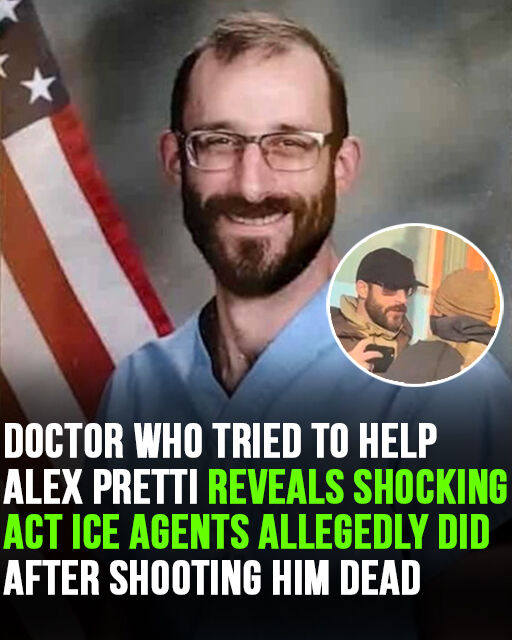
The fatal shooting of Alex Pretti in Minneapolis has reverberated far beyond the city where it occurred, cutting into a national conversation already strained by debates over immigration enforcement, policing, and the limits of state power. Pretti, a 37-year-old intensive care nurse and U.S. citizen, was killed during a confrontation involving ICE agents amid heightened protests over federal enforcement tactics. In the immediate aftermath, officials framed the shooting as an act of self-defense, a familiar narrative in cases involving lethal force by authorities. Yet what distinguished this incident, and propelled it into national consciousness, was not only the violence itself but the allegations about what happened afterward. A physician who witnessed the scene provided a sworn statement claiming that instead of urgently administering life-saving aid, agents focused on counting Pretti’s bullet wounds. That detail, stark and unsettling, shifted public attention from the split-second decision to fire to the minutes that followed, when the obligation to preserve life should have been paramount. For many observers, this allegation transformed the event from a disputed tactical encounter into a profound moral crisis, raising doubts about whether institutional priorities had eclipsed basic human responsibility.
The context surrounding Pretti’s death amplified its impact. Minneapolis had already been grappling with public anger following another ICE-related shooting weeks earlier, when Renee Nicole Good, a 37-year-old mother, was killed during a separate enforcement operation. These back-to-back deaths intensified the sense that federal actions in the city were escalating without adequate oversight or coordination with local authorities. Protests grew not only in size but in emotional intensity, fueled by grief, fear, and a perception that residents were being treated as collateral damage in a broader political agenda. Pretti’s role in this environment was especially poignant. He was not an immigration target, but a citizen present amid chaos, someone whose professional life revolved around saving critically ill patients. His family emphasized this repeatedly, struggling to reconcile his identity as a caregiver with portrayals suggesting he posed a grave threat. As federal statements asserting justification were released rapidly, before independent reviews could unfold, skepticism deepened. To many, the speed and certainty of official conclusions felt less like transparency and more like narrative control, reinforcing long-standing concerns about how power is exercised and explained after deadly encounters.
Central to the controversy is the tension between official accounts and emerging contradictions. The Department of Homeland Security stated that the agent involved acted in self-defense and that Pretti was armed with a handgun. Local officials complicated this picture. Minneapolis Police Chief Brian O’Hara confirmed that Pretti was believed to be a lawful gun owner with a valid permit to carry, a fact that raised critical questions about whether possession alone justified lethal force. At the time of reporting, no publicly released evidence showed Pretti aiming or firing a weapon at agents. This gap between assertion and documentation became a focal point for critics, who noted a recurring pattern in which victims of law enforcement shootings are quickly framed as imminent threats. For Pretti’s family, such implications were deeply painful, casting a shadow over his memory before facts could be fully examined. Civil rights advocates argued that these early narratives shape public perception in ways that are difficult to undo, undermining confidence in subsequent investigations. In a climate of distrust, even accurate statements can be doubted, and inconsistencies, however small, take on outsized significance.
The physician’s eyewitness testimony intensified these concerns by introducing a perspective grounded in medical ethics and emergency response. In the sworn statement, the doctor described seeing Pretti shouting at agents but not attacking them or brandishing a weapon. According to the account, an agent shoved Pretti to the ground, multiple firearms were drawn, and several shots were fired. What followed, however, became the most disturbing element of the narrative. The physician stated that when the shooting stopped, they attempted to provide aid but were confused by Pretti’s positioning and by the actions of the agents. Standard emergency protocol, the doctor explained, prioritizes checking for a pulse, securing an airway, and initiating CPR when necessary. Instead, the witness alleged, agents appeared to be counting bullet wounds. To a medical professional, this behavior was not merely unusual but deeply alarming, suggesting a departure from the most basic principles of life-saving care. Whether this perception accurately reflects the agents’ intent or actions remains under investigation, but the allegation alone struck a nerve, crystallizing fears that once force is used, compassion may fall away.
Federal officials have forcefully rejected claims of misconduct, emphasizing the dangers agents face and the need to secure scenes before rendering aid. Border enforcement representatives went further, asserting that Pretti was attempting to “massacre law enforcement,” language that inflamed an already polarized public response. Supporters of ICE argue that agents operate under constant threat and must make rapid decisions in volatile environments, where hesitation can cost lives. Critics counter that such rhetoric is inflammatory and unsupported by evidence released thus far, serving to justify force rather than illuminate facts. Even among law enforcement professionals, there is broad agreement that once a suspect is subdued and no longer poses a threat, providing or facilitating medical assistance is a fundamental duty. The physician’s account therefore raises ethical questions that transcend this single case, prompting scrutiny of training standards, use-of-force policies, and post-incident protocols within federal agencies. Calls have grown louder for the release of body-camera footage, radio logs, and precise medical timelines to establish what occurred between the final gunshot and the arrival of paramedics.
As investigations continue, the death of Alex Pretti has come to symbolize broader anxieties about authority, accountability, and the erosion of trust between the public and institutions meant to serve it. Minneapolis has become a focal point for these tensions, with ongoing protests and legal challenges reflecting a community struggling to reconcile safety with justice. For many Americans, the issue now extends beyond whether the shooting itself was justified. It encompasses questions about transparency, the sanctity of human life after force is used, and whether systems designed to enforce law are adequately constrained by empathy and oversight. Pretti’s family has appealed for patience and truth, asking that his death not be reduced to competing press releases or partisan talking points. Their plea resonates in a nation weary of unresolved tragedies and conflicting narratives. The story is still unfolding, but its implications are already clear: how authorities act in moments of chaos, and how they account for those actions afterward, will shape not only legal outcomes but public faith itself. Whether this case leads to meaningful reflection and reform remains uncertain, but the questions it raises are unlikely to fade.