The night everything began to unravel did not announce itself with shouting or slammed doors. It arrived quietly, the way exhaustion often does, settling into the body after months of mistaking endurance for stability. Long after midnight, the kitchen clock glowed softly as I stood alone, wondering how a life could fracture without making a sound. By then, my husband Caleb had already filed for divorce. On paper, the reasons looked reasonable, even restrained. He said we had grown apart. He said the arguments had become too frequent. He said I was emotionally overwhelmed and unable to manage stress. He presented himself as calm, consistent, dependable—the parent who kept our family functioning. At first, I was too tired to challenge those words, too worn down to recognize how carefully they were arranged to construct a version of reality where I slowly disappeared.
Our daughter Harper was ten years old, balanced delicately between awareness and innocence. She sensed the tension but still believed that adults ultimately knew what they were doing, or at least that they should. What I did not know then was that she had been carrying something heavy on her own, something frightening she did not yet have the language to explain. While I lay awake worrying about legal filings, schedules, and financial uncertainty, my child was learning how to survive quietly. The divorce proceedings moved quickly, fueled by confidence on Caleb’s side. His attorney spoke with practiced assurance, describing a household burdened by my emotions and instability. I was portrayed as fragile and reactive, while he was framed as the stabilizing force—the parent best equipped to maintain routine and order. Sitting in that courtroom, I felt as though a stranger’s life was being narrated using only his version of events, and I had no evidence strong enough to interrupt the performance.
I wanted to explain the things that never left marks. The way my body tensed when his mood shifted. The way the air in a room seemed to change when his voice hardened. The way I learned to read warning signs before words were spoken. But none of that felt measurable or admissible. The court wanted facts, not feelings. Harper sat beside me, her feet dangling above the floor, her hands folded neatly in her lap. She was quieter than usual, her eyes fixed on the wood grain of the bench ahead of her. When the judge asked if there was anything further to add before adjourning, I shook my head, already preparing myself for the slow erosion of everything I believed fairness was supposed to mean. I had no idea that the most important voice in the room had not spoken yet.
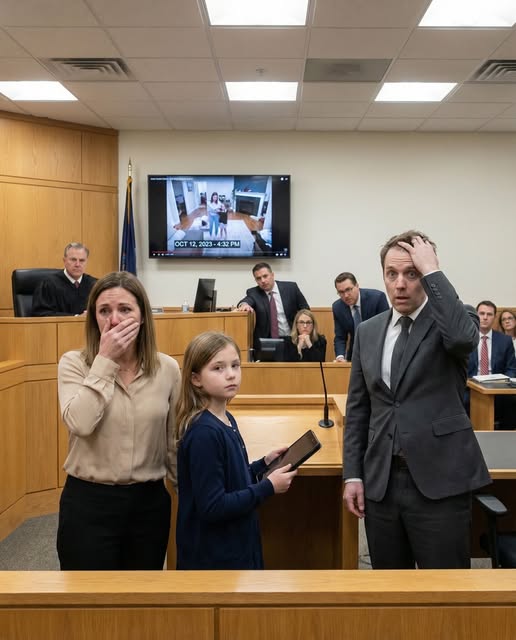
That voice came when Harper stood up. Her chair scraped softly against the floor as she asked, “Your Honor, can I show you something Mommy doesn’t know?” The room froze. The judge leaned forward, his expression careful and attentive, and asked if she felt safe speaking. She nodded, though her hands trembled at her sides. Every instinct in me wanted to protect her, to pull her back into the safety of silence, but I stayed still. I had learned—painfully—that silence had never protected either of us. Harper reached into her jacket pocket and pulled out a small tablet, worn at the corners and smudged with fingerprints. She explained that it was a video, something she recorded because she was afraid she might forget what happened. When the device was connected to the courtroom screen, confusion gave way to dread I couldn’t yet name.
The video opened with a timestamp glowing in the corner, showing a late hour deep into the night. Our kitchen appeared on the screen, ordinary and familiar. Then Caleb’s voice filled the room, stripped of the calm polish he wore in public. He was shouting—not at me, but at our child. His words were sharp and relentless, ordering her to stop crying, blaming her for stress, warning her not to tell me what was happening. Harper’s small, shaking voice could be heard asking for me. At one point, the sound of something breaking echoed through the speakers, making people in the courtroom flinch. I felt detached from my body, watching a truth I had sensed but never fully seen. When the screen went dark, silence followed. The judge’s expression had changed, professional distance replaced by something heavy and unmistakably human. Harper explained that she recorded the video because if she forgot, she worried it might stop being real. But she couldn’t forget. That day ended without an immediate ruling, but the narrative so carefully constructed collapsed—not through argument, but through evidence carried by a child.
In the weeks that followed, the language of the case shifted. Evaluations were ordered. Visits became supervised. Therapy and safeguards were mandated. Where Caleb had once been described as stabilizing, the documents now spoke of concern and risk. I was granted primary custody, not as a victory, but as a necessary measure to ensure safety. Outside the courthouse, Harper clung tightly to my hand, her body finally releasing tension it had carried for far too long. She apologized for not telling me sooner, her voice barely audible. I knelt in front of her and told her what she needed to hear: that fear does not erase bravery, that silence is not consent, and that she protected herself the only way she knew how.
Healing did not arrive all at once. It came slowly—through therapy appointments, difficult conversations, and learning to release the guilt that hindsight tries to impose. Harper began sleeping through the night again. She laughed more freely. I learned that safety is not created by appearances or persuasive arguments, but by listening when a child finally speaks. That day in court changed more than custody arrangements. It reshaped my understanding of strength. Sometimes it looks like authority. Sometimes it looks like control. And sometimes, it looks like a small girl standing in a room full of adults and saying, quietly and bravely, “I have something to show you.”