Travel has always carried an unspoken promise: that stepping away from home will bring rest, novelty, and renewal. Over time, especially for seasoned travelers, that promise becomes woven into routine. You learn what to look for, how to book efficiently, and which platforms feel familiar enough to trust. A polished listing, a friendly host profile, and a long trail of positive reviews create an impression of safety that feels almost automatic. Yet modern travel now exists inside a landscape shaped by digital systems, surveillance technology, and invisible networks of data. What once felt like a simple exchange between guest and host now operates within a complex ecosystem where trust can be manufactured, appearances can be staged, and danger can hide behind ordinary objects. This is not a story rooted in paranoia, but in how quickly confidence can collapse when long-held assumptions are quietly undermined.
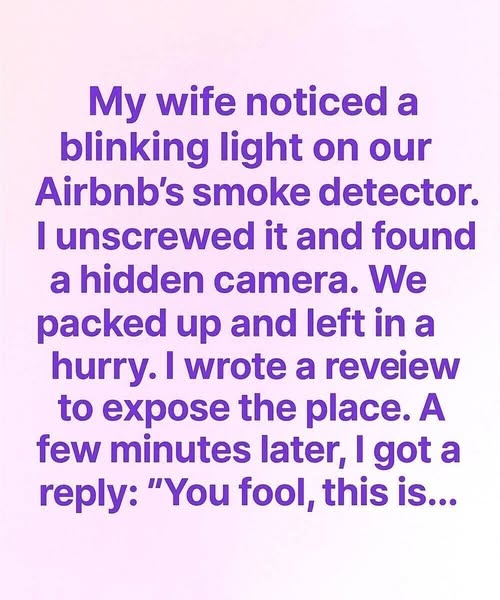
The moment everything changed did not arrive dramatically. It began with something small and easily dismissed—a faint blinking light on a smoke detector in an otherwise charming vacation rental. After a long drive, we were tired, relaxed, and ready to settle in. The house looked exactly like the photos online, and nothing felt immediately wrong. But discomfort has its own language, and my wife sensed it before I did. Curiosity replaced complacency. A closer look revealed a hidden lens tucked behind plastic meant to signal safety rather than scrutiny. In that instant, the space transformed. What had felt welcoming now felt invasive. The walls seemed thinner. The silence felt heavier. We packed without debate or rationalization, guided by instinct rather than logic. Leaving was not a choice so much as a necessity—a way to reclaim control from a situation that had already taken too much.
Relief followed us briefly as we drove away, but it was fragile and incomplete. We stopped at a brightly lit diner, hoping familiarity would steady our nerves. Fueled by adrenaline and disbelief, I shared a detailed warning online. I expected denial or silence. Instead, the response arrived quickly and cut sharply through any remaining sense of safety. The host’s message was not apologetic or explanatory. It was threatening, dismissive, and disturbingly vague. References to unnamed individuals who would be “looking for it” introduced a new layer of fear. The issue was no longer just privacy—it was implication. Who installs such devices, and why respond with intimidation rather than concern? The message suggested awareness, intent, and a confidence that felt deeply unsettling, reframing the experience from an isolated violation into something potentially deliberate.
When we reviewed the photos we had taken, searching for reassurance, we found the opposite. A subtle reflection—easy to miss—hinted at another device positioned elsewhere in the room. That detail changed everything again. It suggested planning, coverage, and an understanding of surveillance that went far beyond a single hidden camera. The rental no longer felt like a misguided attempt at security, but a carefully controlled environment. The realization was sobering. Digital trust had replaced personal accountability, and the systems designed to protect users had become tools that could be exploited. Reviews, verification badges, and professional photos had constructed a convincing narrative, but narratives can be engineered. Once that truth becomes clear, it is impossible to ignore how easily manipulation can blend into normalcy.
Distance eventually brought calm, but not peace. We drove for hours, choosing anonymity over convenience, until exhaustion forced us to stop. Even then, rest came slowly. The possibility that devices could record, track, or identify us lingered uncomfortably. Actions that once might have seemed excessive—disconnecting, documenting, reporting—now felt necessary. Yet doubt remained. Would anyone take this seriously? Technology evolves faster than regulation, and responsibility often dissolves into gray areas between platforms and authorities. That uncertainty was as draining as the fear itself, revealing how exposed travelers can feel once trust is broken.
The larger lesson emerged gradually, shaped by reflection rather than panic. Travel safety today is no longer limited to locks, lighting, or location. It includes understanding how digital tools can be misused and recognizing that convenience often carries unseen trade-offs. Experienced travelers may rely heavily on familiar systems and reputations, making them particularly vulnerable to modern forms of deception. Awareness does not require fear, but it does demand attentiveness. Simple habits, careful observation, and the willingness to leave without hesitation can make a critical difference. Most importantly, safety cannot be outsourced entirely to platforms or promises. It begins with personal vigilance and the courage to question what feels familiar. In a world where trust can be simulated, protection comes from learning to look beyond appearances—and listening closely when something feels wrong.